You may be curious about EMDR and nervous about what an appointment would ask of you.
Will you have to describe everything that happened? What if you become overwhelmed? And if you are not ready to work with a difficult memory right away, is it too early to call?
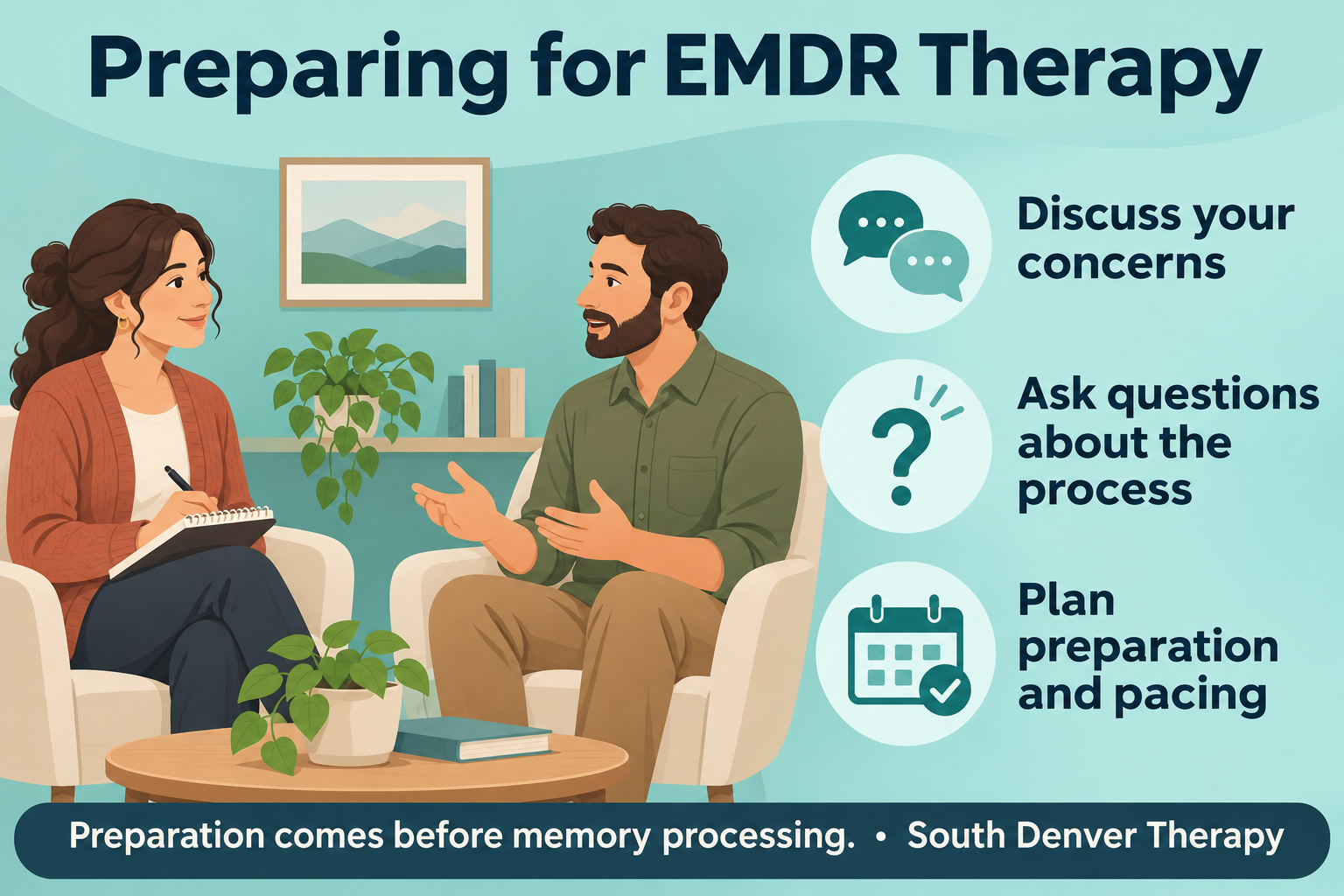
EMDR includes preparation before memory processing. Early work involves understanding your concerns, considering whether the approach fits, and discussing how to manage distress. You can ask about these steps before deciding to begin.
Preparation is part of the treatment
EMDR stands for Eye Movement Desensitization and Reprocessing. It has eight phases. The American Psychological Association describes history-taking and treatment planning first, followed by preparation and then assessment of the memory selected for treatment.
The familiar eye movements, sounds, or taps are one part of a larger process. A useful first conversation is about that whole process, including the reasons for choosing it and the alternatives.
For a broad overview, see our guide to EMDR therapy. Here, we are focusing on getting started.
What can happen before processing begins?
EMDRIA describes preparation as including questions, informed consent, and skills for managing emotional distress. The time spent on this work varies. It is not a test you need to pass before asking for help.
Do you have to tell the whole story immediately?
EMDRIA explains that detailed verbal descriptions of disturbing memories are not always necessary. Your therapist still needs enough information to understand your concerns and assess treatment fit.
You can say, “There is something I want help with, but I am not ready to go into detail today.” Then ask what information would be useful for the first conversation.
Being unsure where to start is itself something you can discuss. You do not need to write a full trauma history for a consultation.
Questions worth asking before you begin
Choose the questions that matter most to you:
What training and experience do you have with concerns like mine?
How do you decide whether EMDR is a good fit?
What would preparation involve for me?
How can I let you know I need to pause?
What should I do if I feel unsettled between appointments?
How will we review progress or consider a different approach?
These questions give you more than a description of a technique. They help you understand how you and the therapist would work together.
You can be interested in EMDR and still have questions about it. I want us to talk about those questions before we decide what the work should look like.

What if you need to slow down?
EMDRIA states that clients can stop the therapist during the process. It also emphasizes that the pace of treatment depends on individual needs.
Ask how pauses work in practice. For example: “If I feel overwhelmed, what should I say or do, and what happens next?”
There is no need to promise yourself that you will push through anything. A clear conversation about pace and choice belongs in the treatment plan.
A simple consultation note
If it helps, bring three short points:
What is difficult now: “Certain reminders leave me tense for the rest of the day.”
What you hope will change: “I want those moments to affect less of my day.”
What worries you about therapy: “I am concerned about how I will feel afterward.”
This is an illustrative example, not a client story. Your concerns may sound completely different.
Common questions
How many preparation sessions will I need?
There is no single number that fits everyone. Discuss your history, current circumstances, and support needs with your therapist. The number of sessions devoted to each phase can vary.
Is a consultation an EMDR treatment session?
South Denver Therapy's free 15-minute consultation is a chance to discuss fit and appointment options. Ask questions about treatment before scheduling an ongoing appointment.
Does Judy only provide EMDR or only see women?
No. Judy Branch, LPC, provides adult individual and couples counseling. Her services also include premarital and discernment counseling. Her practice is not limited to women.
Exploring EMDR with Judy in Castle Rock
Judy offers EMDR therapy for adults at 753 Maleta Lane, Suite 101F, Castle Rock, CO 80108.
Her published session fees are $215 for 60 minutes and $322 for 90 minutes. Ask which appointment length fits the proposed treatment plan. Ongoing sessions are in person; the free consultation is online.
Request a consultation with Judy. Select Judy Branch, then the 15-minute online consultation option. You can begin with questions about fit, preparation, and what to expect next.
Sources
EMDRIA: Experiencing EMDR Therapy. Supports preparation, disclosure, choice, and variable pace.
APA: Eye Movement Desensitization and Reprocessing Therapy. Supports the phases and their sequence.
EMDRIA: Language of EMDR. Supports collaborative planning, informed consent, preparation, and variable time per phase.