You snap at someone over a small request. Later, you wonder why it felt like one more thing you couldn't handle.
Maybe your sleep has changed, too. Or you feel less patient, more worried, or unusually hard on yourself. Counseling gives you a place to talk about what has become difficult and what you want to change.
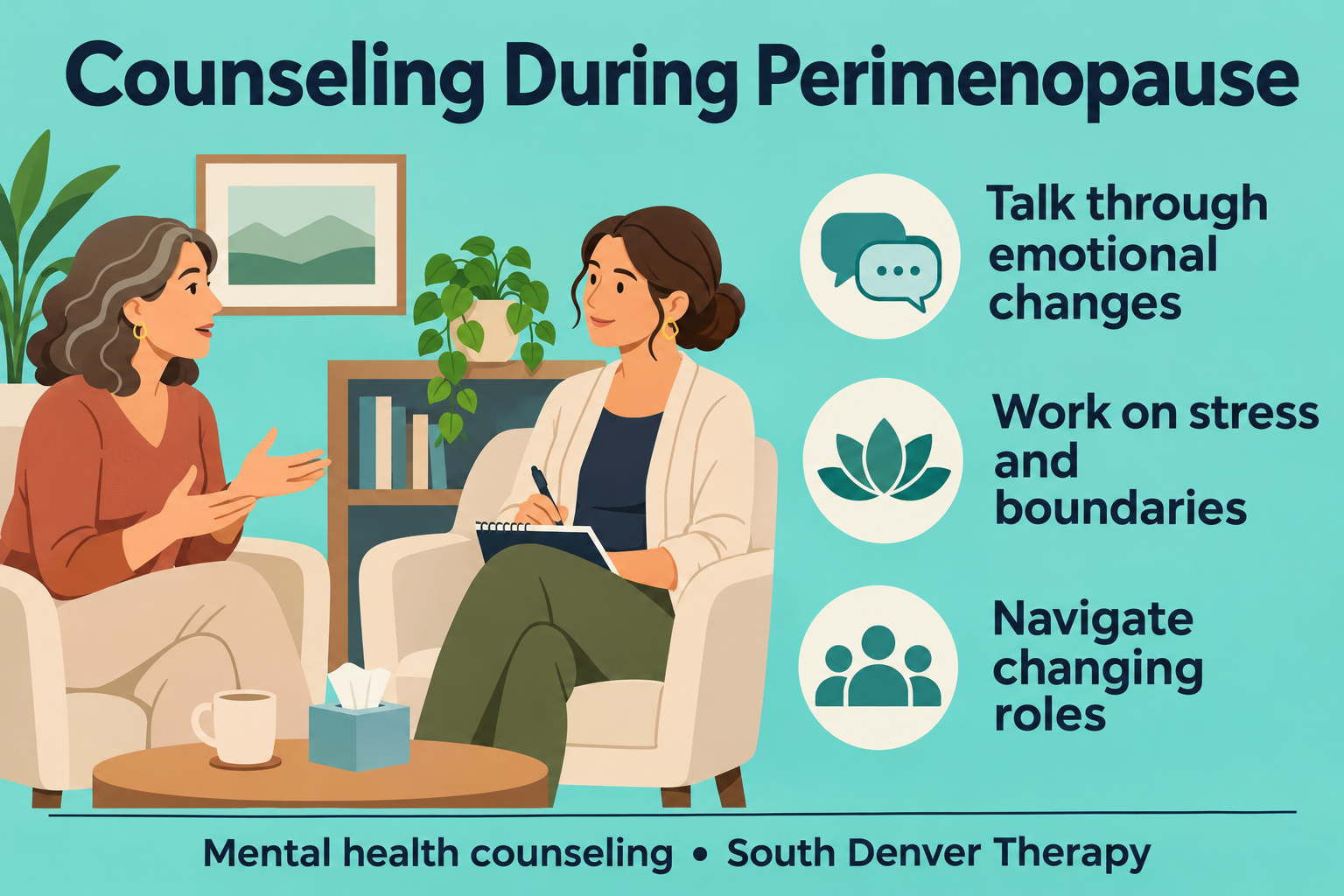
Counseling can help you work through emotional strain, relationships, boundaries, and changing roles. You do not have to put every feeling into words before you start.
You don't need to settle the cause on your own before reaching out.
Why it may be hard to tell what is happening
The American College of Obstetricians and Gynecologists (ACOG) explains that hormonal changes, physical symptoms, and midlife pressures can all contribute to emotional difficulties during perimenopause. Interrupted sleep, caregiving, work demands, and changing family roles may overlap. That does not mean every new symptom is caused by menopause.
Instead of trying to prove one explanation, start with what you have noticed: what changed, when it started, and how it affects your day.
What belongs in a medical visit, and what can counseling address?
- Changes in periods, hot flashes, night sweats, or other physical symptoms
- Questions about possible causes and medical treatment
- New or persistent mood or sleep concerns
- Feeling overwhelmed, anxious, irritable, or unlike yourself
- Boundaries, responsibilities, relationship strain, and identity changes
- How you respond to stress and what support you need
Some concerns belong in both columns. You do not have to choose which kind of support you are allowed to receive.
University of Iowa Health Care recommends contacting a primary-care or gynecology provider when symptoms disrupt daily life. Bringing a short record of changes can help focus that conversation.
What might you actually talk about in therapy?
You can start with an ordinary moment that has become difficult.
For example: “I agree to help everyone, then I get angry because I have no time left.” That gives you something specific to explore: what makes saying no difficult, which responsibilities are yours, and what a more workable response might sound like.
Or you might say: “I keep thinking I should be handling this better.” A conversation could examine that expectation and how it affects the way you treat yourself.
These are examples of concerns someone could bring, not accounts of actual clients or promises about a particular session.
Canada Coleman, LPC, offers individual counseling for women with a CBT foundation and systems-based training. Her work includes stress, boundaries, life transitions, and the emotional experiences of perimenopause and menopause.
She holds the Certified Menopausal Mental Health Provider credential issued by BRIA. Her role is mental health counseling. She does not prescribe hormones or provide medical menopause treatment.
You don't have to arrive with a perfect explanation of what's wrong. We can start with what has been harder lately and what you want to feel different.

A short note to bring to your first appointment
You do not need a polished story. A few lines can be enough to get started:
What feels different: “I lose patience much more quickly.”
Where it shows up: “Mostly after work and during family decisions.”
What else has changed: Sleep, physical symptoms, responsibilities, or significant life events.
What you want help with: “I want to ask for support before I reach my limit.”
For a medical appointment, also bring questions about physical symptoms and your health history. For counseling, you can ask how the therapist would approach your concerns and how you would decide whether the work is helping.
If finding the right words is difficult, our feelings wheel article offers a visual way to explore emotion words. It is a conversation aid, not a diagnosis.
Common questions
Can I seek counseling while receiving medical treatment?
Yes. ACOG describes a role for both medical and mental health professionals during this transition. Tell your providers what care you are receiving so you can discuss how their roles fit together.
Does Canada only work with menopause concerns?
No. Her women's therapy services also include stress, boundaries, and broader life transitions.
Do I need to know exactly what I want to work on?
You can use the consultation to explain what has felt difficult and ask whether Canada's services fit. A consultation is an opportunity to discuss the next step, not a commitment to ongoing therapy.
Talking with Canada in Castle Rock or online
Canada offers perimenopause and menopause counseling at 753 Maleta Lane, Suite 101F, Castle Rock, CO 80108, and online for clients located throughout Colorado.
Sessions are $150 for 60 minutes, private pay. A free 15-minute online consultation is available.
Request a consultation with Canada. Select Canada Coleman, then Online Consultation (15m). The consultation is online; ongoing appointments can be in person or online.
Sources
ACOG: Mood Changes During Perimenopause Are Real. Supports overlapping influences and coordinated care, not an individual diagnosis.
University of Iowa Health Care: Perimenopause and Menopause, What to Ask Your Primary Care Provider. Supports seeking medical assessment and preparing an appointment summary.