Key Takeaways
Anxious attachment wants closeness and worries about losing it.
Anxious attachment is one of the three insecure attachment styles.
Common signs include seeking reassurance, overthinking, and reacting fast to small changes.
You can feel safer with simple self soothing tools and clear, kind communication.
With practice, many people shift toward a more secure style.

Understanding Attachment Theory and How It Shapes Relationships
Attachment theory, first introduced by John Bowlby and expanded by Mary Ainsworth, explains how early caregiver relationships shape the way we bond as adults. There are four primary attachment styles: secure, anxious (preoccupied), avoidant, and disorganized.
When caregivers are responsive, children often develop secure attachment. When care feels inconsistent, anxious attachment can form, leading to heightened worry and dependence on reassurance. Understanding your style helps you recognize patterns and begin moving toward healthier, secure relationships.
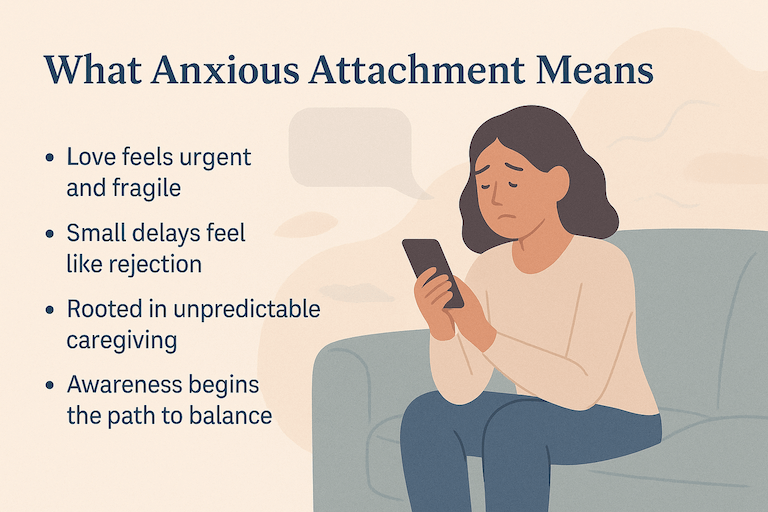
What Anxious Attachment Means
Anxious attachment is a pattern where love feels urgent and fragile. You may read danger into delays or short replies and feel the need to repair things immediately. This is often rooted in inconsistent or unpredictable caregiving during childhood.
With the right tools, anxious energy can be softened and guided into secure connection. Awareness is the first step toward balance.
What Is Anxious Preoccupied Attachment?
Anxious preoccupied attachment involves a strong desire for closeness and deep fear of abandonment. You may seek reassurance often and worry that your partner might pull away. This usually stems from caregiving that was inconsistent—sometimes attentive, sometimes unavailable.
People with this pattern may feel anxious when relationships change or when communication slows. Recognizing this pattern helps you start building trust and self-soothing skills that support long-term connection.

Understanding Anxious Ambivalent Attachment
Anxious ambivalent attachment describes the inner conflict many anxious individuals feel. You crave emotional support yet fear rejection or being “too much.” This creates mixed signals—closeness followed by worry or withdrawal.
These patterns can make relationships feel intense and unpredictable. With practice, you can learn to balance connection and independence so closeness feels safe.

Signs You May Have an Anxious Attachment Style
You worry your partner will lose interest or leave.
You check your phone often and analyze tone or timing.
You ask for reassurance and feel better for a moment, then the worry returns.
You feel big emotions during conflict and want to fix things fast.
You fear being a burden but also fear being ignored.
People with anxious attachment are often hypersensitive to rejection, making even small changes feel threatening.
Do You Have Anxious Attachment? Check Your Signs
The more statements that resonate with you, the more likely anxious attachment plays a role in your relationships. There's no judgment here—just awareness.
5-8 checked: Strong anxious attachment patterns (you're not alone—this is common and changeable)
2-4 checked: Some anxious tendencies (the tools below will help you feel more secure)
0-1 checked: Minimal anxious traits (you may have a different attachment style)
Good news: Anxious attachment can shift toward security with the right tools and practice. Keep reading for specific exercises that help.

Common Anxious Attachment Triggers in Relationships
Anxious attachment triggers are specific situations or cues—often rooted in early experiences—that evoke feelings of insecurity, anxiety, and fear of abandonment in adult relationships.
Delayed replies or last minute plan changes.
Vague language that leaves room to guess.
A partner who needs space during stress.
Silence after a conflict with no repair plan.
Quick reframe: A delay is not proof of rejection. Ask, clarify, and wait for an answer before filling in the blanks.
Your Trigger → Your Thought → Your Secure Response
Learn to recognize your triggers and choose a calmer response instead of reacting from fear
⚠️ Common Trigger
Your partner takes hours to reply to your text
😰 Anxious Thought
"They're ignoring me. They must be upset. Did I say something wrong? They're losing interest."
✓ SECURE RESPONSE
Pause and reframe: "A delay is not rejection. They're probably busy. I'll ask if I need clarity: 'Hey, hope your day is going well. Let me know when you have time to chat.'"
⚠️ Common Trigger
Your partner says they need space after an argument
😰 Anxious Thought
"Space means they're done with me. They're pulling away forever. I need to fix this NOW."
✓ SECURE RESPONSE
Ask for a clear plan: "I understand you need space. When can we reconnect? Can we talk at 7pm tonight?" Having a time helps your nervous system calm down.
⚠️ Common Trigger
Plans change last minute or become vague
😰 Anxious Thought
"They don't prioritize me. I'm not important to them. They're trying to distance themselves."
✓ SECURE RESPONSE
Name your feeling and request clarity: "I feel anxious when plans are unclear. Can we set a specific time? It helps me feel connected."
⚠️ Common Trigger
Your partner seems distant or distracted
😰 Anxious Thought
"Something is wrong with us. They're unhappy with me. I need to figure out what I did."
✓ SECURE RESPONSE
Ask with curiosity, not assumption: "I noticed you seem quiet today. Is everything okay with you? I'm here if you want to talk."
The Pattern: Anxious attachment makes you jump to worst-case scenarios. Secure attachment pauses, checks the facts, and asks before assuming.
The Fear of Abandonment in Anxious Attachment
A core feature of anxious attachment is a persistent fear of being abandoned. It often begins in childhood when emotional needs were inconsistently met. In adulthood, it may show up as jealousy, worry, or clinginess when a partner feels distant.
This fear can make it hard to trust love that feels steady. Healing involves self-awareness, healthy communication, and coping tools that calm your body when uncertainty arises.

How Anxious Attachment Shows Up in Daily Life
You may text often to feel close or scan for signs of trouble while missing signs of care. During conflict, you might talk quickly or repeat your point.
When you slow your body before responding, your words get clearer and your partner can truly hear you.

Simple Tools To Calm Anxiety and Feel Secure
These exercises are healthy coping strategies and self soothing techniques that can help manage anxious attachment responses.
30 second reset
Hand on chest. Inhale four. Exhale six. Say a kind line like I am safe and I can ask. This self soothing technique helps calm your nervous system.
Two feelings, one need
Name two feelings and one clear need in one sentence. Example: I feel worried and alone. I need a call tonight. This is a healthy coping strategy for expressing emotions and needs.
Anchor plan
Pick two anchors for hard days. Example: a short walk and one check in text before lunch. Using these healthy coping strategies can help you feel more secure and resilient.
Your Emergency Calm-Down Toolkit
When anxiety spikes, use these tools BEFORE texting, calling, or reacting. Bookmark this section.
The 4-6 Breathing Reset (30 seconds)
Place your hand on your chest or belly. Breathe in slowly for 4 counts. Breathe out slowly for 6 counts. Repeat 3 times.
Why it works: Longer exhales activate your calm nervous system. Your body learns it's safe right now.
The Grounding "5-4-3-2-1" Technique
Look around and name out loud:
- 5 things you can see
- 4 things you can touch
- 3 things you can hear
- 2 things you can smell
- 1 thing you can taste
Why it works: Brings you back to the present moment instead of anxious future scenarios.
The "Check the Facts" Reality Test
Write down answers to these questions:
- What actually happened? (Just facts, no interpretation)
- What story am I telling myself?
- What are 2 other explanations that are equally likely?
- What do I need to ask to know for sure?
Why it works: Separates your anxious story from reality. Most fears are predictions, not facts.
The "Two Feelings, One Need" Script
Once you're calmer, express yourself clearly in one sentence:
Example: "I feel worried and alone. I need a 10-minute call tonight."
Why it works: Clear requests get better responses than vague hints or multiple texts.
Save this toolkit to your phone. The more you practice these tools, the faster they work.
Communication That Calms and Builds Connection
Use short, kind messages that name the need without blame. This approach can facilitate emotional closeness and understanding between partners. Share timing so both of you know the plan.
Try these
I like feeling close. Can we touch base at 7 tonight?
I got anxious when plans shifted. I need a quick update on timing.
I want to repair this. Can we take ten minutes to talk after dinner?
Copy These Exact Words: Secure Communication Scripts
When anxiety takes over, having the right words ready makes all the difference. Use these templates word-for-word.
❌ ANXIOUS WAY (Don't Say This)
"Why aren't you responding? Did I do something wrong? You always do this. Are you mad at me?"
✓ SECURE WAY (Say This Instead)
"Hey, I noticed I haven't heard from you today and I'm feeling a bit anxious. When you get a chance, can we connect? Even a quick text helps me feel close to you."
❌ ANXIOUS WAY (Don't Say This)
"Don't shut me out! We need to talk about this right now! I can't handle being left in the dark!"
✓ SECURE WAY (Say This Instead)
"I understand you need space right now. That's okay. Can we set a time to reconnect? It helps me when I know when we'll talk. How about tomorrow at 7pm?"
❌ ANXIOUS WAY (Don't Say This)
"Do you still love me? You don't seem as affectionate lately. Are you losing interest? I feel like you don't care anymore."
✓ SECURE WAY (Say This Instead)
"I'm feeling a bit insecure today. Can you tell me one thing you appreciate about us? That would really help me feel connected to you right now."
❌ ANXIOUS WAY (Don't Say This)
"I'm sorry, I'm sorry, I'm sorry. I'm such a mess. You probably think I'm crazy. I'll try not to be so needy."
✓ SECURE WAY (Say This Instead)
"I'm sorry for my reaction earlier. I got overwhelmed and didn't handle it well. Next time I feel anxious, I'll take a breath and ask you directly instead of assuming. Thank you for being patient with me."
Pro Tip: Screenshot these scripts and keep them in your photos. When anxiety hits, pull them up and use the exact words. It works.

How Anxious Attachment Handles Conflict
Conflict can trigger strong emotions for people with anxious attachment. You may feel a rush to fix things immediately. Pause your body before sending multiple texts. Breathe, write one sentence, and wait.
Ask for a time to reconnect if your partner needs space. End with one clear next step so your mind can rest.
Repair phrases:
“I care about us. I felt scared and I need reassurance.”
“What I heard is that you need quiet until 7. I can do that.”
“I’m sorry for pushing. Next time I’ll ask and wait.”
Building Toward a Secure Attachment Style
Security grows with small, steady habits. You do not need to stop wanting closeness. You only need to feel safe enough to ask clearly and tolerate short waits.
Daily micro habits
One appreciation you text or say every day.
One gentle thought that replaces a harsh story about yourself.
One clear ask instead of a hint.
One short repair after a tense moment.
Practicing these daily micro habits can help you develop a more secure sense of self and stability in your relationships.
Your 21-Day Path From Anxious to Secure
Small daily actions rewire your nervous system. Do one thing each day for 21 days and watch anxiety soften.
Week 1: Learn to Pause Before Reacting
Week 2: Practice Clear Communication
Week 3: Build Self-Soothing & Trust
After 21 Days:
You won't be perfect, but you'll notice a shift. Anxiety will feel less urgent. Your partner will feel less pressured. Connection will feel safer.
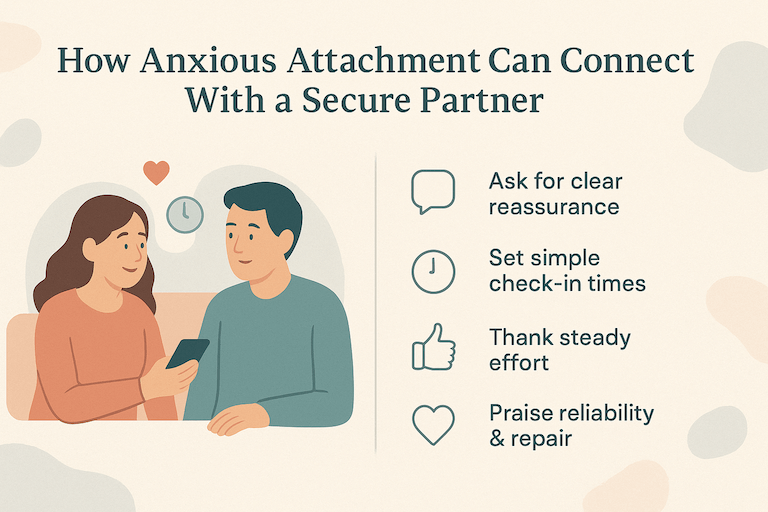
How to Connect With a Secure Partner
A secure partner can help by being steady and clear. A securely attached partner provides a sense of stability and emotional safety. Ask for simple reassurance and agree on check in times. Thank them when they follow through. Praise consistency so both of you keep doing what works. Setting healthy boundaries is crucial, allowing individuals to prioritize their well-being without compromising relationships.
Try this:
I get anxious when plans are loose. It helps me if we set a time to talk at 8.

How to Navigate a Relationship With an Avoidant Partner
Avoidant partners often need space to settle. Some individuals may have a fearful avoidant attachment style, which combines a desire for closeness with a fear of rejection or emotional pain. Ask for a time to reconnect and let them choose a near time. Keep messages short and kind. Celebrate small moments of sharing rather than asking for big emotion all at once.
Try this:
I want to reconnect. Can we talk at 7 for ten minutes and share one feeling and one plan?
How to Thrive With Different Attachment Styles (When You're Anxious)
You (Anxious) + Secure Partner
Good news: This is the easiest pairing for anxious attachment to heal. Secure partners naturally provide the consistency you need.
✓ What Helps:
- Thank them when they follow through on promises
- Let them know that predictability calms you
- Practice self-soothing so they're not your only source of comfort
Your growth goal: Learn to trust their consistency instead of testing it. They're not going anywhere.
You (Anxious) + Avoidant Partner
The challenge: You crave closeness while they need space. This creates a push-pull dynamic that triggers both of you.
✓ What Helps:
- Give space without chasing—then reconnect at the agreed time
- Keep requests small and specific, not overwhelming
- Celebrate small moments of connection instead of pushing for more
- Build your own anchors (friends, hobbies) so they're not your only source of security
Your growth goal: Learn that space doesn't mean abandonment. Set clear reconnection times and trust they'll come back.
You (Anxious) + Another Anxious Partner
The challenge: Both of you seek reassurance constantly, which can create a cycle of mutual triggering and emotional intensity.
✓ What Helps:
- Schedule predictable check-ins so neither spirals between contacts
- Both practice self-soothing techniques independently
- Take turns being the calm one—not both panicking at once
- Create safety rituals (morning texts, evening calls) that become reliable
Your growth goal: Build individual emotional regulation skills. You can both become more secure together with practice.
Remember: Any pairing can work when both people commit to growth, clear communication, and consistent repair.

Parenting When You Have an Anxious Attachment Style
If you are a parent with anxious tendencies, comfort yourself first so you can comfort your child. Name their feelings, offer steady care, and keep predictable routines.
Your good-enough presence builds their sense of safety and teaches that emotions can be managed, not feared.

Not Sure of Your Attachment Style
Get a quick read and a simple next step plan, and see your result in under two minutes. Click here to take a Free Attachment Style Quiz.
Understanding your attachment style is an important step in the attachment process and can guide your next steps toward building more secure relationships.
How Therapy Helps Heal Anxious Attachment
Therapy gives you a safe place to practice calming skills and communication at your own pace. You learn to slow down, speak your needs, and stay steady through uncertainty.
At South Denver Therapy, we teach practical, evidence-based tools to help you feel secure in love and calm in connection.
Ready to feel safer in love. If you are located in Colorado, request an appointment here.
FAQs About Anxious Attachment Styles
What is anxious attachment?
Anxious attachment is a pattern that craves closeness and fears losing it. It often shows up as worry, people-pleasing, or reacting quickly to small changes. This attachment style forms when early caregivers were inconsistent or unpredictable, leading to heightened sensitivity in relationships. With support and awareness, you can learn to feel safe without constant reassurance.
Why do people with anxious attachment feel clingy or needy sometimes?
When you have anxious attachment, your body is wired to stay alert for signs of disconnection. This protective response helped you cope as a child when love felt uncertain. As an adult, it can feel like panic when someone pulls away. Calming your body through slow breathing or self-soothing helps you pause before reacting.
Can anxious attachment change?
Yes. Anxious attachment can absolutely change with steady practice and healthy relationship experiences. Each time you express a need calmly and receive care in return, your brain learns that closeness can be safe. Over time, you can move toward a more secure attachment style through therapy, mindfulness, and consistent support.
How can I ask for reassurance without overwhelming my partner?
Use one simple sentence and add timing so it feels clear and calm. For example: "I'm feeling tense. Can we talk for ten minutes after work." This keeps the request small and specific. Practicing direct communication helps both you and your partner feel more grounded and connected.
What should I do when my partner with avoidant attachment needs space?
Ask when you will reconnect and write it down. For example, "Can we check in tomorrow after dinner." Then focus on self-soothing tools while you wait. Having a clear plan reduces uncertainty and helps your nervous system relax. Space can feel safer when it has a predictable end.
Why do I overthink small changes in my relationship?
People with anxious attachment often notice subtle shifts in tone or timing because their bodies are wired to detect possible loss. It is a form of emotional vigilance. Grounding yourself before reacting, and asking gentle clarifying questions, can help you stay connected without spiraling into worry.
Can two people with anxious attachment have a healthy relationship?
Yes, but it takes communication and self-awareness. Both partners need to work on self-soothing and clear boundaries. When both learn to slow down and repair calmly, the relationship can feel deeply loving and supportive. Therapy or couples counseling can help speed that process.
Related Reading
What Are Attachment Styles? – Learn how early relationships shape the way you connect and explore the four main attachment styles.
Secure Attachment Style: What It Looks Like and How to Build It – Discover how to create balanced, trusting relationships and strengthen emotional security.
Avoidant Attachment Style: Understanding Emotional Distance and How to Bridge It – Learn why emotional space feels safer for some people and how to open up without losing independence.
Disorganized Attachment Style: When Closeness Feels Confusing – Explore the mixed signals of wanting closeness and fearing it, and learn how to build safety and trust.
Take the Free Attachment Style Quiz – Find out your attachment style in under two minutes and get personalized insights to help you grow.