Women's Mental Health Statistics 2026: Anxiety, Depression & Treatment Gaps
If you're a woman struggling with your mental health, you're not alone. Not even close.
The numbers tell a story that affects millions of women across the United States and around the world. Women experience mental illness at significantly higher rates than men, face unique challenges during hormonal transitions, and often carry invisible burdens that go unrecognized and untreated.
This comprehensive guide brings together the most current research on women's mental health. Whether you're trying to understand your own experience, supporting someone you love, or simply want to know the facts, these statistics provide the full picture of what women face today.
Women's Mental Health at a Glance
How Common Is Mental Illness in Women?
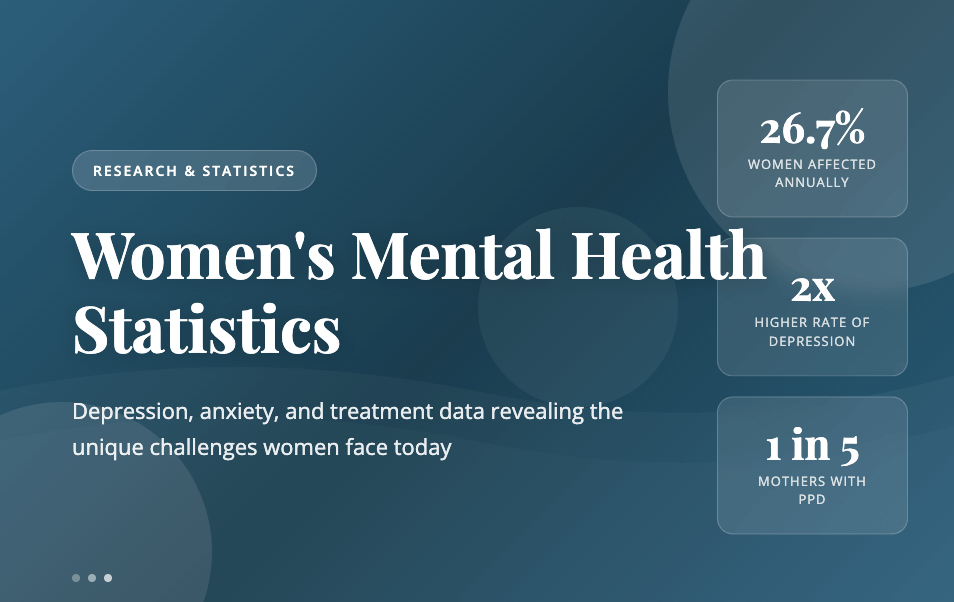
Women experience mental health conditions at higher rates than men across nearly every category. According to NAMI's 2025 data, 26.7% of U.S. women experience mental illness annually, compared to 20.0% of men. That means more than 1 in 4 women are affected each year.
The World Health Organization's 2025 report confirms this global pattern. While mental health disorder prevalence varies by sex, women are disproportionately impacted overall. Anxiety and depressive disorders are the most common types among both genders, but women carry a heavier burden.
Young women face especially high rates. Over 26% of women aged 16-24 report having a common mental health problem in any given week, compared to 17% of adults overall. And this number continues to rise.
Mental Illness Prevalence: Women vs. Men
Depression Statistics for Women
Depression affects women at nearly twice the rate it affects men. Research from Johns Hopkins Medicine and multiple epidemiological studies confirms that women are nearly twice as likely to suffer from major depression.
Here's what the numbers show:
6% of women suffer from depression compared to 4% of men in the U.S.
1 in 3 women will experience major depression in their lifetime versus 1 in 5 men
18.3% of U.S. adults currently have depression or are receiving treatment for it, according to Gallup's 2025 research
Depression rates have increased 60% from 8.2% in 2013-2014 to 13.1% in 2021-2023
The gap starts early and persists throughout life. Young women ages 18-25 experience the highest rates of depression, with 32.2% experiencing mental illness in 2024 according to SAMHSA data.
Depression Rates in Women: Key Statistics
- 2x
- Women experience depression at roughly twice the rate of men
- 1 in 3
- Women will experience major depression in their lifetime
- 60%
- Increase in depression rates from 2013-2014 to 2021-2023
- 32.2%
- Young adults ages 18-25 experienced mental illness in 2024
Why Women Experience Higher Depression Rates
Several factors contribute to women's higher vulnerability to depression:
Hormonal fluctuations play a significant role. Women face increased risk during puberty, pregnancy, postpartum, perimenopause, and menopause. These biological transitions create windows of vulnerability that men simply don't experience. Research from The Menopause Society confirms that women appear particularly vulnerable to depression during perimenopause and the years immediately following.
Trauma and abuse directly connect to women's mental health. Research shows that 53% of women who have mental health problems have also experienced abuse. With 1.6 million women in England and Wales experiencing domestic abuse in 2021 alone, the scope of this problem is enormous. EMDR therapy has become one of the most effective treatments for trauma-related depression in women.
Social and economic factors compound the biological ones. Women often carry disproportionate caregiving responsibilities, face wage gaps, and navigate workplace discrimination, all while trying to meet expectations in multiple roles.
Risk Factors for Depression in Women
Research has identified several factors that increase women's vulnerability to depression:
-
Hormonal transitions
Puberty, pregnancy, postpartum, perimenopause, and menopause create windows of increased vulnerability
-
History of trauma or abuse
53% of women with mental health problems have experienced abuse
-
Caregiving responsibilities
Disproportionate burden of caring for children, elderly parents, or both
-
Economic stress and poverty
35.1% of low-income adults have depression; people below poverty line are 3x more likely to experience it
-
Social isolation and loneliness
33% of lonely adults have depression vs. just 13% among non-lonely adults
Anxiety Statistics for Women
Anxiety disorders affect women at particularly high rates. Women are twice as likely to be diagnosed with anxiety as men, making anxiety one of the most significant mental health concerns for women today.
The numbers paint a clear picture:
19.1% annual prevalence of anxiety disorders among U.S. adults
21.7% of U.S. adults reported generalized anxiety disorder symptoms in the past two weeks according to CDC data
Approximately 18% of people ages 18-54 have an anxiety disorder in a given year
40 million Americans suffer from anxiety overall
For young women, the rates are even more concerning. According to the Ipsos Global Mental Health Survey, among Gen Z women globally, 40% report experiencing prolonged periods of sadness or hopelessness multiple times, and 4 in 10 say they feel anxious or stressed most or all of the time.
Anxiety in Women: By the Numbers
- 2x More likely to be diagnosed with anxiety than men
- 19.1% Annual prevalence of anxiety disorders in adults
- 40M Americans suffer from anxiety disorders
Postpartum and Maternal Mental Health Statistics
Motherhood brings joy, but it also brings significant mental health risks that too often go unaddressed. The data on maternal mental health reveals a crisis affecting hundreds of thousands of women each year.
Postpartum depression affects 1 in 5 U.S. women. That translates to 600,000-800,000 mothers annually experiencing maternal mental health disorders. The global prevalence of postpartum depression is 17.22%, based on an analysis of 565 studies across 80 countries.
Even more alarming: 50% of mothers with postpartum depression remain undiagnosed, and 75% of women with maternal mental health conditions remain untreated. The National Institute of Mental Health provides resources specifically for women experiencing perinatal depression.
Maternal Mental Health Crisis
Postpartum depression affects far more mothers than most people realize
- 1 in 5 U.S. mothers experience maternal mental health disorders
- 800K Mothers affected annually in the United States
- 50% Of mothers with PPD remain undiagnosed
- 75% With maternal mental health conditions go untreated
The Life-or-Death Stakes of Maternal Mental Health
The consequences of untreated maternal mental health conditions are severe:
Suicide and overdose are the leading causes of death for women in the first year postpartum
20% of postpartum deaths are from suicide following untreated postpartum depression
40.1% of depressive episodes have their onset during the postpartum period
The economic cost reaches $32,000 per mother-infant pair, totaling $14.2 billion annually in the U.S.
Postpartum depression rates vary significantly by state, ranging from 9.2% in Colorado to 17.1% in Mississippi. This geographic variation suggests that access to care and support systems make a real difference. If you're a new mother in Castle Rock or South Denver struggling with your mental health, reaching out for support is one of the most important steps you can take.
Warning Signs of Postpartum Depression
If you're a new mother experiencing any of these symptoms for more than two weeks, talk to your doctor or a mental health professional:
Persistent sadness or feeling empty, hopeless, or overwhelmed
Crying more often than usual or for no apparent reason
Difficulty bonding with your baby or feeling disconnected
Withdrawing from family, friends, and activities you enjoyed
Sleeping too much or being unable to sleep even when baby sleeps
Severe fatigue or loss of energy that doesn't improve with rest
Changes in appetite — eating much more or much less than usual
Intense irritability or anger, especially toward baby or partner
Seek immediate help if you have: Thoughts of harming yourself or your baby, thoughts that you or your baby would be better off if you weren't here, or feelings of panic or terror.
Source: CDC, American Psychological Association 2024
Perinatal Anxiety Often Goes Unrecognized
While postpartum depression gets most of the attention, perinatal anxiety disorders affect a similar number of women. Research shows:
20% of women experience maternal anxiety disorders
Anxiety is highest during early pregnancy at 25.5%
OCD prevalence reaches 8% during pregnancy and 17% postpartum
54.9% of women with existing bipolar disorder have a mood episode during the perinatal period
Many women experience anxiety without depression, or both conditions together. Screening for anxiety should be as routine as depression screening during and after pregnancy.
Types of Perinatal Mental Health Conditions
Postpartum depression isn't the only maternal mental health condition. Here's what women may experience during pregnancy and after birth:
Postpartum Depression (PPD)
Persistent sadness, hopelessness, and difficulty bonding with baby lasting more than two weeks after birth
Perinatal Anxiety Disorders
Excessive worry about baby's health, constant fear something bad will happen, panic attacks, racing thoughts
Postpartum OCD
Intrusive, unwanted thoughts (often about harming baby) and compulsive behaviors to reduce anxiety
Postpartum PTSD
Following traumatic birth experience — flashbacks, nightmares, avoidance of reminders, hypervigilance
Postpartum Psychosis
Medical emergency — confusion, hallucinations, delusions, rapid mood swings. Requires immediate treatment.
Sources: Postpartum Support International, ACOG, NCBI 2024-2025
Menopause and Mental Health
The menopausal transition represents another period of heightened mental health vulnerability for women. Hormonal shifts during perimenopause and menopause can trigger or worsen depression and anxiety.
A 2024 study from University College London found that women are 40% more likely to experience depression during perimenopause than those not experiencing menopausal symptoms. The Study of Women's Health Across the Nation (SWAN) reports that up to 60% of women have depressive symptoms during the menopause transition.
Women appear particularly vulnerable during the perimenopause years and in the years immediately after menopause. The "window of vulnerability" theory suggests some women are more sensitive to the hormone shifts that occur during perimenopause.
Mental Health Across the Menopause Transition
Women's mental health vulnerability changes throughout the menopausal transition:
Premenopause (Before age 40-45)
Baseline mental health period. Regular menstrual cycles. Depression and anxiety rates reflect general population averages for women.
Perimenopause (4-10 years before menopause)
HIGHEST RISKThe "window of vulnerability." Hormone fluctuations are most dramatic during this phase.
Early Postmenopause (1-5 years after final period)
Still elevated risk for depression and anxiety. Symptoms may continue or emerge. Sleep disturbances remain common (affecting up to 60% of women).
Late Postmenopause (5+ years after final period)
Hormones stabilize at lower levels. Mental health risk typically returns closer to premenopausal baseline, though individual experiences vary.
Sources: University College London 2024, SWAN Study, The Menopause Society
Symptoms Often Mistaken for "Normal" Aging
Depression during menopause often presents with atypical features that can be mistaken for normal aging or stress:
Fatigue and low energy
Irritability rather than overt sadness
Sleep disturbances (affecting up to 60% of peri- and postmenopausal women)
Difficulty concentrating (over 60% of women report cognitive issues during the menopause transition)
Anhedonia (loss of interest in previously enjoyable activities)
The bidirectional relationship between sleep and mental health makes menopausal mental health particularly challenging. Fragmented sleep heightens emotional reactivity, while anxiety and depression perpetuate insomnia, creating a difficult cycle.
Is It Menopause or Depression?
These symptoms overlap significantly, making diagnosis challenging. Here's how they compare:
Important: If you experience persistent hopelessness, loss of interest, or thoughts of self-harm, seek help regardless of menopause status. These are key indicators that treatment may be needed.
Eating Disorders Disproportionately Affect Women
Eating disorders remain one of the most gendered mental health conditions. Women account for the vast majority of eating disorder diagnoses across all types.
Key statistics:
Lifetime prevalence of eating disorders is 2% to 5% globally
Anorexia nervosa affects up to 4% of females and 0.3% of males over their lifetime
Bulimia nervosa affects up to 3% of females and over 1% of males
Binge eating disorder affects 3.5% of women and 2% of men
13% of women older than 50 experience disordered eating behaviors
Global eating disorder prevalence increased from 3.4% to 7.8% between 2000 and 2018
Eating disorders are serious medical conditions with the highest mortality rate of any mental illness. Anorexia nervosa is associated with a mortality rate nearly 6 times higher than that of individuals of the same age without the condition.
Eating Disorder Prevalence: Women vs. Men
Women are significantly more likely to develop eating disorders across all types:
Anorexia Nervosa
Highest mortality rate of any mental illnessBulimia Nervosa
94.5% have another mental disorderBinge Eating Disorder
Most common eating disorderof women over 50 have disordered eating behaviors
increase in eating disorder prevalence (2000-2018)
Sources: NEDA, NIMH, Lancet Psychiatry 2024-2025
Comorbidity Makes Treatment Complex
Eating disorders rarely occur in isolation:
76.3% of people with bulimia nervosa have lifetime depression
65.5% of people with binge eating disorder have lifetime depression
49.5% of people with anorexia nervosa have lifetime depression
94.5% of those with bulimia nervosa meet criteria for at least one other mental disorder
49.3% of eating disorder patients admitted to residential treatment have PTSD symptoms
The high rates of comorbidity underscore the importance of comprehensive treatment that addresses both the eating disorder and co-occurring conditions.
Eating Disorders Rarely Occur Alone
Most women with eating disorders also have at least one other mental health condition. This high rate of comorbidity makes treatment more complex but also more important.
Bulimia + Depression
Lifetime depression in people with bulimia nervosa
Binge Eating + Depression
Lifetime depression in people with BED
Anorexia + Depression
Lifetime depression in people with anorexia
of those with bulimia meet criteria for at least one other mental disorder
of eating disorder patients in residential treatment have PTSD symptoms
Sources: NEDA, World Psychiatry, Journal of Clinical Psychology 2024
Trauma and PTSD in Women
Women experience post-traumatic stress disorder at significantly higher rates than men, primarily due to higher rates of sexual trauma and intimate partner violence.
PTSD prevalence in women:
Lifetime prevalence of PTSD is 10-12% for women versus 5-6% for men
Women are twice as likely as men to develop PTSD
8% of adolescent girls experience PTSD compared to 2.3% of boys
Among female veterans, 13% have PTSD compared to 6% of male veterans
Sexual assault carries an especially high risk for PTSD. Research shows that 81% of sexual assault survivors have significant PTSD symptoms one week after the assault, and 75% meet criteria for PTSD one month later. Even after one year, 41% still meet diagnostic criteria.
PTSD Risk by Trauma Type in Women
Not all traumas carry the same PTSD risk. Sexual assault has the highest rate of PTSD development:
Significant PTSD symptoms 1 week after assault
PTSD rate in adults with childhood trauma history
PTSD rate among domestic violence survivors
PTSD in female veterans vs. 6% of male veterans
Lifetime PTSD in women
Lifetime PTSD in men
Women's PTSD risk vs. men
Sources: APA, VA, Journal of Traumatic Stress 2024-2025
Intimate Partner Violence and Mental Health
The connection between intimate partner violence (IPV) and mental health is profound:
20% to 40% of women report experiencing physical or sexual IPV
Up to 90% experience psychological IPV each year
PTSD is experienced by 51% to 75% of women who are IPV victims
IPV victims report significant levels of mild to severe PTSD in 55%-92% of cases
Complex PTSD prevalence reaches 40% among domestic violence and sexual abuse survivors
Psychological abuse is a significant predictor of both PTSD and depression, sometimes even more so than physical aggression. This highlights the need to recognize all forms of abuse as traumatic.
Intimate Partner Violence & Mental Health
The mental health impact of domestic abuse is profound and long-lasting
of women report experiencing physical or sexual intimate partner violence
of IPV victims experience psychological abuse each year
of IPV survivors have significant PTSD symptoms
of DV/sexual abuse survivors develop Complex PTSD
Important finding: Psychological abuse is a significant predictor of both PTSD and depression — sometimes even more so than physical aggression. Emotional abuse, coercive control, and manipulation can be just as traumatic as physical violence.
Sources: WHO, Journal of Interpersonal Violence, Trauma Psychology 2024
Women's Mental Health in the Workplace
Women face unique mental health challenges in the workplace, experiencing higher rates of burnout and stress than their male colleagues. According to the Mind Share Partners 2025 Mental Health at Work Report, workplace culture directly impacts employee wellbeing—and women feel the strain more acutely.
Workplace mental health statistics for women:
59% of women report burnout compared to 46% of men
Women in the workforce are 8 percentage points more likely than men to report feeling like they're struggling or in crisis
75% of women report experiencing burnout compared to 58% of men
Female burnout rates are up 4% while male burnout rates are down 3%
Women accounted for 71% of all mental health-related leaves in early 2024
Women working full-time are almost twice as likely to face mental health problems as men, showing a significant gender gap in workplace stress. The NAMI 2025 Workplace Mental Health Poll found that stigma still prevents many employees from seeking help, with 46% worrying about losing their job if they discussed mental health at work.
The Workplace Burnout Gender Gap
Women experience significantly higher rates of workplace burnout and mental health struggles:
of mental health-related work leaves are women
more likely to face mental health problems (full-time workers)
more women than men report struggling or in crisis
Sources: Mind Share Partners 2025, McKinsey Women in the Workplace, Deloitte 2024
Why Women Experience More Workplace Stress
Several factors contribute to women's higher workplace stress:
Double burden: Many women carry disproportionate responsibilities at home while also working full-time. The mental load of managing households, childcare, and eldercare adds to work demands.
Wage gaps and career barriers: Women often work harder for less recognition and compensation, creating chronic stress.
Hostile work environments: More than 60% of Black women have experienced racial trauma in the workplace in the past year. Bisexual women and transgender women of color face some of the highest rates of workplace discrimination and violence.
Less support: Studies show that employees who work at companies that support their mental health are twice as likely to report no burnout or depression, but women often have less access to these supportive environments.
Workplace Burnout Check-In
Are you experiencing signs of workplace burnout? Check any that apply to you:
If you checked 3 or more: You may be experiencing workplace burnout. This is more than just stress — it's a sign your mind and body need support. Consider talking to a therapist who can help you develop healthier boundaries and coping strategies.
Mental Health Treatment Gaps for Women
Despite higher rates of mental illness, women often don't receive adequate treatment. The treatment gap represents one of the most significant challenges in women's mental health today.
Treatment statistics:
Only 43% of women received therapy in the past year (compared to 33% of men)
52.1% of U.S. adults with mental illness received treatment in 2024
The average delay between onset of mental illness symptoms and treatment is 11 years
Only 9% of people living with depression worldwide receive minimally adequate treatment
88% of people with depression report it interferes with daily life
Cost remains the biggest barrier, cited by 52% of Americans. Difficulty finding a provider affects 42%. Women are more likely than men to be asked about their mental health during medical visits (71% vs. 60%), but being asked doesn't always translate to getting help.
The Mental Health Treatment Gap
Despite higher rates of mental illness, many women don't receive the treatment they need:
of women with mental illness got therapy last year
of women with mental illness went untreated
years average delay from symptom onset to treatment
of people with depression globally receive adequate treatment
of people with depression say it interferes with daily life
Good news: Women are more likely than men to be asked about their mental health during medical visits (71% vs. 60%). But being asked isn't the same as getting help — follow-through matters.
Sources: SAMHSA, WHO, Grow Therapy 2024-2025
Barriers Women Face in Accessing Care
Women face specific barriers to mental health treatment:
Time constraints: Women often have less time for self-care due to caregiving responsibilities.
Stigma: Despite progress, many women still feel shame about seeking mental health treatment, particularly mothers who fear being judged as inadequate.
Financial barriers: Women's lower average incomes make out-of-pocket mental health costs more burdensome.
Provider shortages: Many areas lack mental health providers, and wait times can stretch for months. This disproportionately affects women in rural areas.
Misdiagnosis: Women's symptoms are sometimes dismissed as hormonal or not taken seriously, leading to delayed or inadequate treatment.
Why Women Don't Get Mental Health Care
The biggest barriers standing between women and treatment:
Sources: Gallup, SAMHSA, Grow Therapy Research 2024-2025
Special Populations: LGBTQ+ Women
LGBTQ+ women face significantly elevated mental health risks compared to heterosexual women. NAMI research shows that sexual and gender minorities experience mental health conditions at much higher rates, often due to discrimination, minority stress, and barriers to affirming care.
Key statistics:
53.2% of lesbian, gay, or bisexual adults experience mental illness annually according to SAMHSA data
LGBTQ+ individuals are 3 times more likely to experience a mental health condition
66% of LGBTQ+ young people ages 13-24 reported recent anxiety symptoms
53% of LGBTQ+ young people ages 13-24 reported recent depression symptoms
65% of LGBTQ+ high school students experienced persistent feelings of sadness or hopelessness in 2023 according to CDC youth data
Bisexual women and transgender women of color are among the groups most likely to experience violence, compounding mental health risks. Self-reported lifetime eating disorder prevalence among transgender women is 8.1%.
LGBTQ+ Women Face Elevated Mental Health Risks
LGBTQ+ women experience significantly higher rates of mental health conditions compared to heterosexual women:
of LGB adults experience mental illness annually
more likely to have a mental health condition
of LGBTQ+ youth ages 13-24 report anxiety symptoms
of LGBTQ+ youth ages 13-24 report depression symptoms
of LGBTQ+ high schoolers had persistent sadness or hopelessness (2023)
lifetime eating disorder prevalence among transgender women
Important context: Bisexual women and transgender women of color face some of the highest rates of violence and discrimination, compounding mental health risks. Affirming, culturally competent care is especially important for LGBTQ+ individuals.
Sources: Trevor Project, SAMHSA, CDC YRBS 2023-2025
Young Women and Gen Z Mental Health
Young women face unprecedented mental health challenges. Gen Z women report some of the highest rates of mental health struggles ever recorded.
Gen Z women's mental health:
40% of Gen Z women globally report experiencing prolonged periods of sadness or hopelessness multiple times
46% of Gen Z Americans have been diagnosed with a mental health condition
37% of young adults believe they have an undiagnosed mental health condition
40% of Gen Z globally report needing help with their mental health
54% of Gen Z say stress has prevented them from working at least once in the past year
There's some encouraging news: teen depression rates dropped from 18.1% in 2023 to 15.4% in 2024, the first significant decline in over a decade.
Gen Z Women: A Mental Health Crisis
Young women face unprecedented mental health challenges, with Gen Z reporting some of the highest rates ever recorded:
of Gen Z women globally report prolonged sadness or hopelessness multiple times
of Gen Z women feel anxious or stressed most or all of the time
of Gen Z Americans have been diagnosed with a mental health condition
of Gen Z say stress has prevented them from working at least once in the past year
Hopeful sign: Teen depression rates dropped from 18.1% in 2023 to 15.4% in 2024 — the first significant decline in over a decade. Early intervention and increased mental health awareness may be making a difference.
Sources: Deloitte 2024, Ipsos Global Mental Health Survey, Gallup 2024-2025
The Good News: Treatment Works
Despite the sobering statistics, there's substantial reason for hope. Mental health treatment is effective, and recovery is possible.
Evidence of treatment effectiveness:
78% of therapy patients start to see results after just 2-8 sessions
Effective treatments exist for all major mental health conditions
Early intervention significantly improves outcomes
Up to 40% of people with PTSD recover within a year
Family-based treatment for youth with anorexia results in remission rates of 48.6% at 6-12 months
Treatment doesn't have to take years to make a difference. Brief, focused interventions can provide significant relief from symptoms and help women return to full functioning.
The Good News: Treatment Works
Despite the sobering statistics, there's real reason for hope. Recovery is possible.
of therapy patients see results in just 2-8 sessions
of people with PTSD recover within one year
eating disorder remission rate with family-based treatment
Evidence-Based Treatments That Work:
Bottom line: Treatment doesn't have to take years. Brief, focused interventions can provide significant relief and help women return to full functioning. The key is reaching out for help.
When to Seek Help
If you recognize yourself in any of these statistics, consider seeking support. Mental health conditions are treatable, and you don't have to struggle alone.
Signs it's time to reach out:
Feeling sad, hopeless, or empty most of the day, nearly every day
Loss of interest in activities you once enjoyed
Significant changes in sleep or appetite
Difficulty concentrating or making decisions
Persistent worry or anxiety that interferes with daily life
Thoughts of death or suicide
Symptoms lasting more than two weeks
Many women wait too long to seek help, often because they're taking care of everyone else first. But your mental health matters, and getting support early leads to better outcomes.
When to Seek Professional Help
If you recognize yourself in these statistics, consider reaching out. Check any signs you've been experiencing:
If you checked 2 or more: It may be time to talk to a mental health professional. Many women wait too long to seek help, often because they're taking care of everyone else first. But your mental health matters, and getting support early leads to better outcomes.
Seek immediate help if: You have thoughts of harming yourself or others. Call 988 (Suicide & Crisis Lifeline) or go to your nearest emergency room.
Finding Support for Women's Mental Health in Castle Rock
If you're a woman in Castle Rock, Colorado or the surrounding South Denver area dealing with anxiety, depression, trauma, or life transitions like postpartum or menopause, help is available.
At South Denver Therapy, we specialize in helping women navigate the unique mental health challenges they face. Whether you're struggling with depression, anxiety, relationship issues, or the emotional impact of life changes, therapy can make a real difference.
Our Castle Rock therapists provide compassionate, evidence-based treatment in a supportive environment. We understand the pressures women face and can help you develop coping skills, process difficult emotions, and build resilience.
Ready to take the first step? Schedule a free consultation to learn how therapy can help you feel like yourself again.
Women's Mental Health Support in Castle Rock
If you're a woman in Castle Rock or the South Denver area dealing with anxiety, depression, trauma, or life transitions, you don't have to face it alone.
Evidence-based treatment that works
Compassionate, judgment-free care
Flexible scheduling options
In-person & telehealth available
No obligation. Just a conversation about how we can help.
Sources
National Alliance on Mental Illness (NAMI) - Mental Health by the Numbers, 2025
Centers for Disease Control and Prevention (CDC) - National Center for Health Statistics, 2024-2025
Substance Abuse and Mental Health Services Administration (SAMHSA), 2024-2025
Mental Health America - State of Mental Health in America, 2024
University College London - Perimenopause Depression Study, 2024
Frequently Asked Questions About Women's Mental Health
How common is mental illness in women compared to men?
Women experience mental illness at significantly higher rates than men. According to NAMI 2025 data, 26.7% of U.S. women experience mental illness annually compared to 20.0% of men. That means more than 1 in 4 women are affected each year. Women are also twice as likely to be diagnosed with both depression and anxiety disorders. Young women ages 18-25 show the highest rates overall, with 32.2% experiencing mental illness in 2024.
Why do women experience higher rates of depression than men?
Several factors contribute to women's higher vulnerability to depression. Hormonal fluctuations play a significant role, as women face increased risk during puberty, pregnancy, postpartum, perimenopause, and menopause. These biological transitions create windows of vulnerability that men don't experience. Trauma and abuse also directly connect to women's mental health, with research showing that 53% of women who have mental health problems have also experienced abuse. Social and economic factors compound the biological ones, including disproportionate caregiving responsibilities, wage gaps, and workplace discrimination.
What percentage of mothers experience postpartum depression?
Postpartum depression affects 1 in 5 U.S. women, which translates to 600,000 to 800,000 mothers annually experiencing maternal mental health disorders. The global prevalence is 17.22% based on analysis of 565 studies across 80 countries. Even more concerning, 50% of mothers with postpartum depression remain undiagnosed, and 75% of women with maternal mental health conditions go untreated. Suicide and overdose are the leading causes of death for women in the first year postpartum, making early detection and treatment critical.
Are women more likely to have anxiety than men?
Yes, women are twice as likely to be diagnosed with anxiety disorders as men, making anxiety one of the most significant mental health concerns for women today. About 40 million Americans suffer from anxiety overall. For young women, the rates are even more concerning. According to global surveys, 40% of Gen Z women report feeling anxious or stressed most or all of the time, and over 26% of women aged 16-24 report having a common mental health problem in any given week.
How does menopause affect women's mental health?
The menopausal transition represents a period of heightened mental health vulnerability for women. A 2024 study from University College London found that women are 40% more likely to experience depression during perimenopause than those not experiencing menopausal symptoms. The Study of Women's Health Across the Nation reports that up to 60% of women have depressive symptoms during the menopause transition. Women appear particularly vulnerable during perimenopause and the years immediately after menopause. Sleep disturbances affect up to 60% of peri- and postmenopausal women, and the bidirectional relationship between sleep and mental health can create a difficult cycle.
What are the signs a woman should seek mental health help?
Signs it's time to seek mental health support include feeling sad, hopeless, or empty most of the day for more than two weeks, loss of interest in activities you once enjoyed, significant changes in sleep or appetite, difficulty concentrating or making decisions, persistent worry or anxiety that interferes with daily life, and feeling overwhelmed by responsibilities. If you experience thoughts of death or suicide, seek immediate help by calling 988 (the Suicide and Crisis Lifeline) or going to your nearest emergency room. Many women wait too long to seek help because they're taking care of everyone else first, but getting support early leads to better outcomes.
What percentage of women with mental illness receive treatment?
Only 43% of women with mental illness received therapy in the past year. While this is higher than the 33% of men who received treatment, it still means that 57% of women with mental illness went untreated. The average delay between onset of mental illness symptoms and treatment is 11 years. Cost is the biggest barrier, cited by 52% of Americans. Difficulty finding a provider affects 42%. Women are more likely than men to be asked about their mental health during medical visits (71% vs. 60%), but being asked doesn't always translate to receiving adequate care.
Why do LGBTQ+ women face higher mental health risks?
LGBTQ+ women face significantly elevated mental health risks compared to heterosexual women, often due to discrimination, minority stress, and barriers to affirming care. According to SAMHSA data, 53.2% of lesbian, gay, or bisexual adults experience mental illness annually. LGBTQ+ individuals are 3 times more likely to experience a mental health condition overall. Among LGBTQ+ young people ages 13-24, 66% reported recent anxiety symptoms and 53% reported recent depression symptoms. Bisexual women and transgender women of color are among the groups most likely to experience violence, which compounds mental health risks.
