How It Works
Take this free quiz to discover your attachment style in under 2 minutes. No email or signup required to see your results.
Answer 20 Quick Questions
Learn Your Love Language
Get Tips to Strengthen Relationships
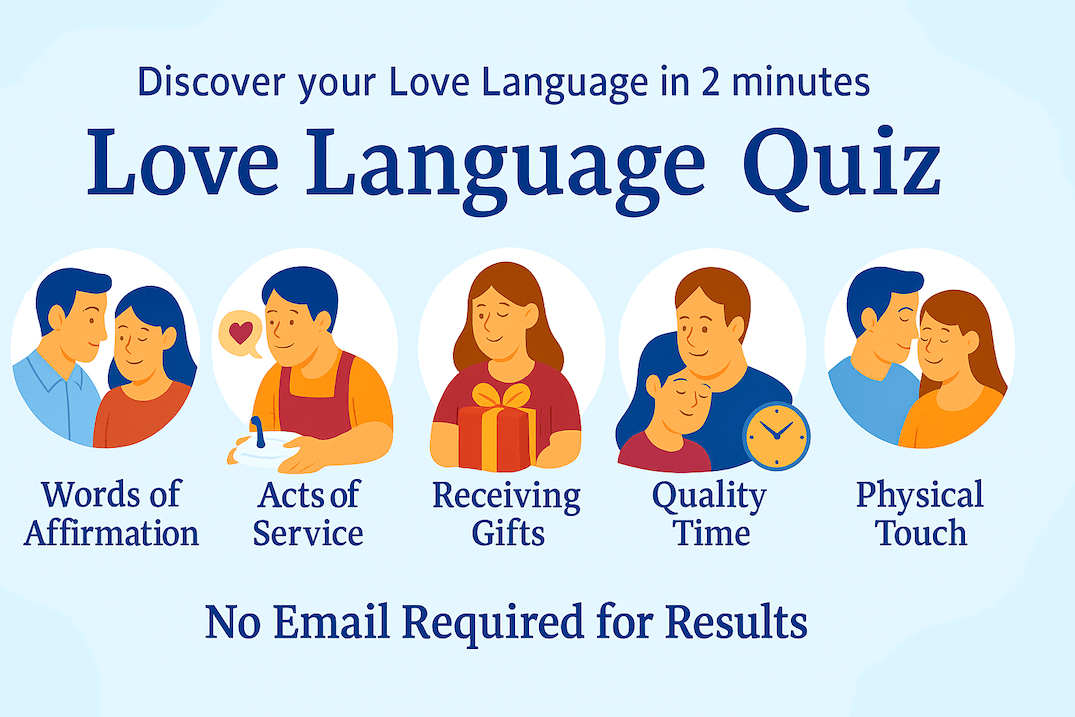
Love Language Quiz
Discover how you experience love most deeply. Choose what would make you feel most loved in each scenario.
Understanding your love language helps you communicate your needs and connect more deeply with your partner.
20 scenario-based questions • Pick what resonates most

You just discovered your love language. Now what? Knowing your results is only the first step. The real magic happens when you understand what your love language means and how to use it to build a stronger relationship.
Whether you got Words of Affirmation, Quality Time, Acts of Service, Physical Touch, or Receiving Gifts, each love language gives you a roadmap for feeling more connected with your partner. And when you learn to speak your partner's language too? Thats when everything changes.
The most common thing I hear from couples is "I do so much for them and they dont even notice." Usually thats a love language mismatch. One partner is doing dishes every night (Acts of Service) while the other is waiting to hear "I appreciate you" (Words of Affirmation). Both are trying. Neither feels loved. Once they identify this gap, the fix is often surprisingly simple.
Understanding the 5 Love Languages
Dr. Gary Chapman developed the five love languages in 1992 after years of marriage counseling. He noticed couples kept having the same problem: one partner would say "I dont feel loved" while the other would say "But Im doing everything right!" The issue wasnt effort. It was that they were speaking different love languages.
Think of it like actual languages. If someone speaks French to you but you only understand English, their words wont land no matter how heartfelt they are. Love languages work the same way. When your partner shows love in a way that matches how you receive it, you feel it deeply. When they dont, you might feel empty even when theyre trying hard.
Words of Affirmation
If Words of Affirmation is your love language, you feel most loved when your partner expresses their feelings through words. Hearing "I love you" matters, but hearing why they love you matters even more. Compliments fill your tank. Encouragement lifts you up. And harsh criticism? It cuts deeper than it might for others.
People with this love language dont just want to hear nice things. They want genuine, specific appreciation. Saying "you look nice" is good, but saying "that color makes your eyes look amazing" hits different. The details matter because they show you're really paying attention.
Signs this might be your love language:
- You save text messages and cards that contain meaningful words
- Compliments make your whole day better
- Criticism sticks with you longer than it does for others
- You often tell your partner what you appreciate about them
- Silence from your partner feels like rejection
- You remember specific things people have said to you years later
Examples of Words of Affirmation
💡 How to love someone whose language is Words of Affirmation
- Be specific with your compliments instead of generic
- Send unexpected texts during the day expressing appreciation
- Write notes and leave them where they'll find them
- Say "I love you" regularly and explain why
- Acknowledge their efforts even for small things
⚠️ What to avoid
Harsh criticism, sarcasm that cuts too deep, giving the silent treatment, or being stingy with verbal appreciation. For this love language, what you dont say can hurt as much as negative words.
Quality Time
Quality Time isnt just about being in the same room. Its about being fully present with each other. If this is your love language, you feel most loved when your partner gives you their undivided attention. No phones. No distractions. Just the two of you, truly connecting.
The activity itself matters less than the togetherness. A walk around the block where you're both fully engaged can mean more than an expensive dinner where your partner keeps checking their phone. What fills your tank is knowing that in this moment, you're the priority.
Signs this might be your love language:
- Canceled plans feel like personal rejection
- You feel disconnected when you dont spend enough one-on-one time together
- Your partner being on their phone during conversations really bothers you
- You remember specific experiences and conversations vividly
- You'd rather have your partner's full attention for 30 minutes than distracted presence for hours
- Long-distance relationships are especially hard for you
Examples of Quality Time
💡 How to love someone whose language is Quality Time
- Put your phone away completely when you're together
- Make eye contact and really listen when they talk
- Schedule regular one-on-one time that you protect
- Be mentally present, not just physically there
- Plan activities you can do together, even simple ones
⚠️ What to avoid
Being distracted during conversations, frequently canceling plans, prioritizing work or other people over time together, or being physically present but mentally elsewhere. For this love language, distraction feels like rejection.
Acts of Service
For people with Acts of Service as their love language, actions truly speak louder than words. You feel most loved when your partner does things to make your life easier. Taking something off your plate, helping without being asked, or handling a task you've been dreading these are love letters to you.
This isnt about keeping score or expecting servitude. Its about the thoughtfulness behind the action. When your partner notices you're overwhelmed and steps in to help, it tells you they see you and they care. The phrase that speaks to this love language: "Let me do that for you."
Signs this might be your love language:
- You notice and deeply appreciate when your partner helps without being asked
- Broken promises and unfulfilled commitments really hurt
- You often show love by doing things for others
- When you're overwhelmed, help with tasks means more than words of comfort
- Laziness or lack of follow-through feels like a lack of love
- You remember when people went out of their way to help you
Examples of Acts of Service
💡 How to love someone whose language is Acts of Service
- Notice what tasks stress them out and take them on
- Follow through on things you say you'll do
- Help without being asked when you see they need it
- Ask "what can I take off your plate today?"
- Do things cheerfully, not begrudgingly
⚠️ What to avoid
Making promises you dont keep, being lazy about shared responsibilities, creating more work for them, or doing tasks with obvious resentment. For this love language, follow-through is everything.
Physical Touch
Physical Touch is about much more than just sex. If this is your love language, you feel most connected through physical closeness holding hands, hugs, a touch on the arm, sitting close together. These physical connections make you feel safe, loved, and bonded to your partner.
The science backs this up. Physical touch releases oxytocin, often called the "bonding hormone." For people with this love language, that physical connection is how they feel emotionally connected too. Without it, they can feel isolated even when other needs are being met.
Signs this might be your love language:
- You naturally reach for your partner holding hands, touching their arm, etc.
- A lack of physical affection makes you feel disconnected
- You feel comforted by hugs when you're upset
- Physical presence during hard times matters more than words
- You remember how people's touch made you feel
- Physical distance in a relationship is especially difficult for you
Examples of Physical Touch
💡 How to love someone whose language is Physical Touch
- Make physical affection part of your daily routine
- Reach for them throughout the day, not just at bedtime
- Be physically present during difficult conversations
- Learn what types of touch they prefer and don't prefer
- Dont withhold physical affection during disagreements
⚠️ What to avoid
Going long periods without physical affection, being physically distant during conflict, or ignoring their need for closeness. For this love language, physical disconnection can feel like emotional rejection.
Receiving Gifts
Receiving Gifts as a love language is often misunderstood as materialism, but its not about the price tag. Its about the thoughtfulness behind the gift. When this is your love language, a gift is a tangible symbol that someone was thinking about you. It says "I saw this and thought of you" and that thought is what you treasure.
People with this love language remember gifts and what they symbolized long after receiving them. A $5 item that shows someone really knows you can mean more than something expensive that feels generic. Its the effort, thought, and meaning that fills their emotional tank.
Signs this might be your love language:
- You treasure gifts and keep them for years, remembering who gave them
- A thoughtless or forgotten gift (like for your birthday) really stings
- You love giving gifts and put thought into choosing them
- You appreciate when someone remembers something you mentioned wanting
- Small, random "I thought of you" gifts mean a lot
- You value the story and thought behind gifts more than the item itself
Examples of Receiving Gifts
💡 How to love someone whose language is Receiving Gifts
- Keep a running list of things they mention wanting
- Give small, thoughtful gifts regularly not just on occasions
- Remember important dates and never miss them
- Focus on thoughtfulness over expense
- Include a meaningful note explaining why you chose it
⚠️ What to avoid
Forgetting birthdays and anniversaries, giving generic or last-minute gifts, or dismissing gift-giving as materialistic. For this love language, a forgotten occasion feels like being forgotten yourself.
Love Language Quick Reference Guide
| Love Language | They Feel Loved When... | They Feel Hurt When... | How to Show Love |
|---|---|---|---|
| 💬 Words of Affirmation | You express appreciation, give compliments, and verbally affirm your love | You criticize harshly, give the silent treatment, or withhold verbal appreciation | Say "I love you" often, leave notes, be specific with compliments |
| ⏰ Quality Time | You give undivided attention and make time to be fully present together | You're distracted, cancel plans, or prioritize other things over time together | Put phones away, schedule date nights, really listen when they talk |
| 🤝 Acts of Service | You help with tasks, lighten their load, and follow through on commitments | You break promises, create more work, or are lazy about responsibilities | Do chores without asking, help when stressed, follow through on promises |
| 🤗 Physical Touch | You're physically affectionate hugs, holding hands, sitting close | You're physically distant, withhold affection, or neglect intimacy | Regular hugs, hold hands, touch them as you pass by, cuddle |
| 🎁 Receiving Gifts | You give thoughtful gifts that show you were thinking of them | You forget special occasions or give generic, thoughtless gifts | Remember what they mention wanting, give small "just because" gifts |
How to Use Your Love Language Quiz Results
Knowing your love language is helpful. Using that knowledge is where the relationship transformation happens. Here's how to put your results into action:
Step 1: Share Your Results With Your Partner
Dont keep your love language to yourself. Have a conversation about what you learned. Explain what makes you feel most loved and ask your partner to take the quiz too. Many couples in Castle Rock and the South Denver area use this quiz as a starting point for deeper conversations about their relationship.
Step 2: Learn Your Partner's Love Language
Once your partner takes the quiz, you'll likely discover you have different primary love languages. Thats normal most couples do. The key is learning to "speak" their language even when it doesn't come naturally to you. Its like learning a second language the more you practice, the more fluent you become.
Step 3: Make a Plan Together
Talk about specific ways you can show love in each other's languages. If your partner's language is Quality Time, maybe you commit to phone-free dinners three nights a week. If yours is Words of Affirmation, maybe they set a reminder to send you an encouraging text during the day. Get specific.
Step 4: Practice Consistently
Love languages work best when they become habits, not one-time gestures. Consistent small efforts in your partner's love language add up to a fuller "emotional love tank" over time.
I had a couple last month where the wife felt completely neglected. He was confused because he was working 60-hour weeks "for the family." Her love language was Quality Time his was Acts of Service. He thought providing was love. She needed presence. Neither was wrong, they were just missing each other. Two weeks after identifying this, they both felt more connected than they had in years.
When You and Your Partner Speak Different Love Languages
Most couples have different primary love languages. This isnt a problem its actually an opportunity for growth. But it does mean you'll need to be intentional about meeting each other where you are.
Here's the common pattern: we tend to show love in our own language, not our partner's. If your love language is Acts of Service, you might show love by doing dishes and running errands. But if your partner's language is Words of Affirmation, they might not "feel" that love because its not in their language. They're waiting to hear appreciation while you're waiting for them to notice all you do.
The solution? Learn to be bilingual. Keep doing what comes naturally to you, but also make deliberate efforts to speak your partner's language. Even if it feels awkward at first, it becomes more natural with practice.
💡 Tips for couples with different love languages
- Dont take it personally when your partner shows love differently than you'd prefer
- Give your partner credit for trying, even when its not perfect
- Be specific about what you need instead of expecting them to guess
- Remember that showing love in their language is a gift, not a chore
- Check in regularly about what's working and what could be better
The Science Behind Love Languages
What Research Shows
Lets be honest about the science: the love languages framework was developed through Dr. Chapman's counseling experience, not academic research. Some studies have supported aspects of the theory, while others have questioned whether people truly have one "primary" language.
A 2006 study did find evidence that the five love languages represent distinct categories. However, a 2023 review noted that empirical evidence doesn't strongly confirm that couples who "match" love languages have higher relationship satisfaction.
So should you ignore love languages? Not necessarily. Many relationship experts, including the therapists at our practice in Castle Rock, find the framework useful not because its scientifically proven, but because it gives couples a shared vocabulary to talk about their needs. The value isnt in the categories themselves its in the conversation they start.
Why Love Languages Still Work in Practice
Even if the science is mixed, the principles behind love languages align with what we know about healthy relationships: that partners need to feel understood, that showing love intentionally matters, and that couples benefit from discussing how they want to give and receive affection.
Think of love languages as a starting point for conversation, not a rigid system. Your needs may not fit neatly into one category and thats okay. What matters is that you and your partner keep talking about how to meet each other's emotional needs.
Frequently Asked Questions About Love Languages
Can I have more than one love language?
Yes! Most people have a primary love language and often a secondary one that's close behind. Some people score similarly across multiple languages. Your results show your percentage for each language, so you can see your complete profile, not just your top result.
Its also normal to appreciate all five love languages to some degree. The quiz helps you identify which ones you prioritize most when you have to choose.
Do love languages change over time?
They can. Major life events like having children, career changes, illness, or personal growth can shift what makes you feel most loved. What you needed in your twenties might be different from what you need in your forties.
Its worth retaking the quiz every few years or whenever you notice changes in your relationship. Many couples find it helpful to check in about love languages periodically as part of ongoing relationship maintenance.
What if my partner and I have completely different love languages?
Thats completely normal and not a problem! Most couples have different primary love languages. The solution is becoming "bilingual" learning to show love in your partner's language even when it doesn't come naturally.
The couples who struggle are the ones who only express love in their own language and then wonder why their partner doesn't feel loved. Once you know each other's languages, you can be more intentional.
Are love languages scientifically proven?
The research is mixed. Some studies support that these five categories represent distinct ways people experience love. Other research questions whether matching love languages actually predicts relationship satisfaction.
What most experts agree on is that the framework is useful as a conversation starter. It gives couples a shared vocabulary to discuss their emotional needs, even if the categories aren't perfect.
Do love languages apply to non-romantic relationships?
Absolutely. Love languages apply to friendships, parent-child relationships, and even work relationships. Understanding how your child, friend, or family member feels appreciated can strengthen those bonds too.
Dr. Chapman even wrote separate books applying love languages to children, teenagers, and workplace relationships because the core concept translates across all relationship types.
Is the Receiving Gifts love language materialistic?
No! This is a common misconception. For people with this love language, its not about expensive items or materialism. Its about the thought and effort behind the gift. A $3 item that shows someone was thinking of you can mean more than something expensive that feels generic.
The gift is a symbol of love. What fills their tank is knowing someone saw something and thought "this would make them happy."
Is Physical Touch the same as wanting sex?
Not at all. Physical Touch as a love language includes all forms of appropriate physical affection: holding hands, hugs, a touch on the arm, sitting close together, back rubs, and yes, sexual intimacy. But its much broader than just sex.
Many people with this love language feel most connected through everyday touch like cuddling on the couch or a kiss goodbye in the morning.
Why is my love language different from how I show love?
We often show love the way we want to receive it, which can be different from what comes naturally. For example, you might crave Words of Affirmation but find yourself doing Acts of Service for others.
This is why knowing both your giving and receiving preferences matters. Your partner might be showing love in a way that doesn't register for you, and vice versa.
How often should I take the love language quiz?
We recommend retaking it whenever you feel like something has shifted in your relationship, or every couple of years as a check-in. Major life changes often shift our needs.
Some couples take it together annually as part of a relationship "state of the union" conversation.
Can love languages help fix a struggling relationship?
Love languages are a helpful tool, but they're not a cure-all. If your relationship has deeper issues like trust problems, ongoing conflict, or communication breakdowns, love languages alone won't fix those.
That said, many couples find that learning each other's love languages helps them reconnect and feel more appreciated. For more significant challenges, working with a couples therapist can help you address root causes while incorporating tools like love languages.
What if I don't relate to any of the love languages?
Thats okay! The five love languages are a framework, not a complete list of every way humans can feel loved. Some people resonate strongly with one or more languages. Others feel like their needs don't fit neatly into these categories.
If thats you, focus less on the labels and more on the underlying question: what specifically makes you feel loved and appreciated? Have that conversation with your partner regardless of how it fits into the framework.
Do I need to enter my email to get my results?
No. Unlike many love language quizzes online, our quiz gives you your results instantly without requiring an email address. Your responses are processed privately, and you'll see your complete love language profile immediately after finishing the quiz.
How can couples therapy help with love languages?
A couples therapist can help you go deeper than a quiz. They can help you understand why certain love languages matter to you (often connected to your history), identify patterns where you're missing each other, and build sustainable habits for showing love in each other's languages.
At South Denver Therapy, we regularly incorporate love languages into our work with couples throughout Castle Rock, Parker, Highlands Ranch, and the surrounding South Denver metro area.
Where did the 5 love languages come from?
Dr. Gary Chapman developed the five love languages concept in 1992 based on his years of experience as a marriage counselor. He noticed that couples often complained about not feeling loved even when their partner was trying. The disconnect was usually that they were speaking different "languages."
His book, "The 5 Love Languages: The Secret to Love That Lasts," has sold over 20 million copies and introduced the concept to mainstream culture.
Continue Your Relationship Journey
📋 Love Language Action Plan
Put your quiz results into action with our free printable guide including weekly challenges for couples.
Download Free Guide →💬 Couples Communication Workbook
Learn communication exercises that help you express your needs and truly hear your partner.
Get Free Workbook →🔗 Attachment Style Quiz
Your attachment style affects how you connect in relationships. Take our free attachment quiz next.
Take Attachment Quiz →📝 Relationship Health Checklist
Assess the overall health of your relationship with our therapist-designed checklist.
Get Free Checklist →Related Reading
Ready to Go Deeper?
Love languages are just the beginning. Our couples therapists in Castle Rock help partners build stronger connections through proven, evidence-based approaches.
Learn About Couples TherapyAbout This Love Language Quiz
This free love language quiz was created by South Denver Therapy, a couples therapy and mental health practice serving Castle Rock, Parker, Highlands Ranch, Littleton, and the greater South Denver metro area in Colorado. Our lead therapist, Kayla Crane, LMFT, specializes in helping couples strengthen their connection using evidence-based approaches.
Unlike many online quizzes, ours uses a 4-option question design (rather than simple yes/no) for more accurate, differentiated results. Your responses are completely private and you'll get instant results no email required.
Explore more relationship insights:
Browse All Relationship Quizzes →