Between Couples Therapy Sessions: How to Keep Growing at Home
Couples therapy is 50 minutes, once a week.
Do the math: that's 50 minutes of structured, facilitated growth in a 168-hour week. Which means 167 hours of daily life — conversations, conflicts, small moments, missed bids for connection — happen without a therapist in the room.
That's not a problem with therapy. That's just the reality of it. And it's why what you do between sessions matters as much — sometimes more — than what happens in the session itself.
This is something we talk about directly with our couples at South Denver Therapy. Therapy is the place where you understand your patterns. Home is where you actually change them.
Here's what the research says about between-session practice — and what we recommend to our couples.
Why Homework in Couples Therapy Works
The clinical term is "between-session assignments," but most couples know it as homework. And it works.
A study published in the journal of couples therapy found that consistent completion of between-session assignments strongly correlates with successful treatment outcomes. Couples who practice communication skills in real-world situations between sessions — not just in the structured safety of the therapy room — show faster and more durable improvement.
This makes sense when you think about how learning works. You don't learn to ride a bike by reading about it. You learn by doing it, falling, adjusting, and trying again. Skills practiced only in therapy are like skills practiced only in a classroom. They don't transfer until you take them into your actual life.
The goal of our between-session recommendations is always the same: help couples bring what they're learning in therapy into the daily texture of their relationship.
5 Things We Recommend to Couples Between Sessions
1. One intentional conversation per day — not about logistics.
This is the one we emphasize most because it's where couples drift most easily.
Without structure, daily conversation between partners fills with scheduling, chores, parenting, finances — the logistics of running a shared life. That's necessary. But it crowds out the conversations that actually build connection.
We ask couples to protect one conversation per day that isn't about tasks or logistics. It doesn't have to be deep or long. It can be a two-minute exchange at the end of the day: "What was the best part of your day? What was the hardest?"
The point isn't the specific questions. The point is the daily habit of genuinely attending to each other.
2. Daily appreciation — said out loud.
John Gottman's research on the "magic ratio" found that stable, happy couples maintain approximately 5 positive interactions for every 1 negative. Not 5 grand romantic gestures — just a generally warm emotional climate where appreciation is expressed regularly.
We ask couples to name one thing they appreciate about their partner every day. Out loud, not assumed. "I noticed you handled that phone call with your mom really graciously today" is more powerful than it sounds.
This practice directly addresses contempt — one of the Four Horsemen Gottman identified as the strongest predictor of relationship failure. Contempt develops gradually over time when partners stop noticing the positive and start filtering everything through a lens of criticism. Daily appreciation reverses that drift before it becomes entrenched.
3. A weekly check-in conversation.
Once a week, block 20 minutes for a structured check-in. Not therapy — just a deliberate conversation where you each answer these three questions:
What's one thing that went well between us this week?
Is there anything I did that landed wrong, that we haven't talked about?
What's one thing I need from you this coming week?
This keeps small things from becoming large things. One of the most common patterns we see in couples is "accumulated grievances" — minor irritations that never get mentioned individually but pile up into a feeling of general resentment. A weekly check-in creates a regular clearing mechanism so nothing has to fester.
4. Use the tools from your sessions during the week.
Whatever skill you've been practicing in therapy — soft startup, active listening, taking a time-out before escalating — try to apply it at least once during the week. Then report back.
Not "I tried it and it worked perfectly." Just: "I noticed the moment where I would have gone to criticism and I used the soft startup instead. Here's what happened."
Real skill development comes from real-world application. This is where therapy stops being something you do once a week and starts being something you live.
5. Track your mood and connection daily.
This one sounds clinical but it's actually quite simple. Just check in with yourself daily: how am I feeling? How connected do I feel to my partner right now? On a scale, even informally.
This builds what therapists call "emotional awareness" — the ability to notice your own state before you're flooded by it. Couples who practice this regularly get better at catching themselves before they're too far into a reactive state to course-correct.
The Tool We Recommend: Connected
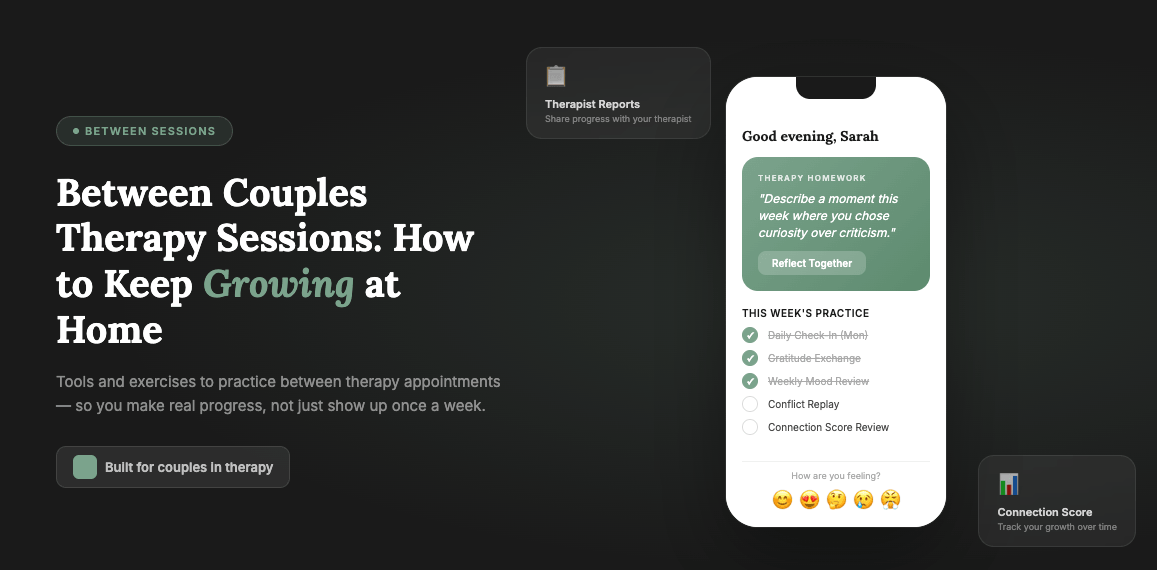
All of the above — daily questions, mood tracking, weekly check-ins, assessments, conflict tools — is built into an app called Connected.
We recommend it to most of our couples for one simple reason: structure matters for habits, and having a single place to do all of this makes it much more likely to actually happen.
Connected is built on Gottman method and emotionally focused therapy research. It includes:
Daily question and mood check-in — the exact daily connection habit we describe above
10+ research-backed assessments — Love Language, Attachment Style, Communication Style, Conflict Style, Relationship Satisfaction, and more — with side-by-side comparison and AI interpretation
Conflict resolution tools — four structured tools for working through disagreements using Gottman-based repair techniques
Weekly check-in — a guided 5-part reflection that covers exactly the three questions we listed above (plus more)
Therapist Export — a professional PDF report of your relationship data that you can bring directly to your therapy sessions
That last feature is particularly useful. When couples bring their Connected Therapist Export to sessions, we can spend less time reconstructing what happened in the past week and more time going deeper into the actual patterns. Mood trends, conflict themes, assessment results — it's all in one place.
Download Connected free at connectedcouples.app →
The free tier covers daily check-ins, mood tracking, and starter questions — enough to build the daily habit. Premium ($9.99/month, one subscription covers both partners) unlocks the full assessment library, conflict tools, and AI coaching.
A Word on What Between-Session Work Can't Do
We want to be honest here: between-session practice works because it reinforces and extends what's happening in therapy. It doesn't replace therapy, and it doesn't work the same way without it.
If you're doing the daily questions and weekly check-ins but you're not in therapy, you'll likely feel more connected. That's real. But the deeper pattern work — understanding your attachment histories, identifying the cycle you keep getting stuck in, processing a significant rupture — that needs a trained professional.
If you're reading this and wondering whether couples therapy might be right for you, we'd love to talk. Our therapists work with couples at all stages — from those who just want to strengthen what's already working, to those navigating real distress.
Learn about our couples counseling services → Schedule a free consultation →
The Honest Goal
Couples therapy, done well, should make itself progressively less necessary.
The goal isn't to be in therapy forever. The goal is to help you build the habits, skills, and self-awareness that make you able to navigate your relationship well on your own — with therapy available when you need it, but not as a permanent crutch.
Between-session practice is how you get there faster. Not because you're doing extra work. Because you're making the work you're already doing count.
Frequently Asked Questions
What should couples do between therapy sessions?
Between sessions, we recommend building a few simple daily habits: one intentional non-logistics conversation, expressing appreciation out loud, and a weekly 20-minute check-in. These small practices help you apply what you're learning in therapy to your actual daily life.
Does what couples do between therapy sessions actually matter?
Yes, a lot. Research shows that consistent between-session practice strongly correlates with better and more durable therapy outcomes. Skills practiced only in the therapy room don't transfer as easily as skills practiced in real life. Home is where the actual change happens.
What is a good weekly check-in for couples in therapy?
Once a week, set aside 20 minutes and take turns answering three questions: What went well between us this week? Is there anything I did that landed wrong? What do I need from you this coming week? It keeps small frustrations from piling up and creates space for honest, low-pressure conversation.
How many positive interactions should couples have for every negative one?
Gottman's research found that stable, happy couples maintain roughly 5 positive interactions for every 1 negative. That's not 5 grand gestures, just a generally warm daily climate where appreciation is expressed regularly and partners feel noticed.
What app do you recommend for couples between therapy sessions?
We recommend Connected (connectedcouples.app) to most of our couples. It includes daily check-ins, mood tracking, research-backed assessments, conflict resolution tools, and a weekly guided check-in, all built on Gottman method and emotionally focused therapy research. It also has a Therapist Export feature so couples can bring their data directly into sessions.
Can between-session practice replace couples therapy?
No. Daily habits and connection practices are most effective when they're reinforcing work happening in therapy. The deeper pattern work, like understanding your attachment histories or processing a significant rupture, needs a trained professional. Think of between-session practice as making your therapy time go further, not as a substitute for it.
