Do Relationship Apps Actually Work? A Couples Therapist's Honest Review
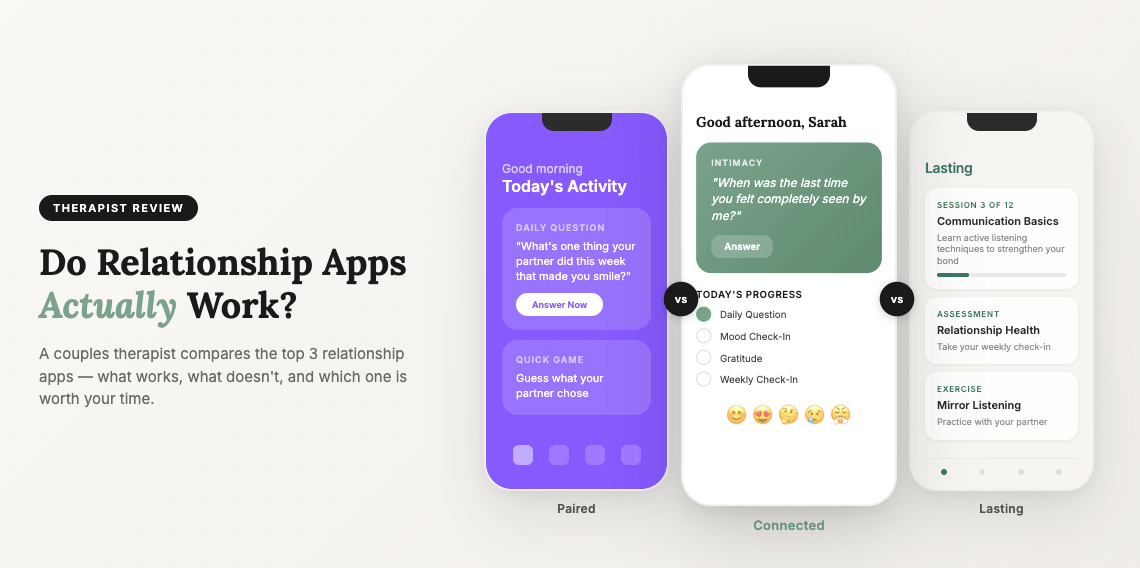
Couples ask me some version of this question all the time: "Is there an app that can help us?"
My honest answer used to be: "Sort of." Most relationship apps I evaluated were either too shallow to move the needle or too gimmicky to feel like serious tools. Daily trivia about your partner. Swipe-based date ideas. Gamified streaks that reward opening the app, not actually connecting.
My answer has changed.
After testing several apps and recommending them to couples in my practice, I've found a few that genuinely work — and one in particular that I now recommend to nearly every couple I work with.
Here's my honest, professional take.
What "Working" Actually Means for a Relationship App
Before I get into specifics, I want to be clear about what I'm evaluating. A relationship app "works" when it does one or more of these things:
Creates regular intentional attention. Most couples don't lack love — they lack structure. An app that creates a consistent daily moment of genuine attention toward each other is addressing a real gap.
Builds shared language. Attachment styles, love languages, communication patterns — these frameworks are clinically useful because they give couples words for dynamics that are otherwise hard to articulate. An app that delivers these assessments well and helps couples understand their specific combination is doing something meaningful.
Supports conflict resolution. This is the biggest gap I see in most apps. Almost none of them address what happens when you disagree. The ones that do — and do it well — are rare and worth paying attention to.
Complements professional care. The best apps don't try to replace therapy. They extend it, reinforce it, and help couples apply what they're learning between sessions.
What I'm not evaluating is whether apps feel good to use. They usually do. I'm evaluating whether they change anything.
What the Research Actually Says
A published study in PMC (the National Institutes of Health's research database) followed 43 couples using a daily question app over 21 days. Participants answered daily prompts 94% of the days — a remarkable engagement rate. Pre and post assessments showed meaningful improvements in relationship skills, partner knowledge, and care for each other's well-being.
Online relationship education more broadly — which includes digital tools and structured programs — has shown equivalent effectiveness to traditional marriage education in randomized controlled trials, according to research in Contemporary Family Therapy.
What the research is also clear about: apps do not replace professional intervention for couples dealing with significant distress. The therapeutic relationship — the experience of being truly understood by a trained professional who is present with you — is irreplaceable. Apps are vitamins. Therapy is medicine.
With that context, here's what I've found.
Apps That Genuinely Help
Connected — My Top Recommendation
I'll be transparent: I know the people who built Connected. It was created by a couples therapy family, and the assessment framework was developed with input from licensed marriage and family therapists using Gottman method and emotionally focused therapy research — the same two frameworks I use in my practice.
I recommend it not because of that relationship, but because it's the only app I've tested that addresses everything I care about clinically.
What impressed me:
The assessment library is genuinely clinical in quality. The Relationship Satisfaction assessment uses the validated CSI-4 scale — an actual research instrument, not a proprietary quiz. The Attachment Style assessment reflects current attachment theory. The Communication Style and Conflict Style assessments give couples a precise picture of their interaction patterns. And crucially, couples compare their results side by side with AI-generated interpretation of what their specific combination means. That's the part that makes assessments useful — not knowing your individual type, but understanding how your types interact.
The conflict tools are unlike anything else I've seen in an app. Four separate tools (Conflict Replay, Guided Talk, Repair Toolkit, Conflict Patterns) built on Gottman research address the thing most apps avoid entirely. The Guided Talk framework, in particular, mirrors the structure we use in session for hard conversations — including a physiological self-soothing step that addresses what Gottman called "flooding" (emotional overwhelm that makes productive communication impossible).
My honest caveats: The AI coaching, while good, is not a substitute for human clinical judgment — it's personalized to your data but can't read body language or notice what you're not saying. And like all apps, it only works if you actually use it.
Verdict: For couples in therapy who want structured between-session practice, and for couples who want to invest in their relationship without starting therapy, Connected is the strongest option I've found.
Gottman Card Decks — Best Free Clinical Supplement
Built by the Gottman Institute, this free app gives you digital versions of the card decks used in couples therapy research. Love Maps, Expressing Needs, Fondness & Admiration — the questions are excellent and the research foundation is legitimate.
I recommend this as a supplement, not a standalone tool. Pull a card during dinner or on a walk. It creates conversation without requiring either partner to generate the prompt.
Verdict: Genuinely useful. Free. No tracking, no assessments, no conflict tools — but as a question prompt, it's clinically sound.
Lasting — Best for Structured Learning
Lasting takes a curriculum approach — structured programs on communication, conflict, intimacy, and marriage health, built on Gottman research. It's the closest thing to therapy content you can access independently.
It works well for couples who do well with structured learning. It's less useful for couples who need real-time support during conflict, or who are dealing with acute distress.
Verdict: Good for couples who want to understand relationship science and are willing to do coursework together. Not a replacement for conflict support.
Paired — Best for Daily Habit Building
Paired does one thing well: daily questions. Both partners answer independently, reveal together. The content quality is high, the habit tends to stick, and it's beginner-friendly.
What it doesn't have: assessments, conflict tools, AI coaching, or growth tracking. It's relationship maintenance, not repair.
Verdict: Good starting point for couples who've never used a relationship app. Outgrow it quickly if you want more depth.
Apps That Fall Short (In My Assessment)
Most relationship app categories — gamified couple trivia, streak-based daily check-ins with no depth, apps that reward opening the app rather than actual connection — don't move the needle clinically. They feel productive without changing anything.
The warning signs I look for:
Gamification over depth. If the primary feature is earning badges or protecting streaks, the app is designed for engagement, not growth.
No conflict tools. An app that only addresses the positive side of relationships is addressing half the picture. Conflict is where most relationships get stuck — and any serious relationship tool needs to address it.
No assessment depth. "What's your love language?" as a one-time quiz with no follow-up or partner comparison is a novelty, not a tool.
My Bottom Line
Yes, relationship apps can work — with the right app, used consistently, by both partners who are genuinely engaged.
The ones that work do something specific: they reduce the friction of intentional connection so that it actually happens, daily, rather than being crowded out by the logistics of life.
For my couples, I recommend Connected as the primary between-session tool and the Gottman Card Decks as a free supplement for question prompts.
For couples who want to take a deeper step and work with a therapist alongside the app, I invite you to reach out to us at South Denver Therapy. We work with couples in Castle Rock, Parker, Highlands Ranch, and the South Denver area using Gottman method and emotionally focused therapy.
Learn about our couples therapy services → Schedule a free consultation →
Frequently Asked Questions
Do relationship apps actually work?
Some do, yes. The ones that work create consistent daily connection, give couples shared language for their patterns, and include tools for navigating conflict. Apps that rely on gamification or shallow prompts without any depth tend not to move the needle clinically.
What makes a relationship app worth using?
From a therapist's perspective, the best relationship apps do a few things well: they create a daily habit of intentional attention, offer clinically grounded assessments so couples understand how their patterns interact, and include tools for conflict, not just connection.
Can relationship apps replace couples therapy?
No. Apps are a great supplement, but they can't replace a trained therapist who is present with you, tracking what you're not saying as much as what you are. Think of apps as vitamins and therapy as medicine. Both can be valuable, but they're not interchangeable.
What is the best relationship app recommended by therapists?
We recommend Connected (connectedcouples.app) as our top pick. It's built on Gottman method and emotionally focused therapy research and is the only app we found that addresses daily connection, clinical assessments, and conflict resolution in one place.
What is the Gottman Card Decks app?
It's a free app from the Gottman Institute that gives you digital versions of the question card decks used in couples therapy research. It's a great free supplement for generating meaningful conversation, though it doesn't include assessments, conflict tools, or progress tracking.
What should I look for when choosing a relationship app?
Look for apps with clinically grounded assessments, tools for navigating conflict (not just connection), and features that work for both partners together. Be cautious of apps that focus mainly on streaks or gamification. Those tend to reward opening the app, not actually improving your relationship.
Are relationship apps helpful for couples in therapy?
Yes, especially for practicing skills between sessions. Research shows that structured relationship skills practice outside of therapy significantly improves outcomes. An app like Connected can help couples apply what they're learning in session during the rest of the week.
