Physical Symptoms of Anxiety: When Your Body Signals Distress
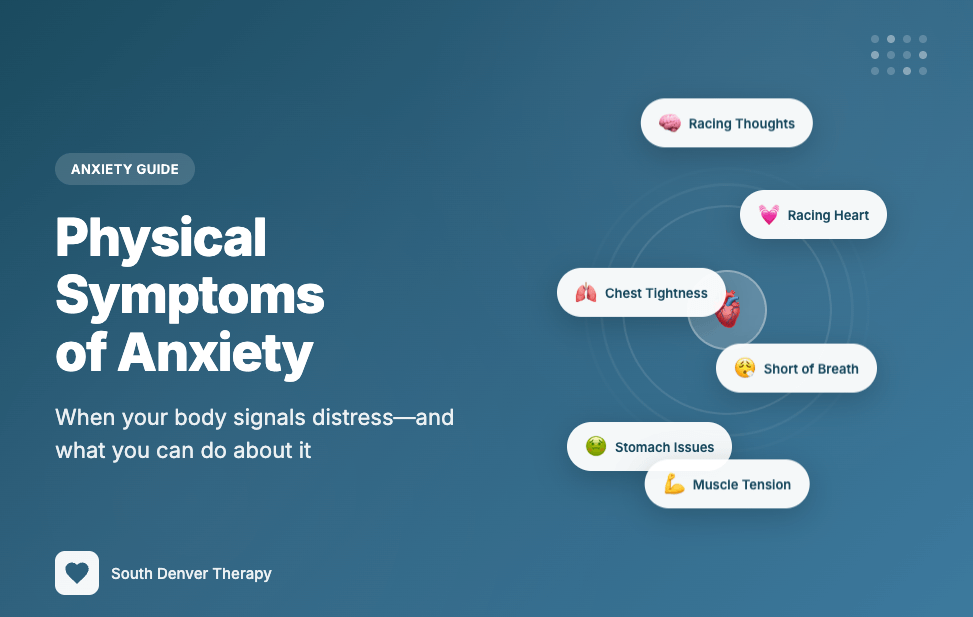
Your heart races. Your chest feels tight. Your stomach churns. You wonder if something is seriously wrong with your body.
But here's something that might surprise you: up to 40% of emergency room visits for chest pain are caused by anxiety—not heart problems. Many people go through expensive tests and scans, only to learn their body was responding to stress and worry.
Anxiety doesn't just live in your mind. It shows up in your body in ways that can feel scary and confusing. This guide will help you understand why anxiety causes physical symptoms, what those symptoms feel like, and when it's time to get help.
Why Does Anxiety Cause Physical Symptoms?
When you feel anxious, your brain thinks you're in danger. It doesn't matter if the "danger" is a work deadline or a difficult conversation—your body responds the same way it would if you were running from a bear.
This is called the fight-or-flight response. Your brain releases stress hormones like adrenaline and cortisol. These chemicals prepare your body to either fight the threat or run away from it.
Here's what happens inside your body:
Your heart pumps faster to send blood to your muscles
Your breathing speeds up to get more oxygen
Your muscles tense up, ready for action
Your digestion slows down (running from danger is more important than digesting lunch)
Your senses become sharper and more alert
This response saved our ancestors from real physical threats. But today, your body can't tell the difference between a lion and a looming credit card bill. So it reacts the same way to both. If this stress response happens often, it can lead to burnout over time.
What Happens to Your Body During Anxiety
The fight-or-flight response affects nearly every system
These responses were designed to help us survive real physical threats. Today, they activate for mental and emotional stressors too.
The Most Common Physical Symptoms of Anxiety
Chest Pain and Tightness
Chest pain is one of the most alarming physical symptoms of anxiety. About 40% of people with anxiety report chest pain or tightness. It often feels like:
A squeezing or pressing sensation
Sharp, stabbing pains
A dull ache that won't go away
Tightness like someone is sitting on your chest
Research shows that approximately 50% of people who go to the emergency room for chest pain have non-cardiac causes. Anxiety and panic are among the most common reasons.
The chest pain happens because anxiety makes your muscles tense up—including the muscles around your ribs and chest. You might also be breathing differently without realizing it, which adds to the discomfort.
Important: Chest pain should always be checked by a doctor first. Once heart problems are ruled out, you can work on managing anxiety-related chest pain.
Racing Heart and Palpitations
During anxiety, your heart can beat 20-30% faster than its normal resting rate. You might feel:
Your heart pounding or racing
Skipped beats or fluttering
A thumping sensation in your chest or neck
Awareness of your heartbeat when you normally wouldn't notice it
This happens because adrenaline tells your heart to pump harder and faster. It's preparing your body to run or fight. While uncomfortable, anxiety-related heart palpitations are usually not dangerous.
Anxiety Chest Pain vs. Heart Attack
⚠️ When in doubt, always seek medical attention. It's better to be safe.
- Sharp or stabbing pain
- Usually stays in one spot
- Comes with racing thoughts or worry
- Often improves with deep breathing
- May come with tingling in hands/face
- Usually peaks within 10-20 minutes
- Often triggered by stress or worry
- Crushing, squeezing pressure
- Radiates to arm, jaw, neck, or back
- Comes with cold sweats, nausea
- Does NOT improve with rest or breathing
- May feel like heartburn or indigestion
- Lasts more than a few minutes
- May occur during physical exertion
Shortness of Breath
60% of people who experience panic attacks say shortness of breath is their most distressing symptom. It can feel like:
You can't get enough air
You're breathing but it's not satisfying
Your chest is too tight to take a deep breath
You're suffocating or choking
Anxiety often causes hyperventilation—breathing too fast and shallow. This actually lowers the carbon dioxide in your blood, which makes you feel even more breathless. It's a cycle that feeds on itself.
The good news: slow, deep breathing can break this cycle. Breathing exercises are one of the most effective tools for managing anxiety symptoms in the moment.
Stomach Problems and Nausea
Ever had "butterflies" before a big event? That's your gut-brain connection at work. Your digestive system has millions of nerve cells that talk directly to your brain.
When you're anxious, you might experience:
Nausea or feeling like you might throw up
Stomach cramps or pain
Diarrhea or urgent need to use the bathroom
Constipation
Loss of appetite or stress eating
Bloating and gas
Here's a striking statistic: people with anxiety disorders are 5 times more likely to develop Irritable Bowel Syndrome (IBS) than people without anxiety. And among people hospitalized with IBS, 38% also have anxiety and 27% have depression.
The Gut-Brain Connection
Your gut has its own nervous system with millions of nerve cells—often called your "second brain." When you feel anxious, your gut feels it too.
Here's the section with natural internal links added:
Muscle Tension and Pain
Up to 75% of people with anxiety disorders experience persistent muscle tension. You might notice:
Tight shoulders and neck
Jaw clenching or teeth grinding
Headaches (especially tension headaches)
Back pain
General body aches
Many people don't realize they're holding tension until it becomes pain. You might catch yourself with your shoulders up by your ears or your jaw clenched tight. This constant tension exhausts your muscles and can cause real pain over time.
Dizziness and Lightheadedness
Feeling dizzy or unsteady is common with anxiety. This happens because:
Hyperventilation changes the oxygen and carbon dioxide balance in your blood
Stress hormones affect your inner ear and balance
Muscle tension in your neck can affect blood flow to your head
Your brain is on high alert and processing too much information
Dizziness can feel scary, which often makes anxiety worse. Learning that it's a normal anxiety response can help reduce the fear around it.
Sleep Problems
Anxiety and sleep have a complicated relationship. Anxiety can cause:
Trouble falling asleep (racing thoughts)
Waking up in the middle of the night
Waking up too early
Restless, unsatisfying sleep
Nightmares
And poor sleep makes anxiety worse. When you're tired, your brain has fewer resources to manage stress and worry. It becomes a cycle that can be hard to break without addressing both the anxiety and the sleep.
If you're highly sensitive, these physical symptoms may feel even more intense.
Do You Experience These Physical Symptoms?
Common physical signs of anxiety—check all that apply to you
If you checked 3 or more: Physical symptoms of anxiety may be affecting your quality of life. Speaking with a therapist can help you understand what's driving these symptoms and find relief.
Less Common Physical Symptoms
Anxiety can also cause symptoms that surprise people:
Tingling or numbness in hands, feet, or face (from hyperventilation)
Hot flashes or chills (stress hormones affecting body temperature)
Excessive sweating (body preparing to fight or flee)
Frequent urination (nervous system affecting bladder)
Dry mouth (reduced saliva production during stress)
Trembling or shaking (adrenaline in your system)
Difficulty swallowing (throat muscles tensing)
Vision changes (pupils dilating, eye muscles tensing)
These symptoms can be alarming when you don't know what's causing them. Many people worry they have a serious medical condition before learning it's anxiety. Understanding what generalized anxiety disorder actually is can help make sense of these symptoms.
When Physical Symptoms Become a Problem
An occasional racing heart before a job interview is normal. But chronic physical symptoms of anxiety can seriously impact your life.
65% of people with chronic anxiety report significant changes in appetite—either eating too much or too little. Over time, chronic anxiety can contribute to:
Weakened immune system (you get sick more often)
Digestive disorders like IBS
Chronic pain conditions
Cardiovascular strain
Weight changes
Exhaustion and burnout
The physical symptoms of anxiety are your body's way of sending a message. When those messages become constant, it's time to listen and get help.
When to Seek Professional Help
- Crushing chest pain or pressure
- Pain radiating to arm, jaw, or back
- Difficulty breathing that doesn't improve
- Fainting or loss of consciousness
- Thoughts of harming yourself
- Physical symptoms happen frequently
- You avoid activities due to anxiety
- Symptoms interfere with work or relationships
- You've had symptoms for 6+ months
- Self-help strategies aren't enough
Remember: Seeking help is a sign of strength, not weakness. Anxiety is highly treatable—most people see significant improvement with proper support.
Here's the section with natural internal links added:
What Helps Physical Symptoms of Anxiety?
In the Moment: Grounding Techniques
When physical symptoms hit, try these:
Box Breathing: Breathe in for 4 counts, hold for 4 counts, breathe out for 4 counts, hold for 4 counts. Repeat 4 times. This activates your body's calm-down system.
Progressive Muscle Relaxation: Tense each muscle group for 5 seconds, then release. Start with your feet and work up to your face. This helps you notice and release tension you didn't know you were holding.
Cold Water: Splash cold water on your face or hold ice cubes. This triggers your body's "dive reflex" which naturally slows your heart rate.
5-4-3-2-1 Grounding: Name 5 things you can see, 4 you can hear, 3 you can touch, 2 you can smell, 1 you can taste. This pulls your attention away from physical symptoms and into the present moment.
For more techniques like these, check out our guide on proven strategies to reduce anxiety and stress.
Long-Term: Therapy That Works
Physical symptoms often improve dramatically with proper anxiety treatment. Two approaches have strong research support:
Cognitive Behavioral Therapy (CBT) helps you identify thought patterns that trigger anxiety and learn new ways to respond. It's one of the most effective treatments for anxiety disorders. You can learn more about top DBT skills, which complement CBT techniques.
EMDR Therapy can be especially helpful if your anxiety is connected to past stressful or traumatic experiences. By processing these memories, the physical symptoms often decrease significantly.
"Many of my clients come in focused on their physical symptoms—the racing heart, the stomach problems, the constant tension," says Kayla Crane, LMFT, lead therapist at South Denver Therapy. "But once we address what's driving the anxiety underneath, those physical symptoms often improve on their own. Your body is trying to tell you something. Therapy helps you understand and respond to that message."
Lifestyle Changes That Help
Regular exercise: Even a 20-minute walk can reduce anxiety symptoms
Sleep hygiene: Consistent sleep schedule, cool dark room, no screens before bed
Limit caffeine and alcohol: Both can worsen anxiety symptoms
Reduce processed foods: The gut-brain connection means diet affects mood
Mindfulness practice: Even 5 minutes daily can help regulate your nervous system
Ready to Feel Better—Mentally and Physically?
If physical symptoms of anxiety are affecting your daily life, therapy can help. At South Denver Therapy, we specialize in treating anxiety with evidence-based approaches like CBT and EMDR that address both the mental and physical symptoms.
Serving Castle Rock, Parker, Highlands Ranch, and all of Colorado via telehealth
The Bottom Line
Physical symptoms of anxiety are real. The chest pain, racing heart, stomach problems, and muscle tension aren't "in your head"—they're in your body. Your nervous system is working exactly as designed. It just needs help learning that you're safe.
If physical symptoms of anxiety are affecting your daily life, you don't have to manage them alone. Therapy can help you understand what's driving your symptoms and give you tools to feel better—both mentally and physically.
Related Resources:
Frequently Asked Questions About Physical Symptoms of Anxiety
Why does anxiety cause physical symptoms?
When you feel anxious, your brain thinks you're in danger and triggers the fight-or-flight response. Your brain releases stress hormones like adrenaline and cortisol that prepare your body to fight or flee. This causes your heart to pump faster, breathing to speed up, muscles to tense, and digestion to slow down. Your body can't tell the difference between a real physical threat and a stressful situation, so it reacts the same way to both.
What are the most common physical symptoms of anxiety?
The most common physical symptoms of anxiety include racing heart and palpitations, chest pain or tightness, shortness of breath, stomach problems like nausea and cramping, muscle tension especially in the neck, shoulders and jaw, dizziness and lightheadedness, and sleep problems. Up to 75% of people with anxiety experience persistent muscle tension, and 60% say shortness of breath is their most distressing symptom during panic attacks.
Can anxiety cause chest pain that feels like a heart attack?
Yes, anxiety can cause chest pain that feels alarming. About 40% of people with anxiety report chest pain, and up to 40% of emergency room visits for chest pain are caused by anxiety, not heart problems. Anxiety chest pain typically feels sharp or stabbing, stays in one spot, comes with racing thoughts, and often improves with deep breathing. However, chest pain should always be checked by a doctor first. Seek immediate care if you have crushing pressure, pain radiating to your arm or jaw, or symptoms that don't improve.
Why does anxiety affect my stomach and digestion?
Your digestive system has millions of nerve cells that communicate directly with your brain, often called the gut-brain connection. When you're anxious, this connection causes symptoms like nausea, stomach cramps, diarrhea, constipation, and bloating. People with anxiety disorders are 5 times more likely to develop Irritable Bowel Syndrome than people without anxiety, and 38% of people hospitalized with IBS also have anxiety.
What helps physical symptoms of anxiety in the moment?
Several grounding techniques can help when physical symptoms hit. Box breathing involves breathing in for 4 counts, holding for 4, breathing out for 4, and holding for 4. Progressive muscle relaxation involves tensing and releasing each muscle group from feet to face. Splashing cold water on your face triggers your body's dive reflex which slows your heart rate. The 5-4-3-2-1 grounding technique pulls attention away from symptoms by naming things you can see, hear, touch, smell, and taste.
What therapy works best for physical symptoms of anxiety?
Physical symptoms often improve dramatically with proper anxiety treatment. Cognitive Behavioral Therapy helps you identify thought patterns that trigger anxiety and learn new ways to respond. EMDR Therapy can be especially helpful if your anxiety is connected to past stressful or traumatic experiences. By addressing what's driving the anxiety underneath, the physical symptoms often improve on their own. Most people see significant improvement with proper support.
When should I see a doctor for physical symptoms of anxiety?
Seek immediate medical care if you have crushing chest pain, pain radiating to your arm, jaw, neck or back, difficulty breathing that doesn't improve, fainting, or thoughts of harming yourself. Schedule an appointment with a therapist if physical symptoms happen frequently, you avoid activities due to anxiety, symptoms interfere with work or relationships, you've had symptoms for 6 or more months, or self-help strategies aren't providing enough relief.
Can chronic anxiety cause long-term health problems?
Yes, chronic physical symptoms of anxiety can seriously impact your health over time. Long-term effects can include a weakened immune system causing more frequent illness, digestive disorders like IBS, chronic pain conditions, cardiovascular strain, weight changes, and exhaustion and burnout. About 65% of people with chronic anxiety report significant changes in appetite. The physical symptoms are your body's way of sending a message that it's time to get help.
Last updated: January 2026
