If you're considering EMDR therapy for yourself or someone you love, you probably want to know one thing: does it actually work?
The short answer is yes. The research backing EMDR is remarkably strong, and the numbers tell a compelling story.
This guide breaks down the latest EMDR statistics, success rates, and research findings so you can make an informed decision about your mental health treatment.
Key EMDR Statistics at a Glance (2026)
Here are the most important numbers you should know:
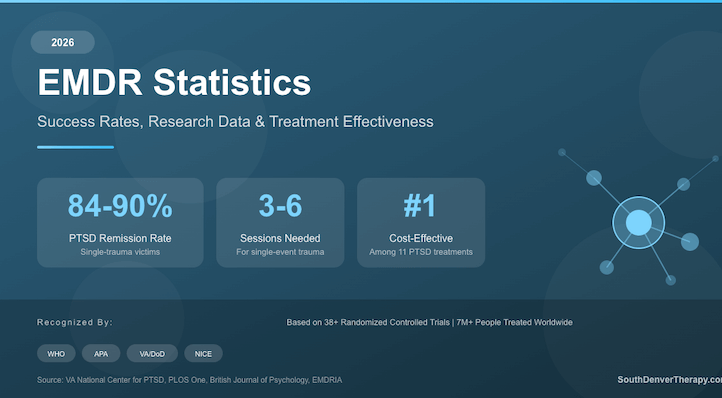
84-90% of single-trauma victims no longer have PTSD after just 3 sessions
77% of multiple-trauma victims are PTSD-free after 6 sessions
78% of combat veterans show significant symptom reduction after 12 sessions
150,000+ trained EMDR therapists practicing worldwide
38+ randomized controlled trials support EMDR's effectiveness
#1 ranking as most cost-effective PTSD treatment among 11 options studied
EMDR Success Rates for PTSD Treatment
The effectiveness of EMDR therapy for PTSD has been studied extensively. The results consistently show high success rates across different populations.
Single-Trauma PTSD Success Rates
For people who experienced a single traumatic event (like a car accident, assault, or natural disaster), EMDR shows remarkable effectiveness:
84-90% no longer meet PTSD diagnostic criteria after 3 sessions of 90 minutes each
100% achieved remission in some studies after 6 sessions of 50 minutes each
84% maintained their recovery at 15-month follow-up assessments
These numbers come from multiple peer-reviewed studies and represent some of the highest success rates among any PTSD treatment.
Multiple-Trauma PTSD Success Rates
For individuals with complex PTSD from childhood trauma or repeated traumatic experiences, EMDR still shows strong results:
77% no longer meet PTSD criteria after 6 sessions
Significant improvements in depression, anxiety, and overall functioning
Effects maintained at 3-month and longer follow-ups
Combat Veteran PTSD Success Rates
EMDR for veterans and first responders has been studied specifically because this population often has treatment-resistant PTSD. The research shows:
77-78% of combat veterans no longer meet PTSD criteria after 12 sessions
An early controlled trial of EMDR with combat veterans (Carlson et al., 1998) reported zero dropout, with about 76% of participants no longer meeting PTSD criteria after 12 sessions
Both in-person and telehealth delivery show similar effectiveness
A 2025 chart review by Fairbanks et al. found EMDR effective for veterans, with Cohen's d effect sizes of 0.76 for PTSD symptoms and 0.56 for depression, and similar treatment completion and outcomes whether delivered in person or via telehealth.
Natural Disaster Survivors
Large-scale studies following natural disasters provide some of the most impressive EMDR statistics:
92.7% of earthquake survivors were PTSD-free after 5 sessions (study of 1,500 participants)
200 children treated after a flood in Mexico reduced symptoms from severe to subclinical levels in just 1 session using group EMDR protocols
EMDR vs. Other Treatments: How Does It Compare?
Understanding how EMDR stacks up against other evidence-based treatments helps put these statistics in context.
EMDR vs. CBT for PTSD
When comparing EMDR vs. CBT, research shows:
Both are equally effective at reducing PTSD symptoms
EMDR achieves similar results in fewer sessions (often half as many)
EMDR requires no homework (CBT typically requires 50+ hours of homework exercises)
EMDR has lower dropout rates than exposure-based therapies
A 2024 meta-analysis by Wright et al. found EMDR equally effective as Prolonged Exposure (PE) and Cognitive Processing Therapy (CPT) across 15 randomized controlled trials
EMDR vs. Medication
When comparing EMDR to pharmacological treatments:
91% of EMDR patients were PTSD-free at follow-up vs. 72% of those taking fluoxetine (Prozac)
According to the National Center for PTSD, 53 of 100 patients receiving trauma-focused therapy (including EMDR) will no longer have PTSD, compared to 42 of 100 with medication alone
EMDR has no side effects compared to SSRIs
Treatment effects are maintained long-term without ongoing medication
Cost-Effectiveness Rankings
A comprehensive 2020 study published in PLOS One evaluated the cost-effectiveness of 11 different PTSD treatments. EMDR ranked #1 as the most cost-effective intervention for adults with PTSD, followed by:
EMDR (most cost-effective)
Combined somatic/cognitive therapies
Self-help with support
Psychoeducation
SSRIs
Trauma-focused CBT
A 2025 systematic review in the British Journal of Psychology confirmed these findings, analyzing 29 clinical RCTs and finding EMDR the most cost-effective intervention compared to 10 other treatments including TF-CBT.
| Factor | EMDR | CBT/PE | Medication |
|---|---|---|---|
| PTSD Remission Rate | 77-90% | 70-80% | 42% |
| Typical Sessions Needed | 3-12 | 12-20 | Ongoing |
| Homework Required | None | 50+ hours | None |
| Average Dropout Rate | Low | ~25% | Variable |
| Cost-Effectiveness Rank | #1 | #6 | #5 |
| Side Effects | None | Minimal | Common |
EMDR Treatment Timeline Statistics
One of the most common questions people ask is how long EMDR therapy takes. Here's what the research shows:
Number of Sessions Needed
| Trauma Type | Typical Sessions | Success Rate |
|---|---|---|
| Single traumatic event | 3-6 sessions | 84-100% |
| Multiple traumas | 6-12 sessions | 77% |
| Complex/developmental trauma | 8-12+ sessions | Varies |
| Combat-related PTSD | 12-20 sessions | 76-78% |
Session Length
Standard sessions: 50-90 minutes
Intensive formats: 2 sessions daily for 10 days (shown equally effective as weekly treatment)
Most patients need fewer than 10 sessions to return to a stable mental state
Treatment Formats
Research supports multiple delivery formats:
Weekly individual sessions: The most common approach
Intensive daily treatment: 10-day programs show equivalent results to weekly treatment
Group EMDR protocols: Effective for disaster response and community settings
Telehealth EMDR: 2025 research confirms similar outcomes to in-person treatment
EMDR Effectiveness Beyond PTSD
While EMDR was developed for trauma treatment, research now supports its use for many other conditions.
EMDR for Anxiety Disorders
EMDR therapy for anxiety has shown promising results:
Significant reduction in anxiety symptoms (effect size g = -0.71)
17 clinical trials with 647 participants support its effectiveness
Particularly effective for trauma-related anxiety and generalized anxiety disorder
EMDR for Panic Attacks
Can EMDR help with panic attacks? The research says yes:
Effective with an effect size of g = -0.62
6-session courses show promising results
Helps address underlying traumatic memories that trigger panic responses
EMDR for Phobias
Overcoming phobias with EMDR therapy is supported by research:
Effect size of g = -0.45 for phobia treatment
83% of dental phobia patients remained in regular dental treatment one year after EMDR
Single-session EMDR effective for test and performance anxiety
EMDR for Depression
EMDR's effectiveness for depression is growing:
A 2024 meta-analysis of 25 studies with 1,042 participants found EMDR effective for depression
Particularly helpful for treatment-resistant depression
Superior to fluoxetine in some comparative studies
Addresses traumatic memories underlying depressive symptoms
Other Conditions Treated with EMDR
Research supports EMDR for:
OCD: Helps process memories underlying obsessive thoughts
Grief and loss: Effective for complicated bereavement
Chronic pain: Reports of phantom limb pain elimination
Tinnitus: Clinically significant improvement maintained at 6 months
Eating disorders: Promising preliminary results
Addiction: Helps address underlying trauma driving substance use
EMDR Research: The Scientific Evidence
The research base supporting EMDR is extensive and continues to grow.
Randomized Controlled Trials
38+ randomized controlled trials have been conducted with EMDR treatment arms
30+ RCTs specifically demonstrate effectiveness for PTSD in adults
Studies conducted in the US and internationally (Netherlands, Indonesia, Turkey, and many more countries)
2024-2025 Research Highlights
Recent research continues to strengthen the evidence base:
Neuroimaging Evidence
Brain imaging studies show EMDR produces measurable changes:
Reduced hyperactivity in the amygdala (the brain's fear center)
Normalized hippocampal function (memory processing)
Increased grey matter volume in the left parahippocampal gyrus
Decreased grey matter volume in the left thalamus region
These changes visible on brain scans after just 3 months of treatment
How EMDR Changes the Brain
Neuroimaging research shows measurable changes after treatment
Timeline: Brain scan changes visible after just 3 months of EMDR treatment
Source: Bossini et al. 2017, fMRI neuroimaging studies
EMDR for Special Populations
Research supports EMDR across diverse populations with specific needs.
EMDR for Children and Teens
EMDR therapy for children and teens has strong research support:
Effective from age 4 years and up according to meta-analyses
200 children treated after a flood reduced symptoms from severe to subclinical in 1 session
PTSD symptom scores dropped from 60 to 24 in one study of children and adolescents
Both the World Health Organization and Australian Psychological Society recommend EMDR for children with PTSD
Younger children process memories faster (5-10 minutes vs. longer for adults)
EMDR for Individuals with Intellectual Disabilities
Research shows EMDR works for people with IQ scores between 50-85:
60% were diagnosis-free immediately post-treatment
43% maintained improvements at 3-month follow-up
EMDR for Postpartum Trauma
Women who experienced traumatic birth benefit from EMDR:
Shown to be safe and effective for postpartum women
Helps process traumatic birth experiences
Can address betrayal trauma in relationships
EMDR for Cancer Patients
Cancer patients receiving EMDR showed:
Significantly lower rates of PTSD, anxiety, and depression
Improved quality of life during and after cancer treatment
EMDR for Older Adults
Older adults with PTSD benefit from EMDR:
Treatment is feasible and well-tolerated
Reduces frailty associated with chronic PTSD
Improves overall quality of life
Who Can Benefit from EMDR Therapy?
Research-supported effectiveness across diverse populations
Key Finding: EMDR is adaptable for nearly all populations, with research supporting its safety and effectiveness across age groups, health conditions, and cognitive abilities.
Global EMDR Statistics
EMDR has become a worldwide treatment approach.
Number of EMDR Therapists Worldwide
150,000+ trained EMDR therapists practicing globally
18,000+ EMDRIA members in the United States (as of 2024)
Practitioners in 130+ countries
7+ million people treated since 2016
International Recognition
EMDR is recognized by major health organizations worldwide:
World Health Organization (WHO): Recommends EMDR as a first-line treatment for PTSD
American Psychological Association (APA): Lists EMDR as a best practice
U.S. Department of Veterans Affairs/Department of Defense: Category A recommendation (highest category) for PTSD treatment
NICE Guidelines (UK): Recommends EMDR as an evidence-based treatment
International Society for Traumatic Stress Studies (ISTSS): Strong recommendation
Regional Growth
EMDR continues to expand globally:
EMDR Europe: Started in 1999 with 6 national associations, now includes members across the continent
EMDR Asia: Active training programs in China, India, Indonesia, and more
171 practitioners completed Part 1 and 2 EMDR training in 4 Chinese cities in 2024 alone
Latin America and Caribbean: Approximately 2,500 members across 12 countries
EMDR Cost Statistics
Understanding the cost of EMDR therapy helps with treatment planning.
Average Session Costs
$100-$250 per session (national average)
$75-$150 for standard 50-60 minute sessions
$150-$300 for extended 90-minute sessions
$500-$1,500 for intensive day-long or weekend formats
Total Treatment Costs
Based on typical session needs:
| Treatment Length | Estimated Total Cost |
|---|---|
| 6 sessions (single trauma) | $600-$1,500 |
| 12 sessions (multiple traumas) | $1,200-$3,000 |
| 20+ sessions (complex trauma) | $2,000-$5,000+ |
Cost-Effectiveness Research
The 2020 PLOS One study found EMDR to be the most cost-effective PTSD treatment when comparing:
Quality-adjusted life years (QALYs) gained
Total treatment costs
Long-term outcomes
EMDR's shorter treatment duration and lack of required homework make it more economical than treatments requiring 50+ hours of homework exercises.
Frequently Asked Questions About EMDR Statistics
The Bottom Line on EMDR Statistics
The research on EMDR is clear: it's one of the most effective, efficient, and cost-effective treatments available for trauma and PTSD. With success rates of 77-90% across different populations and conditions, EMDR has earned its place as a first-line treatment recommended by major health organizations worldwide.
If you're struggling with trauma, anxiety, depression, or other conditions that may have roots in difficult past experiences, EMDR offers a research-backed path to healing that works faster than many traditional approaches.
Find EMDR Therapy in Castle Rock and South Denver
At South Denver Therapy, we offer EMDR therapy in Castle Rock and throughout the South Denver metro area, including Parker and Highlands Ranch. Our therapists are trained in EMDR and ready to help you begin your healing journey.
Related Resources:
Sources and References
Carlson, J. G., et al. (1998). Eye Movement Desensitization and Reprocessing (EMDR) treatment for combat-related PTSD. Journal of Traumatic Stress.
Mavranezouli, I., et al. (2020). Cost-effectiveness of psychological treatments for post-traumatic stress disorder in adults. PLOS One.
Wright, L. A., et al. (2024). EMDR v. other psychological therapies for PTSD: a systematic review and individual participant data meta-analysis. Psychological Medicine.
Every-Palmer, S., et al. (2024). EMDR for PTSD with co-occurring psychotic disorders. PubMed.
Fairbanks, C. L. D., Penix-Smith, E. A., Glitsos, S. C., et al. (2025). A multisite retrospective review exploring the delivery of eye movement desensitization and reprocessing (EMDR) therapy to veterans via telehealth versus in person. Psychological Trauma: Theory, Research, Practice, and Policy, 18(3), 659–670. https://doi.org/10.1037/tra0001917
Simpson, J. (2025). Clinical and cost-effectiveness of EMDR for treatment and prevention of PTSD in adults. British Journal of Psychology.
U.S. Department of Veterans Affairs, National Center for PTSD. EMDR for PTSD clinical guidelines.
World Health Organization. (2013). Guidelines for the management of conditions specifically related to stress.
EMDR International Association (EMDRIA). Find an EMDR Therapist Directory.
Torres-Giménez, A., et al. (2024). Efficacy of EMDR for early intervention after a traumatic event. Journal of Psychiatric Research.
