High-Functioning Anxiety: Signs You're Struggling While Appearing Fine
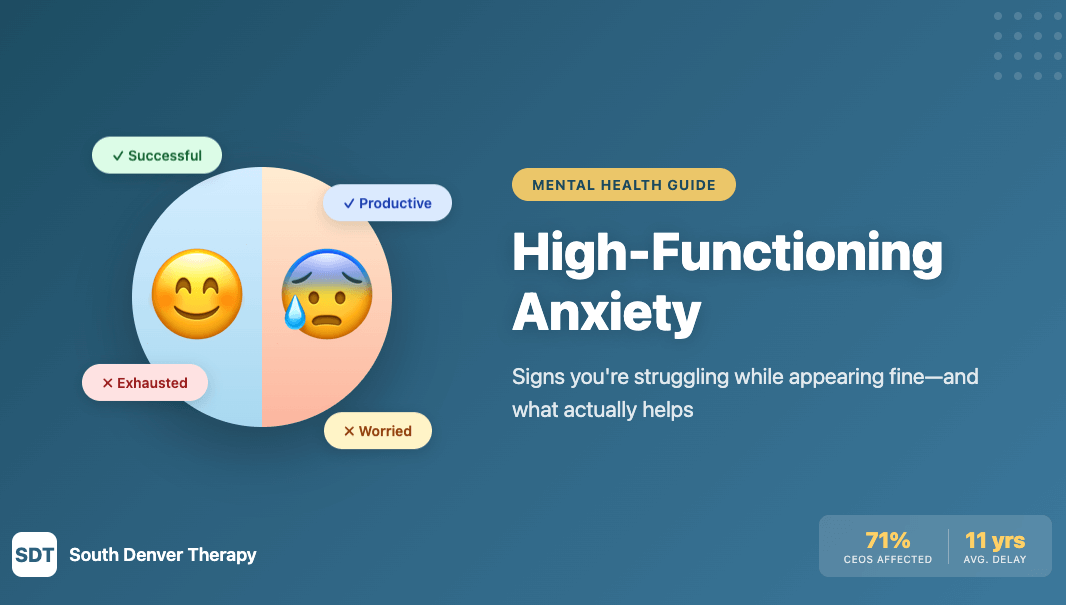
From the outside, everything looks great. You're hitting your deadlines, getting promotions, showing up for your family, and maintaining a busy social calendar. Your coworkers admire your productivity. Your friends think you have it all together.
But inside? It's a different story.
You can't remember the last time you felt truly relaxed. Your mind races at 3 AM replaying every conversation from the day. You check your email obsessively, convinced you've made a terrible mistake. The compliment your boss gave you yesterday? You're still analyzing whether it was genuine or a setup for criticism.
If this sounds familiar, you might be dealing with high-functioning anxiety—a form of anxiety that hides behind achievement and keeps millions of successful people suffering in silence.
The Hidden Anxiety Epidemic
Millions struggle silently while appearing successful
What Is High-Functioning Anxiety?
High-functioning anxiety isn't a formal diagnosis you'll find in medical textbooks. Instead, it describes people who experience significant anxiety symptoms but continue to function—and often excel—in their daily lives.
Here's the paradox: the very traits that help you succeed are often fueled by anxiety. Your attention to detail? Driven by fear of making mistakes. Your work ethic? Powered by worry about falling behind. Your reliability? Motivated by dread of disappointing others.
A 2023 study found that 44% of the U.S. population experienced anxiety symptoms—but 11.5% of them didn't even recognize they had anxiety. They just thought they were "stressed" or "driven." These are the high-functioning group.
The National Institute of Mental Health reports that 43.5% of people with anxiety disorders experience what's classified as "mild impairment"—meaning they're functioning well enough that no one notices their struggle. But "mild impairment" doesn't mean mild suffering.
The Hidden Signs of High-Functioning Anxiety
High-functioning anxiety doesn't look like what most people picture when they think of anxiety. You're not having visible panic attacks or avoiding social situations. Your anxiety wears a mask of productivity and perfectionism.
1. You're an Overachiever Who Never Feels "Good Enough"
You exceed expectations consistently, yet accomplishments feel hollow. The praise rolls off you because you're already worried about the next challenge. You've been called a "perfectionist" so many times you've started wearing it as a badge of honor—but deep down, you know it's exhausting.
Research on perfectionism shows that 88.6% of young people with perfectionistic tendencies have experienced burnout. The standards you set aren't about excellence—they're about avoiding the catastrophic feeling of failure.
2. Your Mind Never Stops
Overthinking is your constant companion. You replay conversations looking for mistakes. You imagine worst-case scenarios before meetings. You lie awake analyzing your to-do list, even though you've already checked everything off twice.
This isn't productive planning—it's rumination driven by anxiety. Your brain treats routine tasks like threats, triggering the same stress response our ancestors felt running from predators.
3. You Can't Say No
Your calendar is packed because saying "no" feels impossible. Every request triggers fear: What if they think I'm lazy? What if they don't ask me next time? What if they realize I'm not as capable as they thought?
This people-pleasing pattern keeps your life impossibly full while your actual needs go unmet. You're exhausted but keep agreeing to more.
4. Downtime Feels Uncomfortable
When you have a free evening, you feel guilty, anxious, or restless. Relaxation doesn't feel earned. You fill every moment with productivity because stillness means sitting with uncomfortable feelings.
You might not even remember the last time you truly relaxed. Weekends are for catching up on work, preparing for Monday, or tackling the house projects that "need" to get done.
5. You Have Physical Symptoms You Can't Explain
Anxiety lives in your body just as much as your mind. Common physical signs include:
Muscle tension (especially neck, shoulders, jaw)
Digestive issues like nausea or IBS
Headaches
Fatigue despite adequate sleep
Racing heart or chest tightness
Teeth grinding at night
You've maybe seen doctors about these symptoms but been told nothing's physically wrong. That's because the cause is anxiety—not a medical condition.
Where Anxiety Lives in Your Body
High-functioning anxiety causes real physical symptoms
Important: If you've seen doctors for these symptoms with no physical cause found, anxiety may be the culprit. Treating the anxiety often resolves the physical symptoms.
6. Imposter Syndrome Is Your Constant Companion
Despite your track record of success, you're convinced you're a fraud. According to Korn Ferry's 2024 research, 71% of CEOs experience imposter syndrome—proving that achievement doesn't eliminate self-doubt.
You attribute your successes to luck, timing, or fooling people. You discount positive feedback while magnifying any hint of criticism. The fear of being "found out" keeps you working harder than necessary to prove yourself.
🎭 Imposter Syndrome: You're Not Alone
High achievers everywhere share your secret fear of being "found out"
Sources: Korn Ferry, 2024; GITNUX Research, 2024; NerdWallet
7. You're Secretly Exhausted
This might be the biggest tell. You maintain a high-achieving exterior, but you're running on fumes. The mental energy required to manage constant anxiety while meeting everyone's expectations is draining.
Burnout is extremely common among people with high-functioning anxiety. You might mistake your exhaustion for needing more sleep or better time management—when the real issue is an overworked nervous system.
8. Small Mistakes Feel Catastrophic
When you make a minor error—a typo in an email, forgetting someone's name, being five minutes late—your reaction is disproportionate. Your heart races. You spiral into self-criticism. You replay the mistake for days.
This catastrophic thinking is a hallmark of anxiety. Your brain can't distinguish between actual threats and minor inconveniences, so everything feels equally urgent.
9. You Need Constant Reassurance
You ask others "Are you sure it's okay?" more than necessary. You reread emails before sending. You check in repeatedly to make sure you haven't upset anyone. This need for reassurance temporarily soothes anxiety but never fully satisfies it.
10. Success Feels Like Relief, Not Joy
When you achieve something, the predominant feeling isn't happiness—it's relief. Relief that you didn't fail. Relief that the worst didn't happen. The moment passes quickly as you move to the next potential failure to avoid.
Do You Have High-Functioning Anxiety?
Check the signs that apply to you
If you checked 3 or more: You may be experiencing high-functioning anxiety. These patterns are treatable—you don't have to keep pushing through alone. Consider taking our free anxiety quiz for a more comprehensive assessment.
Why High-Functioning Anxiety Goes Unrecognized
There are several reasons why high-functioning anxiety stays hidden:
Society rewards the behavior. Your productivity, attention to detail, and reliability get praised. No one encourages you to slow down because your anxiety benefits them.
You don't fit the stereotype. When people picture anxiety, they imagine someone unable to function—not someone running a department or raising three kids while volunteering for the school board.
You've normalized it. This has been your normal for so long that you assume everyone feels this way. You think constant worry is just "being responsible" or "caring about doing a good job."
Treatment delays are common. The Anxiety & Depression Association of America reports that only 36.9% of people with anxiety disorders receive treatment. For those with high-functioning anxiety, the rate is likely even lower because they don't identify as having "real" anxiety.
The Anxiety-Achievement Cycle
Why high-functioning anxiety perpetuates itself
The Problem: Your success proves the anxiety "works"—so your brain keeps it running. But the cost (exhaustion, health issues, missed life moments) keeps growing.
High-Functioning Anxiety vs. Generalized Anxiety Disorder
Understanding Generalized Anxiety Disorder (GAD) helps clarify where high-functioning anxiety fits. GAD is characterized by excessive worry about everyday things for at least six months, with symptoms like restlessness, fatigue, difficulty concentrating, irritability, muscle tension, and sleep problems.
Many people with high-functioning anxiety meet criteria for GAD but manage to maintain (or even exceed) typical functioning levels. The anxiety is still clinically significant—it's just being channeled into achievement rather than avoidance.
The Cost of "Functioning" Through Anxiety
Just because you're functioning doesn't mean you're thriving. High-functioning anxiety takes a serious toll:
Mental health impact: You're at higher risk for depression, as chronic anxiety often leads to emotional exhaustion. The NAMI reports that nearly half of people diagnosed with depression also have an anxiety disorder.
Physical health consequences: Chronic stress weakens your immune system, raises blood pressure, and increases inflammation. Your body wasn't designed to operate at high alert indefinitely.
Relationship strain: Your anxiety may make you distant, irritable, or unable to be fully present with loved ones. You might struggle to communicate your needs because you don't want to burden others.
Missed life experiences: All that time spent worrying is time not spent enjoying the present. Your anxiety is stealing moments you can't get back.
The Hidden Costs of "Functioning"
Mental Health
Higher risk of depression, emotional exhaustion, and eventual breakdown. Nearly 50% with depression also have anxiety.
Physical Health
Weakened immune system, elevated blood pressure, chronic inflammation, and increased illness.
Relationships
Emotional unavailability, irritability, inability to be present, and unspoken resentment from carrying too much.
Life Experiences
Time spent worrying is time not spent living. Vacations feel stressful. Joy gets overshadowed by "what ifs."
Treatment That Actually Works
The good news: high-functioning anxiety responds very well to treatment. You don't have to white-knuckle through life.
Cognitive Behavioral Therapy (CBT)
CBT is considered the gold standard for anxiety treatment. It helps you identify thought patterns that fuel anxiety and develop more balanced perspectives. For high-functioning anxiety, CBT is particularly helpful for challenging perfectionist thinking and catastrophic beliefs.
EMDR Therapy
If your anxiety has roots in past experiences—critical parents, early failures, trauma—EMDR therapy can help process those memories so they stop driving your current anxiety. Many clients find that EMDR therapy provides faster relief than talk therapy alone.
DBT Skills
Dialectical Behavior Therapy skills teach emotional regulation and distress tolerance—perfect for managing the intensity of high-functioning anxiety while learning to be present rather than perpetually future-focused.
Evidence-Based Treatments for High-Functioning Anxiety
Lifestyle Changes That Support Recovery
Mindfulness practice: Even 5-10 minutes of meditation daily helps calm an overactive nervous system
Physical movement: Exercise metabolizes stress hormones and provides natural anxiety relief
Journaling: Getting thoughts out of your head and onto paper can break rumination cycles
Healthy boundaries: Learning to say no without guilt
Reduced caffeine and alcohol: Both worsen anxiety symptoms
Many of my clients with high-functioning anxiety are surprised by how much better they feel after just a few sessions. They've spent so long powering through that they don't realize relief is possible. Once they learn to recognize anxiety's disguises and develop new coping strategies, they can finally achieve without suffering.
When to Seek Help
You don't need to hit rock bottom to deserve support. Consider reaching out if:
You've experienced these symptoms for six months or longer
Your anxiety is affecting your sleep, health, or relationships
You're relying on substances to manage stress
You feel exhausted despite "succeeding"
You can't remember the last time you felt genuinely relaxed
The average delay between anxiety symptom onset and treatment is 11 years. You don't have to wait that long.
Take the First Step
Recognizing high-functioning anxiety in yourself is the hardest part. Once you see it, you can address it.
Not sure if what you're experiencing is anxiety? Our free Anxiety Quiz can help you understand your symptoms better. Or download our Complete Anxiety Relief Journal to start identifying patterns.
If you're ready to stop just surviving and start actually thriving, we're here to help. Our Castle Rock therapists specialize in helping high-achievers like you find relief from anxiety while maintaining the success you've worked so hard to build.
You don't have to keep exhausting yourself to feel good enough. There's another way.
Ready to Achieve Without the Suffering?
You don't have to keep exhausting yourself to feel good enough. Our Castle Rock therapists specialize in helping high-achievers find relief from anxiety while maintaining success.
Serving Castle Rock, Parker, Highlands Ranch & South Denver Metro
Frequently Asked Questions About High-Functioning Anxiety
What is high-functioning anxiety?
High-functioning anxiety describes people who experience significant anxiety symptoms but continue to function and often excel in their daily lives. It's not a formal diagnosis but rather describes a pattern where anxiety fuels achievement. The traits that help you succeed, like attention to detail, strong work ethic, and reliability, are often driven by fear of making mistakes, worry about falling behind, or dread of disappointing others. About 43.5% of people with anxiety disorders experience mild impairment, meaning they function well enough that no one notices their struggle.
What are the signs of high-functioning anxiety?
Common signs include being an overachiever who never feels good enough, a mind that never stops racing, inability to say no to requests, feeling uncomfortable during downtime, unexplained physical symptoms like muscle tension and stomach issues, constant imposter syndrome despite success, secret exhaustion, catastrophic reactions to small mistakes, needing frequent reassurance, and feeling relief rather than joy when you succeed. These signs often go unnoticed because they're masked by productivity and achievement.
Why does high-functioning anxiety go unrecognized?
High-functioning anxiety stays hidden for several reasons. Society rewards the behavior, with productivity and attention to detail getting praised. You don't fit the anxiety stereotype of someone unable to function. You've normalized constant worry as just being responsible. And treatment delays are common, with only 36.9% of people with anxiety disorders receiving treatment. The average delay between anxiety symptom onset and treatment is 11 years.
How is high-functioning anxiety different from Generalized Anxiety Disorder?
Generalized Anxiety Disorder is characterized by excessive worry about everyday things for at least six months, with symptoms like restlessness, fatigue, difficulty concentrating, irritability, muscle tension, and sleep problems. Many people with high-functioning anxiety meet criteria for GAD but manage to maintain or exceed typical functioning levels. The anxiety is still clinically significant, it's just being channeled into achievement rather than avoidance.
What are the hidden costs of functioning through anxiety?
Just because you're functioning doesn't mean you're thriving. High-functioning anxiety can lead to higher risk of depression as chronic anxiety causes emotional exhaustion. Physical health suffers with weakened immune system, raised blood pressure, and increased inflammation. Relationships become strained as you may be distant, irritable, or unable to be fully present. And you miss life experiences because time spent worrying is time not spent enjoying the present.
What treatments work for high-functioning anxiety?
High-functioning anxiety responds very well to treatment. Cognitive Behavioral Therapy is the gold standard, helping you identify thought patterns that fuel anxiety and challenge perfectionist thinking. EMDR therapy can help if your anxiety has roots in past experiences like critical parents or early failures. DBT skills teach emotional regulation and distress tolerance. Lifestyle changes like mindfulness practice, exercise, journaling, healthy boundaries, and reduced caffeine also support recovery.
What is imposter syndrome and how does it relate to high-functioning anxiety?
Imposter syndrome is the persistent feeling that you're a fraud despite evidence of your success. Research shows 71% of CEOs experience imposter syndrome, proving that achievement doesn't eliminate self-doubt. People with imposter syndrome attribute successes to luck or fooling people, discount positive feedback while magnifying criticism, and work harder than necessary to avoid being found out. It's a constant companion for many with high-functioning anxiety.
When should I seek help for high-functioning anxiety?
You don't need to hit rock bottom to deserve support. Consider reaching out if you've experienced these symptoms for six months or longer, your anxiety is affecting your sleep, health, or relationships, you're relying on substances to manage stress, you feel exhausted despite succeeding, or you can't remember the last time you felt genuinely relaxed. The average delay between anxiety symptom onset and treatment is 11 years. You don't have to wait that long.
