The Best App for Couples in Therapy: What We Recommend to Clients
Most couples ask us the same question at some point during their time with us.
It usually comes up after a session that went somewhere real — a conversation that cracked something open, an insight that landed. They're leaving the office feeling motivated, and they want to know: "Is there something we can do between sessions to keep this going?"
Yes. There is.
After working with couples for years, we've tried recommending various resources — books, worksheets, conversation prompts. Some of them help. Some collect dust on nightstands.
But one app has genuinely impressed us: Connected.
Here's why we recommend it, who it's best for, and exactly how to use it alongside couples therapy.
Why Between-Session Practice Matters More Than Most Couples Realize
Couples therapy typically runs 50 minutes, once a week. That leaves 167 hours between sessions.
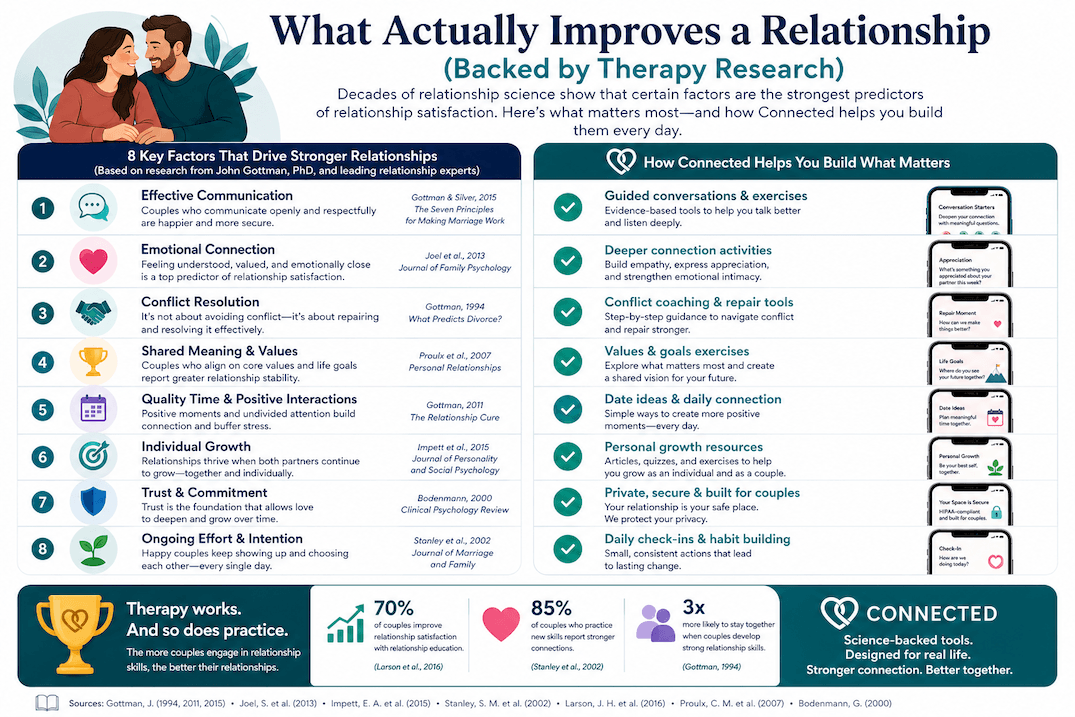
Research is consistent on this: the outcomes of couples therapy are directly tied to what happens outside the therapist's office. Homework completion, daily practice of communication skills, and consistent intentional check-ins between partners all significantly improve therapy outcomes.
A 2021 study in the journal Contemporary Family Therapy reviewed nine studies involving over 2,000 couples and found that structured relationship education and skills practice — including digital tools — showed meaningful improvements in relationship satisfaction, communication, conflict management, and emotional connection.
What this means practically: the work you do in our office is the foundation. What you do with it between sessions determines how fast and how far you go.
What Is Connected?
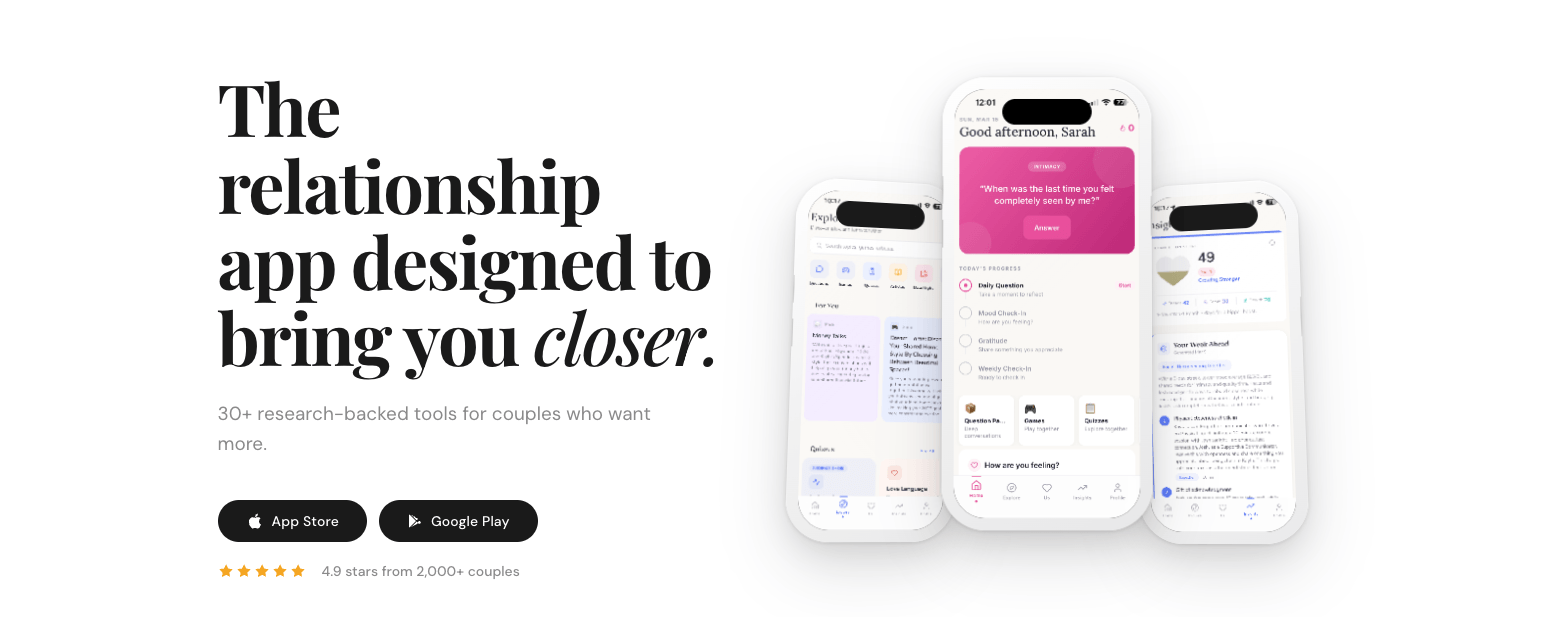
Connected is a relationship app built on Gottman method and emotionally focused therapy (EFT) research.
It has over 30 features, but the ones most relevant for couples in therapy are:
Daily questions and mood check-ins. A fresh conversation prompt every day, plus a quick emotional check-in. These create the daily habit of turning toward each other — one of the core behaviors Gottman's research identified in stable, happy couples.
10+ research-backed assessments. Love Language, Attachment Style, Communication Style, Conflict Style, Core Values, Relationship Satisfaction (using the validated CSI-4 scale), Stress Profile, and more. Both partners take each assessment independently, then compare results side by side with AI-generated interpretation.
Conflict resolution tools. Four separate tools — Conflict Replay, Guided Talk, Repair Toolkit, and Conflict Patterns — designed to help couples work through disagreements without escalating. These tools are built directly on Gottman's research around the Four Horsemen and repair attempts.
AI coaching. Personalized, therapist-quality guidance based on your actual assessment results and check-in patterns. Not generic relationship advice — specific recommendations for your relationship's dynamics.
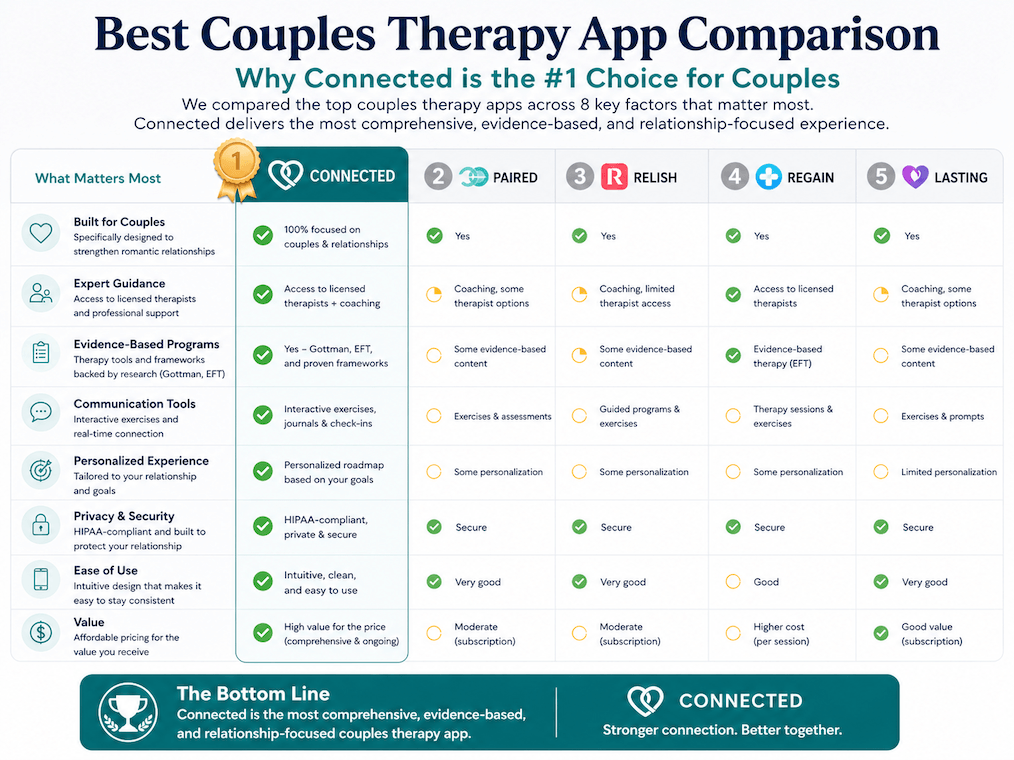
Why Connected Is Our Top App Recommendation for Couples in Therapy
Couples therapy works best when partners keep practicing between sessions. Connected helps couples turn what they learn in therapy into small, consistent habits at home.
Built specifically for couples
Connected includes daily questions, check-ins, shared exercises, assessments, and tools both partners can use together.
Helpful between therapy sessions
The app helps couples keep practicing communication, emotional connection, and repair outside the therapist’s office.
Research-informed relationship tools
Connected includes concepts inspired by evidence-based approaches such as Gottman Method, Emotionally Focused Therapy, attachment work, and conflict repair.
| What Couples Need | Why It Matters | How Connected Helps |
|---|---|---|
| Daily emotional check-ins | Small check-ins help couples notice disconnection before it becomes a bigger conflict. | Mood tracking and daily check-ins create an easy shared habit. |
| Better communication | Many couples know they need to talk, but do not always know how to start safely. | Guided prompts and conversation tools make hard topics easier to approach. |
| Relationship insight | Couples often repeat patterns until they have language for what is happening. | Assessments help partners understand strengths, patterns, values, and growth areas. |
| Conflict repair | Healthy couples still fight. The difference is whether they can repair and reconnect. | Conflict tools help couples slow down, reflect, and return to the conversation with more care. |
Best for couples who want therapy to stick
Use Connected as a simple daily practice to build communication, emotional connection, and follow-through between sessions.
Try ConnectedHow Connected Complements Couples Therapy (Without Replacing It)
We want to be clear about something: Connected is not therapy. It does not replace what happens in the room with a trained therapist.
What it does is keep the momentum going between sessions.
Think of it this way: if couples therapy is the intensive training session, Connected is the daily practice that makes the training stick. Without consistent practice between sessions, the insights gained in therapy tend to fade. With it, couples can apply what they're learning in real time — and come back to each session ready to go deeper.
Specifically, here's how we see couples using it most effectively:
Using the daily check-in as a temperature gauge. When both partners do the mood check-in consistently, they build a shared picture of how they're doing that doesn't require either person to initiate a potentially loaded conversation. "I noticed you've been marking that you feel disconnected — can we talk about that tonight?" is a much gentler opening than "What's wrong with you lately?"
Using assessment results as shared language. When one partner has an anxious attachment style and the other has an avoidant one, it helps to have a name for what's happening. Connected's assessments give couples that vocabulary. We've seen couples come into sessions saying things like "I think my attachment system got triggered at dinner last night" — because they now have the words for it.
Using conflict tools before arguments escalate. The Guided Talk feature gives couples a structured framework for hard conversations. It's not a replacement for in-session conflict work, but it helps couples practice what they're learning in therapy in lower-stakes moments so the skills become automatic.
Who Benefits Most From Using an App During Therapy
In our experience, Connected is most useful for:
Couples who are motivated but have trouble maintaining momentum between sessions. The daily structure keeps the work present, not just a once-a-week event.
Couples in the early stages of therapy. The assessments are particularly valuable early on — they give us a detailed picture of each partner's patterns before we've had many sessions together.
Couples managing busy lives. Parents, dual-career couples, people with demanding schedules — the five-minute daily habit is realistic even when life is full.
Couples who want to support a hesitant partner. One of the things we've seen is that partners who feel resistant to couples therapy are sometimes more willing to engage with an app first. The low-stakes, phone-based format reduces the emotional stakes enough that some partners open up more than they would in session.
It's less useful for couples in acute crisis — active betrayal processing, severe emotional disconnection, or situations that need intensive in-person support. In those cases, the app can still help, but it shouldn't be the primary vehicle for that work.
How to Get Started
If you're currently working with us and want to add Connected to your between-session practice:
Download it free at connectedcouples.app or on the App Store. The free tier includes daily check-ins, mood tracking, and starter questions — enough to build a genuine daily habit.
Do the assessments in your first week. Start with Love Language and Attachment Style — those two tend to generate the most useful in-session discussion.
Premium ($9.99/month, covers both partners) unlocks the full assessment library, conflict tools, and AI coaching. It's not required to start — the free tier is genuinely useful.
If you're not currently in therapy with us but are curious about couples counseling in Castle Rock or the South Denver area, we'd love to talk. You can learn more about our couples therapy services here or schedule a free consultation here.
Frequently Asked Questions
What is the best app for couples in therapy?
We recommend Connected to our couples therapy clients. It's built on Gottman method and emotionally focused therapy research and helps couples stay engaged between sessions with daily check-ins, relationship assessments, and conflict resolution tools.
Can a couples app replace therapy?
No, and we're honest about that with our clients. Connected is designed to support the work happening in therapy, not replace it. Think of it as daily practice that helps the insights from your sessions actually stick.
How does the Connected app work alongside couples counseling?
Couples use it between sessions for daily mood check-ins, relationship assessments like Love Language and Attachment Style, and structured tools for navigating conflict. It keeps the momentum going during the 167 hours between your weekly sessions.
Is Connected free to use?
Yes, there's a free tier that includes daily check-ins, mood tracking, and starter questions. The premium plan is $9.99 per month and covers both partners, unlocking the full assessment library, conflict tools, and AI coaching.
Who benefits most from using a relationship app during couples therapy?
Couples who are motivated but struggle to maintain momentum between sessions tend to get the most out of it. It's also a great fit for busy couples, people in the early stages of therapy, and situations where one partner is hesitant about therapy but willing to try a low-stakes app first.
Do you recommend apps to your couples therapy clients in Castle Rock and the South Denver area?
Yes, we often recommend Connected as a between-session tool for clients at South Denver Therapy. Whether you're coming in for couples counseling in Castle Rock, Parker, Highlands Ranch, or seeing us online across Colorado, it's an easy way to keep building connection between appointments.
What research supports using digital tools in couples therapy?
A 2021 study in Contemporary Family Therapy reviewed nine studies with over 2,000 couples and found that structured relationship skills practice, including digital tools, led to meaningful improvements in satisfaction, communication, and emotional connection.
How do I get started with couples therapy in Castle Rock, Colorado?
You can schedule a free 15-minute consultation with us at South Denver Therapy. We offer in-person couples counseling at our Castle Rock office and online therapy across Colorado. Reach us at 720-663-8046 or visit southdenvertherapy.com to book.
