Discernment Counseling: A Complete Guide to Finding Clarity When You're Unsure About Your Marriage
You've been lying awake at night, replaying the same conversation in your head. Your spouse wants to work on the marriage. You're not so sure anymore. Or maybe it's the other way around—you're desperate to save your relationship while your partner has one foot out the door.
This painful in-between place is more common than you might think. Research shows that 36% of couples who seek therapy are in this exact situation, where one partner wants to save the marriage and the other is considering leaving. Traditional couples counseling assumes both partners are committed to fixing the relationship. But what happens when that's not the case?
That's where discernment counseling comes in. Developed by Dr. William Doherty at the Doherty Relationship Institute, discernment counseling is a specialized approach designed specifically for couples who are uncertain about their future together. Unlike regular marriage counseling, it doesn't try to fix your relationship problems. Instead, it helps you gain clarity and confidence about what direction to take—whether that means working on the marriage, moving toward divorce, or taking more time to decide.
The Discernment Counseling Decision
What Is Discernment Counseling?
Discernment counseling is a short-term counseling approach lasting one to five sessions. It's designed for couples where one partner is "leaning out" of the marriage (considering divorce) while the other is "leaning in" (wanting to save it). According to GoodTherapy's clinical guidelines, these are often called "mixed-agenda" couples, and they represent a significant portion of people seeking relationship help.
The fundamental difference between discernment counseling and traditional marriage counseling is the goal. Regular couples therapy tries to solve problems and improve the relationship. Discernment counseling helps you decide whether solving those problems is even what you want. Think of it as an assessment before treatment—like getting a diagnosis before starting medication.
During discernment counseling, a therapist works with both partners but spends significant time with each person individually. This structure allows honest conversations that might not happen in joint sessions. The leaning-out partner can explore their doubts without feeling pressured. The leaning-in partner can express their hopes without being dismissed. Both partners examine their own contributions to the relationship problems, not to assign blame, but to gain understanding.
Who Is Discernment Counseling For?
Discernment counseling works best for couples in specific situations. You might be a good candidate if one partner is seriously considering divorce while the other wants to save the marriage. It's also helpful when you've tried couples therapy before but couldn't make progress because of different commitment levels, or when you need clarity before making a life-changing decision.

"The couples I see in discernment counseling often tell me they feel like failures for being unsure. But uncertainty isn't weakness—it's wisdom. You're taking the time to make one of the biggest decisions of your life with intention rather than reaction. Whether you ultimately choose to fight for your marriage or move forward separately, you'll do it knowing you gave this decision the careful thought it deserves."
This approach isn't right for everyone. Discernment counseling isn't appropriate when one partner has already made a final decision to divorce and isn't open to any possibility of reconciliation. It's also not recommended when domestic violence is present in the relationship, or when one partner is being coerced into participating.
The "leaning out" and "leaning in" terminology describes where each partner stands emotionally. The leaning-out spouse may have been thinking about divorce for months or even years. They're often exhausted from trying to fix things and skeptical that counseling can help. The leaning-in spouse typically wants to fight for the marriage and may feel blindsided by their partner's doubts. Discernment counseling meets both partners exactly where they are.
Is Discernment Counseling Right for You?
✓ Good Candidates
- One partner considering divorce, other wants to stay
- Both willing to attend without coercion
- Final decision hasn't been made yet
- Previous therapy didn't work due to mixed agendas
- Want clarity before taking legal steps
✗ Not Recommended
- Domestic violence present
- One partner has completely decided to divorce
- Attending only to "prove" to partner it's over
- Partner being forced or coerced to participate
- Active substance abuse without treatment
The Three Paths in Discernment Counseling
Every couple who completes discernment counseling ends up choosing one of three paths. Understanding these options helps you know what you're working toward.
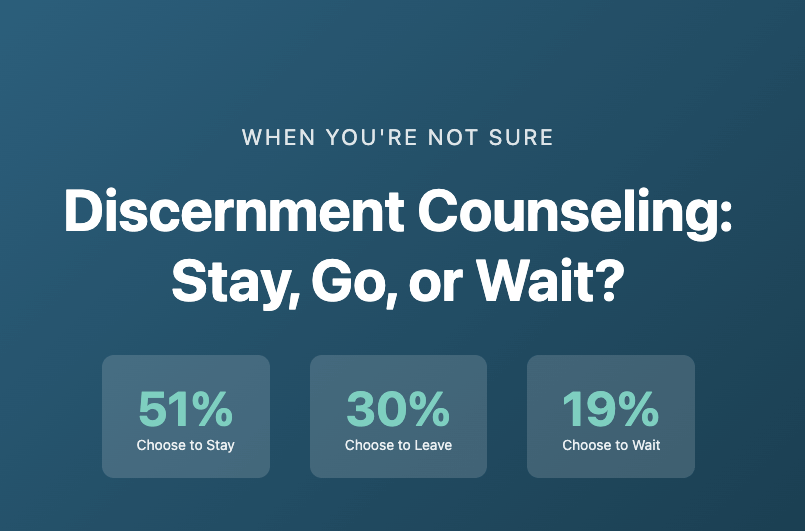
Path 1: Commit to Six Months of Couples Therapy This is called "taking divorce off the table." Both partners agree to put aside thoughts of divorce for six months and give the relationship their full effort through intensive couples therapy. This doesn't mean you're guaranteed to stay together forever—it means you're committing to giving your marriage a real chance before making a final decision. Research from certified discernment counselors shows that 51% of couples choose this path.
Path 2: Move Toward Separation or Divorce Some couples gain clarity that ending the relationship is the right choice. When both partners understand why the marriage didn't work and their own contributions to its problems, they can separate with less anger and resentment. According to CDC data on marriage and divorce, approximately 2.4 per 1,000 Americans divorce each year—and this process is particularly impactful for couples with children who will need to co-parent effectively. About 30% of couples choose this path.
Path 3: Maintain the Status Quo A smaller group (about 19%) decides they need more time. They may not be ready to commit to intensive therapy, but they're also not ready to divorce. This might involve individual therapy, addressing personal issues like addiction, or simply taking a separation to gain perspective.
How Discernment Counseling Works: Session by Session
The first session typically lasts about two hours. You'll start together with the therapist, discussing what brought you here and the history of your relationship. Then the therapist meets individually with each partner for deeper exploration of feelings and concerns. The session ends with a joint conversation about whether to continue.
Individual conversations are the heart of discernment counseling. During these private sessions, the therapist helps each partner examine their role in the relationship's problems. For the leaning-out spouse, this means looking honestly at whether they've truly given the marriage their best effort. For the leaning-in spouse, it means understanding their partner's concerns without dismissing them.
Sessions two through five (if the couple chooses to continue) follow a similar pattern. Each session ends with a decision: continue with more discernment work, or choose one of the three paths. Unlike traditional therapy that can go on indefinitely, discernment counseling has a built-in limit. This structure creates focus and prevents couples from getting stuck in limbo.
How a Discernment Counseling Session Works
-
Step 1: Opening Together (15-20 min)
Both partners meet with the therapist to discuss current state and what's happened since last session
-
Step 2: Individual Session - Partner 1 (30-40 min)
Private conversation exploring feelings, concerns, and contributions to relationship problems
-
Step 3: Individual Session - Partner 2 (30-40 min)
Same deep exploration with the other partner, examining their perspective and role
-
Step 4: Closing Together (15-20 min)
Partners share key insights and decide whether to continue discernment or choose a path forward
Discernment Counseling vs. Traditional Couples Therapy
Understanding the key differences helps you know which approach is right for your situation. In traditional couples therapy, both partners want to improve the relationship. The Gottman Institute's research shows that standard approaches work best when both partners are committed to change. The therapist works with the couple together to address communication problems, resolve conflicts, and rebuild connection. Success means the relationship gets better.
In discernment counseling, the goal isn't improvement—it's clarity. The therapist doesn't take sides or push for any particular outcome. Success means both partners understand what happened to their relationship and feel confident in their decision, whatever it is. This neutrality is essential when partners have different agendas.
The session structure differs significantly. Couples therapy happens primarily in joint sessions with occasional individual work. Discernment counseling is the opposite—most of the intensive work happens one-on-one, with joint sessions serving mainly as bookends. This allows each partner to be completely honest without worrying about their spouse's reaction in the moment.
Why Traditional Therapy Often Fails Mixed-Agenda Couples
When one partner is considering divorce, traditional couples therapy faces an uphill battle. The leaning-out spouse may go through the motions without genuine engagement. They've often mentally checked out of the marriage already and see therapy as pointless. The leaning-in spouse may notice this halfhearted participation and feel even more frustrated.
Therapists working with mixed-agenda couples often feel caught in the middle. Whose goals do they prioritize? If they focus on saving the marriage, they may alienate the leaning-out partner. If they seem to accept the possibility of divorce, the leaning-in partner may feel betrayed. This dynamic can lead to ineffective treatment and early dropout.
Research by Dr. Doherty found that therapists themselves reported feeling stuck with these couples. Traditional training didn't prepare them for situations where partners wanted fundamentally different things. The American Association for Marriage and Family Therapy now recognizes discernment counseling as a specialized approach, developed specifically to fill this gap and give therapists and couples a framework for navigating this difficult terrain.
The Research Behind Discernment Counseling
The development of discernment counseling stemmed from an interesting discovery. When Dr. Doherty and colleagues studied couples already in divorce proceedings, they found that about 30% of individuals still had hope for their marriage and were interested in receiving help to reconcile. Many people were moving toward divorce without being completely sure it was the right choice.
A landmark study published in the Journal of Marital and Family Therapy examined 100 consecutive discernment counseling cases and showed promising results. Of couples who completed the process, 48% chose to commit to six months of intensive couples therapy. Another 42% chose to move toward divorce, but with greater understanding and less acrimony. About 2% decided to maintain the status quo.
More recent data from 952 cases gathered from 73 certified discernment counselors across the country showed similar patterns. According to the American Psychological Association, roughly 40-50% of first marriages end in divorce—yet approximately 51% of couples who complete discernment counseling choose the path of reconciliation through couples therapy. Another 30% chose separation or divorce, and 19% chose to continue as they were. A follow-up study found that about 40% of all couples were still married two years after completing discernment counseling.
What Happens After Discernment Counseling?
If you choose Path 1 (intensive couples therapy), the discernment phase is complete. You'll transition to regular couples counseling with a clear agreement: both partners will fully engage for six months with divorce off the table. The insights gained during discernment—particularly each partner's understanding of their contributions to problems—provide a strong foundation for this work.
Couples who choose Path 2 (divorce) often report that discernment counseling helped them separate more constructively. They understand what went wrong and why, which reduces blame and resentment. For couples with children, this understanding supports healthier co-parenting relationships. Studies show that cooperative co-parenting is one of the most important factors in protecting children from the negative effects of divorce.
Those who choose Path 3 (status quo) may eventually return to discernment counseling when they're ready, pursue individual therapy to address personal issues, or find that time apart brings clarity on its own. This path isn't a failure—it's an acknowledgment that some decisions need more time.
What Happens After Discernment Counseling?
Common Questions About Discernment Counseling
"Will the therapist try to save our marriage?"
No. A trained discernment counselor remains strictly neutral. Their job isn't to push you toward reconciliation or divorce—it's to help you make a clear, confident decision. If you felt pressured either way, that would defeat the purpose of discernment counseling.
"What if my spouse won't participate?"
Discernment counseling requires both partners. If your spouse refuses to attend, you might consider individual therapy to work through your own feelings and decisions. Sometimes when one partner starts individual work, the other becomes more open to participating.
"How is this different from a trial separation?"
A trial separation is taking time apart. Discernment counseling is structured work with a professional to gain clarity about your future. Some couples use both—doing discernment counseling while living separately—but they serve different purposes. Discernment provides guided reflection and insight; separation provides space.
"What if we've already contacted lawyers?"
Research shows that couples who have already contacted a lawyer are less likely to choose reconciliation, but discernment counseling can still be valuable. It may help you divorce more constructively, with less conflict and better co-parenting outcomes. Some couples who've started legal proceedings do change course after gaining clarity through discernment.
The Psychology of Divorce Ambivalence
Research reveals that divorce is rarely a clean, clear decision. Studies of couples already in divorce proceedings found that a significant percentage still harbored hope for reconciliation. This ambivalence is normal but often goes unaddressed. Lawyers aren't trained to explore it. Friends and family usually take sides.
Many couples rush into divorce during moments of crisis without fully examining whether ending the marriage is truly what they want. The American Psychological Association estimates that 41% of first marriages end in divorce, but research suggests that nearly half of divorced people later regret their decision. They realize they didn't fully understand what went wrong or didn't give the marriage their best effort.
Discernment counseling addresses this by creating space for genuine reflection. It slows down the process just enough for couples to make thoughtful decisions rather than reactive ones. Even when couples ultimately divorce, doing so with clarity and understanding leads to better outcomes for everyone, especially children.
Special Situations in Discernment Counseling
After an Affair
Infidelity is one of the most common situations that brings couples to discernment counseling. The betrayed partner may be the one leaning out, devastated by broken trust. Or the unfaithful partner may want to leave for the affair partner. Discernment counseling can help both understand the factors that led to the affair before deciding the marriage's future.
When One Has "Fallen Out of Love"
This is perhaps the most painful scenario for the leaning-in partner. The leaning-out spouse may say they love their partner but aren't "in love" anymore. Discernment counseling explores whether emotional intimacy can be rebuilt or whether the disconnection is too deep to repair.
When Children Are Involved
The stakes feel higher when children are watching. Discernment counseling helps parents consider the impact on their children while making authentic decisions about their marriage. Sometimes staying together for the children works; sometimes a healthy divorce is better than an unhappy marriage. The process helps parents think clearly about these complex questions.
Discernment Counseling for Special Situations
💔 After Infidelity
When trust is shattered, discernment counseling provides space to decide if rebuilding is possible. The betrayed partner can explore whether they can ever trust again, while the unfaithful partner examines their commitment to change.
🌊 Grown Apart Over Time
Sometimes couples wake up feeling like strangers. Discernment helps identify whether you've genuinely changed in incompatible ways or simply lost connection that can be rebuilt with intentional effort.
👨👩👧👦 When Children Are Involved
Staying for the kids vs. modeling healthy relationships is a painful dilemma. Discernment counseling helps you consider your children's wellbeing while making an authentic decision about your marriage.
🔄 When Previous Therapy Didn't Work
Traditional couples therapy often fails when partners have different goals. Discernment counseling works precisely because it acknowledges this mixed agenda instead of pretending both people want the same thing.
Preparing for Your First Discernment Session
Before your first session, take some time to reflect individually. Think about what brought your relationship to this point. Consider your own contributions to the problems—not to blame yourself, but to understand. Think about what you would need to see to feel hopeful about the marriage.
Be prepared for emotional honesty. The individual conversations in discernment counseling require you to share thoughts and feelings you may not have expressed even to yourself. This isn't easy, but it's necessary for gaining clarity. The therapist creates a safe space for this exploration.
Come with an open mind about the outcome. Even if you think you know what you want, discernment counseling often reveals new perspectives. Couples who thought they were done sometimes discover renewed hope. Others who were fighting for the marriage sometimes realize they need to let go. Trust the process.
Preparing for Your First Session
💭 Questions to Reflect On
- What brought you to this point in your marriage?
- What have you tried to make things better?
- What's your contribution to the problems?
- What would need to change for you to stay?
- What are your fears about staying?
- What are your fears about leaving?
- What do you want your life to look like?
📋 What to Bring
- An open mind about the outcome
- Willingness to be emotionally honest
- Brief timeline of your relationship
- Notes on previous therapy attempts
- Questions you want to explore
- Patience with yourself and the process
The Role of Individual Work in Discernment
Much of discernment counseling's power comes from the individual sessions. When meeting alone with the therapist, you can explore thoughts you might hesitate to share with your spouse present. The leaning-out partner can voice doubts without triggering defensiveness. The leaning-in partner can express hurt without escalating conflict.
For the leaning-out partner, individual work often involves honest examination of whether they've truly given the marriage their best effort. Sometimes people want out because they're exhausted from trying. But sometimes they realize they gave up too soon or never addressed their own contributions to the problems. This self-reflection is essential for a confident decision.
The leaning-in partner uses individual time differently. They work on understanding their spouse's perspective rather than just defending the marriage. They examine their own role in the disconnection. They may need to accept that they can't force their partner to stay, and begin considering what they would do if their spouse chooses divorce.
When Discernment Counseling Leads to Divorce
Choosing divorce after discernment counseling isn't a failure of the process. It may be exactly the right outcome. The difference is that couples who divorce after discernment typically do so with greater understanding and less hostility than those who didn't go through this process.
Understanding why the marriage ended matters. Research on divorce regret shows that many people wish they'd understood their role in the relationship's problems. Through discernment counseling, both partners gain this insight before separating. They're less likely to repeat the same patterns in future relationships.
For couples with children, a "good divorce" makes an enormous difference. When parents understand what went wrong and aren't consumed by blame, they can co-parent more effectively. The skills learned in discernment—honest communication, self-reflection, seeing multiple perspectives—serve families well even after divorce.
Why Discernment Counseling Leads to Better Divorces
Clarity Over Blame
Both partners understand their contributions, reducing finger-pointing and resentment
Better Co-Parenting
Understanding replaces anger, helping parents work together for their children
Healthier Future Relationships
Insights about patterns help avoid repeating the same mistakes
When Discernment Counseling Leads to Reconciliation
About half of couples who complete discernment counseling choose to pursue reconciliation through intensive couples therapy. This path requires taking divorce off the table for six months and committing fully to the work. It's not a guarantee of success, but research shows couples who make this choice after discernment are more likely to succeed than those who enter couples therapy with mixed agendas.
The leaning-out partner's shift is crucial. Through discernment counseling, they've examined whether they truly gave the marriage their best effort. If they choose reconciliation, it's because they genuinely want to try—not because they feel guilted or pressured. This authentic commitment makes all the difference in couples therapy.
The leaning-in partner also enters therapy differently after discernment. They better understand their own contributions to the problems. They've stopped seeing themselves purely as victims trying to hold the marriage together. Both partners approach the work with self-awareness and mutual accountability.
Discernment Counseling and Attachment Styles
Your attachment style plays a significant role in how you experience relationship distress and decisions about staying or leaving. People with anxious attachment often lean in intensely, sometimes in ways that push their partner further away. Those with avoidant attachment may lean out prematurely, running from intimacy rather than working through problems.
Discernment counseling can help you recognize these patterns. An anxiously attached partner might realize their desperate pursuit is part of the problem. An avoidantly attached partner might see that their emotional walls contributed to the disconnection. Understanding attachment helps couples make decisions based on reality rather than reactive patterns.
Individual sessions provide space to explore attachment without your partner's reactions influencing you. A skilled discernment counselor helps you separate genuine relationship issues from attachment-driven fears. This clarity is essential whether you ultimately stay or go.
How Attachment Styles Affect Discernment
😰 Anxious Attachment Pattern
Often Leaning In: May pursue partner intensely, which can push them away. Fear of abandonment can make it hard to see clearly.
Discernment Helps: Creates space to reflect without reactivity. Helps distinguish genuine hope from fear-driven clinging.
🏃 Avoidant Attachment Pattern
Often Leaning Out: May withdraw when intimacy demands increase. Can mistake discomfort with closeness for fundamental incompatibility.
Discernment Helps: Individual sessions allow safe exploration. Helps see whether issues are about the relationship or about intimacy itself.
The Importance of Timing
Couples often wonder if they waited too long or are moving too fast. Research by Dr. John Gottman found that couples typically wait 6-8 years after problems begin before seeking help. By then, negative patterns may be deeply entrenched. Discernment counseling can still help, but earlier intervention generally leads to better outcomes.
At the same time, discernment counseling shouldn't be rushed. Making a life-changing decision in a moment of crisis rarely leads to good outcomes. The 1-5 session structure provides enough time for reflection without letting the process drag on indefinitely. If you've been contemplating divorce for years, a few weeks of focused discernment work is a small investment.
If you've already contacted a lawyer, discernment counseling can still be valuable, but research shows these couples are less likely to choose reconciliation. The further along the divorce process, the harder it becomes to shift course. If you're considering divorce but haven't taken legal steps yet, this may be the ideal time for discernment work.
Supporting Each Other Through Discernment
Even though you're on opposite ends of the spectrum, you can support each other through this process. For the leaning-in partner, this means respecting that your spouse needs space to make a genuine choice. Pressure and guilt rarely change minds—they just create resentment. Focus on your own growth rather than convincing your partner.
For the leaning-out partner, support means engaging honestly in the process. Your spouse deserves clarity, even if the answer isn't what they want. Participate fully in sessions and do the individual reflection work. If you ultimately leave, do so having genuinely considered all options.
Both partners benefit from patience. Discernment counseling creates a structured pause in what may feel like an urgent situation. Trust that the process is designed to help you make the best decision, whatever that turns out to be. Resist the urge to rush to resolution before you've gained genuine clarity.
Supporting Each Other Through Discernment
For the Leaning-In Partner
- Give your partner space to make a genuine choice
- Avoid pressure, guilt trips, or ultimatums
- Focus on your own growth, not convincing them
- Listen to understand, not to argue
- Prepare yourself for any outcome
- Trust the process even when it's painful
For the Leaning-Out Partner
- Engage honestly and fully in the process
- Your partner deserves clarity, even if hard
- Examine whether you truly gave it your best
- Stay open to insights that surprise you
- Avoid making final decisions until complete
- Commit to leaving well if that's your choice
Discernment Counseling in Castle Rock and South Denver
At South Denver Therapy, we understand how painful this uncertain place feels. Our therapists are trained in discernment counseling and have helped many couples in the Castle Rock area find clarity about their relationships. We serve couples throughout the South Denver metro area, including Parker, Highlands Ranch, Littleton, and Centennial.
What sets our approach apart is our commitment to meeting you where you are. We don't have a hidden agenda to save your marriage or encourage divorce. Our only goal is helping you make a decision you can live with—one that comes from clarity rather than confusion, from understanding rather than reaction.
We offer both in-person sessions at our Castle Rock office and online therapy throughout Colorado. The first step is a free consultation where we can discuss whether discernment counseling is right for your situation. There's no pressure and no commitment—just an honest conversation about what you're going through and how we might help.
Taking the Next Step
If you're reading this article, you're probably in that difficult place between staying and going. Maybe you've been there for months or even years. The weight of this decision can feel paralyzing—too important to make quickly, but too painful to leave unresolved.
Discernment counseling offers a way forward. Not a quick fix or an easy answer, but a structured process for gaining the clarity you need. Whether you ultimately choose to work on your marriage, move toward divorce, or take more time, you'll do so with confidence and understanding.
You don't have to figure this out alone. A trained discernment counselor can guide you through the process, helping you see what you might miss on your own. The insights you gain—about yourself, your partner, and your relationship—will serve you whatever path you choose.
Ready to Find Clarity?
If you're unsure about the future of your relationship, discernment counseling can help you make a confident decision. Schedule a free consultation to see if it's right for you.
Schedule Free ConsultationServing Castle Rock, Parker, Highlands Ranch & South Denver Metro
