Feeling Lonely in Your Marriage? 5 Types of Married Loneliness + How to Reconnect
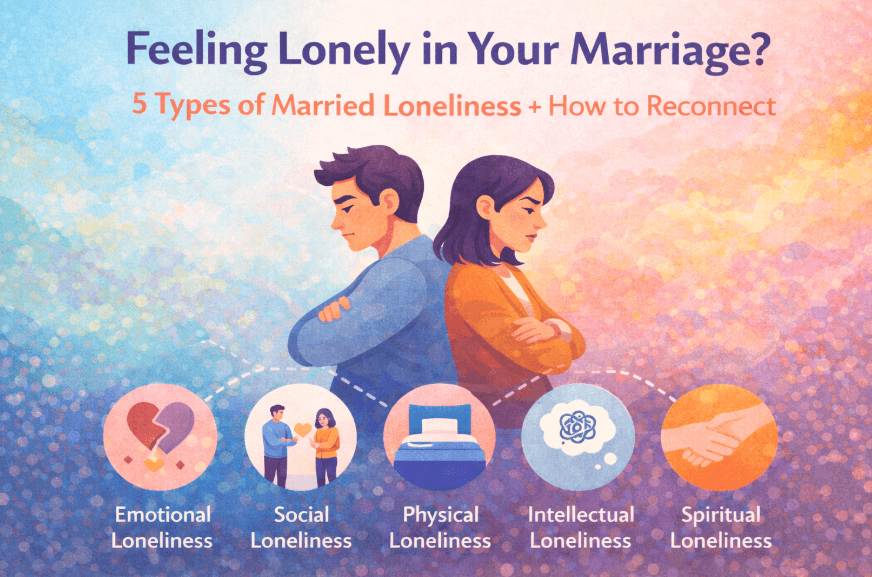
There is a special kind of pain that comes from feeling lonely in your marriage.
It is not the loneliness of being single. That loneliness makes sense. You can name it. You can explain it to friends who understand.
Married loneliness is different. You share a bed with someone every night. You eat dinner across from them. You build a life together. And yet somehow, you feel more alone than you ever did when you were actually alone.
This loneliness comes with confusion. And guilt. And a nagging question that keeps you up at night: Is it supposed to feel like this?
The answer is no. It is not supposed to feel like this. But you are also not broken, and neither is your marriage. What you are experiencing is incredibly common, surprisingly fixable, and says nothing about your worth as a partner or a person.
Let's talk about what is really going on and what you can do about it.
Feeling lonely in marriage is surprisingly common—research shows 20-60% of married people experience it. This type of loneliness is especially painful because it contradicts what marriage is supposed to provide: companionship, connection, and being truly known.
👇 Keep reading to identify your type of loneliness, understand what caused it, and learn exactly how to reconnect
Why Married Loneliness Hurts More Than Being Alone
Here is something that might validate what you have been feeling: Research shows that loneliness within marriage is often more painful than loneliness when you are single.
Why? Because of the gap between expectation and reality.
When you are single and lonely, your situation matches your expectation. You do not have a partner, so feeling alone makes sense.
But when you are married and lonely, there is a betrayal. Not necessarily by your partner, but by the promise of what marriage was supposed to be. You expected companionship. You expected to feel known. You expected your person to be there.
And when that expectation crashes into a reality where you feel invisible, unheard, or disconnected, it creates a pain that is hard to even put into words.
So if married loneliness feels worse to you than being single ever did, you are not imagining it. The research backs you up.
The 5 Types of Loneliness in Marriage
Not all marital loneliness is the same. Understanding which type you are experiencing helps you know what to do about it.
Type 1: Emotional Loneliness
This is the most common type. You feel emotionally disconnected from your partner. They do not know what is happening in your inner world, and you do not know what is happening in theirs.
What it sounds like:
"I could be going through something major and they would not even notice."
"We talk, but not about anything that matters."
"I do not feel like they really know me anymore."
What it feels like: Like being invisible. Like your feelings do not matter. Like you are carrying the weight of your emotional life alone.
Type 2: Physical Loneliness
Physical intimacy has faded or disappeared. And it is not just about sex. The casual touches, the hugs, the physical affection that used to happen naturally have all dried up.
What it sounds like:
"I cannot remember the last time we really touched each other."
"We sleep in the same bed but might as well be miles apart."
"I miss being held. I miss feeling wanted."
What it feels like: Touch-starved. Unwanted. Like your body is not enough.
Type 3: Intellectual Loneliness
You have stopped stimulating each other mentally. Conversations are surface-level at best. You no longer share ideas, debate topics, or learn from each other.
What it sounds like:
"We used to talk for hours. Now we barely talk at all."
"I have thoughts and ideas but no one to share them with."
"I feel like we have nothing in common anymore."
What it feels like: Bored. Understimulated. Like you are living with a roommate, not a partner.
Type 4: Social Loneliness
Your social lives have become completely separate. You have your friends, they have theirs. You rarely do things together with other people, and your worlds feel disconnected.
What it sounds like:
"They have their life and I have mine."
"I do not even know their friends anymore."
"We never go out together as a couple."
What it feels like: Like you are living parallel lives. Like your worlds only intersect at home, if at all.
Type 5: Existential Loneliness
This is the deepest type. You feel like your partner does not understand who you are at your core. Your values, your purpose, your sense of meaning in life feel unshared or even unknown by them.
What it sounds like:
"They do not understand what matters to me."
"I feel like I am on this journey alone."
"We want different things from life."
What it feels like: Profoundly alone. Misunderstood at the deepest level. Like you are strangers who happen to be married.
Self-Assessment: What Type of Loneliness Are You Experiencing?
Most people experience multiple types at once. Check all that apply to identify your specific pattern.
Check all that apply to your current experience:
3-5 total: Moderate loneliness—prioritize reconnection strategies
6+ total: Significant loneliness across multiple areas—consider couples therapy
Why You Feel Lonely in Your Marriage: The 9 Root Causes
Understanding why you feel lonely is the first step toward not feeling lonely anymore. Here are the most common causes:
Cause 1: Life Pushed You Apart
Kids. Careers. Aging parents. Financial stress. Health issues. The demands of life consumed all your energy, and the relationship got whatever scraps were left over.
This is probably the most common cause and also the most fixable. The love is still there. You just stopped feeding it.
Cause 2: You Stopped Sharing Your Inner World
At some point, you stopped telling them what you were really thinking and feeling. Maybe it felt pointless. Maybe you feared their reaction. Maybe you just got out of the habit.
But when you stop sharing, they stop knowing you. And when they stop knowing you, loneliness is inevitable.
Cause 3: Your Emotional Bids Go Unanswered
Researcher John Gottman discovered that couples make small bids for connection throughout the day. A comment about something you saw. A touch on the shoulder. A question about their day.
When those bids are consistently ignored or dismissed, you stop making them. And the connection dies.
Take our Emotional Bids Quiz to see how often your bids are being answered.
Cause 4: Unresolved Conflict Created Walls
When the same fights happen over and over without resolution, you eventually stop trying. You build walls to protect yourself from the disappointment and frustration.
Those walls keep out the pain. But they also keep out the connection.
Cause 5: You Have Different Attachment Styles
Your attachment style shapes how you connect in relationships. If you have different styles—one anxious, one avoidant, for example—you can end up in a painful dance where one pursues and the other withdraws.
This pursuer-withdrawer pattern creates loneliness for both partners, even though they are responding to it differently.
Cause 6: A Major Life Transition Disrupted Connection
Certain transitions are notorious for creating loneliness:
Job loss or career change
Moving to a new city
Empty nest
Retirement
Health crisis
Loss of a parent
These transitions change roles, routines, and identities. If you do not navigate them together, you can end up navigating them alone.
Cause 7: Individual Mental Health Struggles
Depression makes it hard to connect. Anxiety makes it hard to be present. Burnout leaves nothing for the relationship.
Sometimes the loneliness is not about the marriage. It is about what one or both partners are going through individually.
Cause 8: You Have Grown Apart
You are not the same people you were when you got married. And maybe you have grown in different directions.
Growing apart creates loneliness because you no longer feel known by someone who used to know you better than anyone.
Cause 9: Your Partner Does Not Know You Feel Lonely
This one might surprise you. Many partners have no idea their spouse feels lonely. They are going through life assuming everything is fine because no one has told them otherwise.
Your loneliness might be invisible to the one person who could help.
The Loneliness Spiral: How It Gets Worse If You Do Not Act
Loneliness in marriage does not stay static. Left unaddressed, it follows a predictable spiral:
Stage 1: Quiet Loneliness You feel disconnected but do not say anything. You hope it will pass. You tell yourself it is just a busy season.
Stage 2: Withdrawal You stop trying to connect as much. You protect yourself by expecting less. You start living more in your own world.
Stage 3: Resentment The loneliness hardens into resentment. You start keeping score. You notice everything they do wrong and nothing they do right.
Stage 4: Seeking Connection Elsewhere You start getting your emotional needs met outside the marriage. Friends. Work. Social media. Sometimes an emotional affair. This is not always intentional, but it happens when the marriage leaves you starving.
Stage 5: Contemplating Exit You start wondering if you would be happier alone. Or with someone else. The loneliness has become so painful that leaving seems like the only escape.
The good news: This spiral can be reversed at any stage. But the earlier you intervene, the easier it is.
How to Tell Your Partner You Are Lonely
One of the hardest parts of married loneliness is telling your partner about it. You might fear:
They will get defensive
They will feel attacked
They will dismiss your feelings
Nothing will change anyway
You will make things worse
These fears are understandable. But here is the truth: Your partner cannot fix what they do not know is broken.
The key is how you say it.
Use "I" statements and lead with vulnerability, not blame. Try one of these:
12 Ways to Reconnect When You Feel Lonely in Your Marriage
Knowing you need to reconnect is one thing. Knowing how is another. Here are specific, actionable strategies:
Strategy 1: Start With Daily Micro-Connections
You do not need grand gestures. You need consistent small ones.
A real hug when you wake up (at least 6 seconds)
One text during the day that is not about logistics
Eye contact when they talk to you
Asking one genuine question about their day
Saying "I love you" and meaning it
These tiny moments rebuild the foundation of connection over time.
Strategy 2: Create a Daily "How Are You Really?" Ritual
Set aside 10-15 minutes every day to check in on a deeper level. Not about schedules or tasks, but about how you are actually doing.
Take turns answering: "How are you really doing today?" And then listen. Really listen.
Strategy 3: Revive Physical Touch (Without Pressure)
If physical intimacy has faded, start with non-sexual touch. Hold hands. Sit close on the couch. Give shoulder rubs. Hug for no reason.
Physical touch releases oxytocin, which literally bonds you together. But start slow if it has been a while.
Strategy 4: Have a Weekly Marriage Meeting
Set aside 30-45 minutes each week to check in on the relationship itself. Share appreciations. Discuss what is working and what needs attention. Plan something fun together.
This creates a dedicated space for connection and keeps small issues from becoming big ones.
Strategy 5: Bring Back Date Nights (Real Ones)
Not dinner with the kids. Not watching TV in the same room. An actual date where you focus on each other.
It does not have to be expensive. A walk. A coffee shop. Cooking together after the kids are in bed. The activity matters less than the intention.
Strategy 6: Ask Questions You Have Never Asked
You might assume you know everything about your partner. But people change. Get curious again.
You may think you know everything about them. Ask anyway. People change.
- What's weighing on you most right now?
- What are you looking forward to?
- What do you need more of in your life?
- What makes you feel most alive?
- What do you wish I knew about you?
- When do you feel most connected to me?
- What do you miss about how we used to be?
- How can I make you feel more loved?
- What's one thing you wish we did more often?
- What's your favorite memory of us?
- What are you most proud of about yourself?
- What do you want our life to look like in 5 years?
- What scares you that you don't talk about?
- What do you need from me that you haven't asked for?
- What would make you happier in our marriage?
Strategy 7: Share Something You Have Been Holding Back
Loneliness often comes from hiding parts of yourself. Share something real. A fear. A dream. A struggle. Something that lets them see you.
Vulnerability creates connection. You cannot feel known if you are not willing to be seen.
Strategy 8: Respond to Their Bids for Connection
Start noticing when your partner reaches out, even in small ways. A comment. A question. A touch. And respond positively instead of brushing them off.
Gottman's research shows that couples who turn toward each other's bids 86% of the time stay together. Those who turn toward only 33% of the time divorce.
Strategy 9: Address Underlying Resentments
If there are old hurts poisoning the connection, they need to be processed. This might require difficult conversations or professional help, but you cannot build connection on top of unresolved pain.
Learning to communicate better and fight fairly can help you work through issues without making things worse.
Strategy 10: Create Shared Experiences
New experiences create new memories and new connection. Take a class together. Travel somewhere new. Start a project. Learn something as a team.
Shared experiences remind you that you are partners, not just cohabitants.
Strategy 11: Express Appreciation Daily
Loneliness often comes with feeling invisible or undervalued. Combat this by expressing specific appreciation every day.
Not "thanks for everything" but "I really appreciated that you made coffee this morning. It made me feel taken care of."
Strategy 12: Get Professional Help
Sometimes you need a third party to help you reconnect. A couples therapist can identify patterns you cannot see, facilitate conversations that keep derailing, and give you tools tailored to your specific situation.
This is not a sign of failure. It is a sign of commitment to your marriage.
Try to check off at least 5 of these each day:
What If Your Partner Does Not Know You Are Lonely?
Many spouses are shocked to learn their partner feels lonely. They had no idea. They thought everything was fine.
Before assuming your partner does not care, consider that they might genuinely not know.
Here is why this happens:
You have been hiding your loneliness to avoid conflict
You have been hoping they would notice without being told
They are distracted by their own stressors and struggles
Your communication styles are different
They interpret your behavior as contentment when it is actually withdrawal
If you have not explicitly told your partner you are lonely, that is your first step. Use the scripts above to start that conversation.
What If You Have Told Them and Nothing Changed?
This is harder. You have communicated your loneliness and your partner has not responded in a meaningful way.
First, consider how you communicated. Was it in a moment of frustration? Did it come across as blame? Was it clear enough?
Sometimes the message does not land the first time. Or the second. People need repetition to really hear something that challenges their perception.
But if you have communicated clearly, multiple times, and your partner is unwilling to engage, you have a bigger problem than loneliness. You have a partner who is not invested in meeting your needs.
At that point, couples therapy becomes not optional but necessary. A skilled therapist can sometimes reach a resistant partner in ways you cannot.
And if your partner refuses therapy and refuses to change after you have made clear this is affecting you deeply, you may need to make some hard decisions about your future.
- They may be protecting themselves from more disappointment
- They may feel hopeless that things can change
- They may not realize how serious the situation is
- They may be dealing with their own individual struggles
- They may need to see YOU making changes first
- Focus on yourself first — Start making changes in your own behavior. Be warmer. Be more present. Sometimes one partner changing shifts the whole dynamic.
- Be direct and specific — Not "we need to work on things" but "I am worried about our marriage. I feel lonely, and I need this to change."
- Give it time, but not forever — They may need to see you're serious. But if nothing changes after genuine effort, you may need to make difficult decisions.
- Get individual support — Even if they won't go to couples therapy, you can benefit from individual therapy as you navigate this.
When Married Loneliness Becomes Dangerous
Loneliness in marriage is painful. But sometimes it crosses into territory that requires immediate attention.
Married loneliness can cross into territory that requires immediate attention. Take these seriously:
If you are experiencing any of these warning signs, please reach out for help. Talk to a therapist, a doctor, a trusted friend, or a crisis line if needed. Your wellbeing matters, and you deserve support.
How Long Does It Take to Feel Less Lonely?
If both partners are engaged and putting in effort, most people start feeling less lonely within a few weeks. Real, sustained change typically takes 2-3 months of consistent effort.
When to See a Couples Therapist
You do not have to be in crisis to benefit from couples therapy. In fact, the earlier you get help, the better.
Consider therapy if:
You have tried to reconnect on your own without lasting change
The same issues keep coming up
Conversations about your loneliness turn into fights
One or both of you feels hopeless
There are underlying issues (resentment, past hurts, communication patterns) you cannot resolve alone
You want professional guidance to reconnect more effectively
Our couples therapists at South Denver Therapy specialize in helping couples rebuild connection. We also offer couples counseling intensives for those who want accelerated progress.
FAQ: Loneliness in Marriage
Frequently Asked Questions
Is it normal to feel lonely in a marriage?
Yes, feeling lonely in marriage is surprisingly common. Research shows anywhere from 20-60% of married people experience it at some point. Loneliness does not mean your marriage is failing or that you chose wrong. It means your connection needs attention. The couples who stay together are not the ones who never feel lonely—they are the ones who recognize it and take action to reconnect.
Why do I feel lonely when my spouse is right there?
Physical presence does not equal emotional connection. You can share a bed, eat meals together, and live in the same house while still feeling emotionally disconnected. Loneliness in marriage comes from not feeling known, seen, or understood by your partner—regardless of physical proximity. This usually happens gradually as life gets busy and emotional intimacy fades.
How do I tell my spouse I feel lonely without hurting them?
Lead with vulnerability, not blame. Use "I" statements like "I have been feeling lonely and disconnected" rather than "You never pay attention to me." Express your loneliness as something you are experiencing, not something they caused. Frame it as wanting to reconnect, not as criticism of them. Saying "I miss you" or "I miss feeling close to you" is often received better than "You make me feel lonely."
Can a marriage survive if one person feels lonely?
Absolutely. In fact, most marriages go through periods where one or both partners feel lonely. The marriage survives—and often becomes stronger—when the loneliness is acknowledged and both partners commit to reconnecting. What damages marriages is unaddressed loneliness that festers into resentment, withdrawal, or seeking connection elsewhere. Early intervention leads to better outcomes.
How long does it take to stop feeling lonely in marriage?
With consistent effort from both partners, most people start feeling less lonely within 2-4 weeks. More significant, lasting change typically takes 2-3 months of daily connection practices. The timeline varies based on how long the loneliness has been building, what caused it, and whether there are underlying issues to address. Couples therapy can accelerate the process.
When should I see a therapist about feeling lonely in my marriage?
Consider couples therapy if: you have tried to reconnect on your own without lasting change, conversations about your loneliness turn into fights, you are experiencing depression or anxiety symptoms, your partner is resistant to engaging, or you have been feeling lonely for more than a few months. You do not have to be in crisis to benefit from therapy—earlier intervention typically leads to faster results.
You Deserve to Feel Connected
Let me leave you with this:
Feeling lonely in your marriage is painful. But it is not permanent. And it is not a sign that you chose wrong or that your marriage is broken.
It is a signal. A message that something needs to change. And that change is possible.
Millions of couples have felt exactly what you are feeling right now. And millions of them have found their way back to connection. Not by luck, but by intention. By showing up differently. By doing the work.
You can be one of those couples.
You deserve to feel seen in your marriage. Heard. Known. Valued. You deserve to feel like you have a partner, not just a roommate.
And with the right approach, that is exactly what you can have.
The loneliness you feel right now does not have to be your forever. Start with one conversation. One small change. One moment of genuine connection.
And build from there.
Our couples therapists in Castle Rock help partners who feel disconnected find their way back to each other. If you're tired of feeling alone in your marriage, we can help.
Serving Castle Rock, Parker, Highlands Ranch, Littleton, and the greater South Denver area.
In-person and telehealth appointments available.

Kayla is a Licensed Marriage and Family Therapist and the founder of South Denver Therapy. She specializes in helping couples reconnect after growing apart, heal from infidelity, and build stronger relationships. With over a decade of experience, she has helped hundreds of couples in Castle Rock and the South Denver area find their way back to each other.
Related Articles
This article is part of our emotional connection series:
Feeling Disconnected From Your Partner? The 8 Real Reasons Why - Identify what is causing your disconnection and get a reconnection roadmap.
Growing Apart in Marriage: How to Reconnect When You've Drifted - The 5 stages of growing apart and how to grow back together.
Building Emotional Intimacy: 18 Ways to Deepen Your Connection - Therapist-approved strategies for real closeness.
Emotional Distance After Baby: How to Reconnect With Your Partner - Navigate parenthood without losing your marriage.
For more connection tools, take our Relationship Health Quiz or download our free Couples Intimacy and Bonding Exercise Guide.