Feeling Disconnected From Your Partner? Here's What's Really Happening
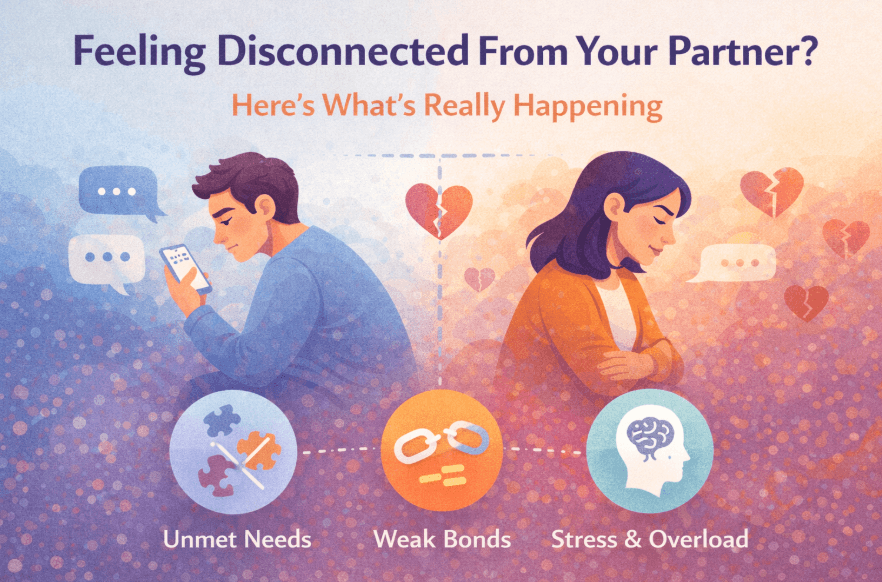
Feeling disconnected from your partner means you feel emotionally distant even when physically together. It is one of the most common relationship experiences and usually signals that something needs attention—not that your relationship is broken.
👇 Keep reading to identify YOUR type of disconnection and get a personalized reconnection roadmap
You are sitting right next to them. Maybe on the same couch you have shared for years. But it feels like there is an invisible wall between you.
You are not fighting. You are not even unhappy, exactly. You are just... not connected. Like roommates who happen to share a bed.
If this sounds familiar, you are not imagining things. And you are definitely not alone.
Feeling disconnected from your partner is one of the most common experiences in long-term relationships. Research suggests that most couples go through periods of disconnection multiple times throughout their relationship. The difference between couples who thrive and those who drift apart is not whether they experience disconnection. It is what they do about it.
This article will help you understand what is really happening when you feel disconnected, identify the specific type of disconnection you are experiencing, and give you a clear path back to each other.
What Does Feeling Disconnected Actually Feel Like?
Before we dig into the causes, let's name what disconnection actually looks like. Because sometimes we feel it before we can describe it.
You might feel disconnected if:
You share the same space but feel alone. You could be cooking dinner together, watching TV together, even lying in bed together, but there is no sense of togetherness. Just two people occupying the same room.
Conversations stay on the surface. You talk about the kids' schedules, what to have for dinner, who is picking up the dry cleaning. But you cannot remember the last time you talked about anything that actually mattered. Your inner worlds have become private.
You have stopped reaching for each other. When something good happens, you do not think to tell them first. When something bad happens, you handle it alone. The instinct to share has faded.
Physical touch has decreased or feels hollow. Maybe you still hug goodbye, but it is mechanical. The lingering touches, the spontaneous affection, the desire to be close, it has quietly disappeared.
You feel like strangers who know each other's routines. You could predict exactly what they will do on a Saturday morning. But you could not tell me what they are worried about, excited about, or dreaming about right now.
You miss them even when they are right there. This is the most painful sign. The loneliness of feeling disconnected from someone you love can be worse than being actually alone.
If you recognized yourself in any of these descriptions, keep reading. What you are feeling has a name, a cause, and most importantly, a solution.
The 8 Hidden Reasons Couples Feel Disconnected
Here is what most articles about disconnection get wrong: they treat all disconnection the same. But there are actually distinct reasons couples drift apart, and each one requires a different approach.
Understanding your specific type of disconnection is the first step to fixing it.
Reason 1: Life Got in the Way
This is the most common and most fixable type of disconnection. Nothing is actually wrong with your relationship. Life just got busy.
Work demands increased. Kids came along. Aging parents needed care. Financial stress piled up. Slowly, without either of you noticing, the relationship moved from the center of your life to the edge.
You did not choose to disconnect. You just stopped having time and energy to connect. The relationship got put on autopilot while you handled everything else.
Signs this is your situation:
You still love each other and generally get along
You cannot remember the last time you had uninterrupted time together
When you do connect, it still feels good
You both feel exhausted and stretched thin
The disconnection crept up gradually rather than starting after a specific event
What helps: Intentional time together. It really can be that straightforward. Couples in this category often reconnect quickly once they prioritize the relationship again. Schedule weekly date nights, protect morning coffee time together, put your phones away after dinner. Small consistent efforts compound.
For practical strategies, see our guide to building emotional intimacy.
Reason 2: Unresolved Conflict is Creating Distance
Sometimes disconnection is not about neglect. It is about protection.
When couples have the same argument over and over without resolution, they eventually stop having it. Not because the issue is resolved, but because it is too painful to keep fighting about. So they create distance instead.
The issue is still there, sitting between them like an elephant in the room. They just stop talking about it. And then they stop talking about other things too. The emotional walls built to protect against conflict start blocking connection entirely.
Signs this is your situation:
There are topics you both avoid
You can feel tension under the surface even when things seem calm
Small disagreements escalate quickly or get shut down immediately
You or your partner have become defensive, critical, or withdrawn
The disconnection started after a specific conflict or series of conflicts
What helps: Learning to fight differently. The goal is not to eliminate conflict but to make it safe enough that you can work through issues instead of around them. Our guide on fair fighting rules for couples can help. If the Four Horsemen (criticism, contempt, defensiveness, stonewalling) have taken hold, addressing those patterns is the priority.
Reason 3: You Have Fallen Into the Pursuer-Withdrawer Trap
This is one of the most common relationship patterns, and it creates disconnection that feels impossible to break.
One partner (the pursuer) wants more closeness. They reach out, try to talk, ask for more connection. The other partner (the withdrawer) feels overwhelmed by these attempts and pulls back to get space.
The more the pursuer pursues, the more the withdrawer withdraws. The more the withdrawer withdraws, the more the pursuer pursues. Both partners end up feeling disconnected, frustrated, and misunderstood.
Signs this is your situation:
One of you wants to talk about the relationship more than the other
One of you tends to need space during conflict while the other wants to resolve things immediately
You feel like you are always reaching and they are always retreating (or vice versa)
Arguments often end with one person shutting down or walking away
You have had the "you never want to talk" / "you are always criticizing" argument
What helps: Understanding the pattern and meeting in the middle. Pursuers need to give more space; withdrawers need to engage more. Neither partner is wrong. You just have different needs that have become polarized. Read our full article on the pursuer-withdrawer pattern for specific strategies.
Reaches out repeatedly
Feels rejected and frustrated
May become critical
distance
Needs space to process
Pulls back for relief
May shut down entirely
Reason 4: Emotional Bids Are Being Missed
Dr. John Gottman's research identified something he calls "bids for connection." These are the small moments throughout the day when one partner reaches out for attention, affection, or engagement.
A bid might be obvious: "Can we talk?" Or subtle: a sigh, a comment about something they read, pointing out something outside the window.
When bids are consistently missed or rejected, disconnection grows. The partner making bids eventually stops trying. The other partner may not even realize bids were being made.
Signs this is your situation:
One or both of you often feels ignored or unimportant
Small moments of potential connection get overlooked
One partner has gradually become quieter or more withdrawn
You feel like you are talking but not being heard
Phones, TV, or other distractions often interrupt moments together
What helps: Learning to recognize and respond to bids. Couples who turn toward each other's bids 86% of the time stay together. Couples who only turn toward 33% of the time do not. Take our Emotional Bids Quiz to see how well you are responding to your partner's connection attempts.
Reason 5: You Have Grown Into Different People
People change. Interests evolve. Values shift. The person you married at 25 is not the same person at 40, and neither are you.
Sometimes couples grow together, their individual changes complementing each other. Other times, they grow in different directions. When this happens, the connection that once felt effortless now feels forced or foreign.
Signs this is your situation:
You have different interests, friend groups, or hobbies than you used to share
Conversations about the future reveal different visions
You feel like you do not really know who your partner has become
The things that used to bond you no longer feel relevant
You have grown, but in different directions
What helps: Curiosity and intentional rediscovery. Instead of mourning who your partner used to be, get curious about who they are now. Ask questions. Learn about their current interests. Find new shared experiences. For more on this, see our article on growing apart in marriage.
Reason 6: A Major Life Transition Created a Rift
Certain life events are notorious for creating disconnection between partners:
Having a baby (this is so common we wrote a whole article on emotional distance after baby)
Job loss or career changes
Moving to a new city
Health crises
Death of a loved one
Kids leaving home
Retirement
These transitions change everything: routines, roles, identities, even the foundation of what your relationship was built on. Couples who were rock-solid can suddenly feel like strangers.
Signs this is your situation:
The disconnection started around a specific life change
You are both stressed and depleted
Your roles in the relationship have shifted
You are grieving something (even if you have not named it)
You feel like you are dealing with the transition separately rather than together
What helps: Acknowledging the transition and its impact on both of you. Talk about how things have changed. Grieve what you have lost. Create new rituals and routines that fit your current reality. Get support, individual and couples, during major transitions.
Reason 7: There Is an Attachment Wound at Play
Our early experiences with caregivers shape how we connect in adult relationships. If you or your partner has an insecure attachment style (anxious, avoidant, or disorganized), disconnection can be a recurring pattern.
Partners with anxious attachment often feel disconnected because they need more reassurance than their partner naturally gives. Partners with avoidant attachment often create disconnection because closeness feels threatening. When an anxious partner pairs with an avoidant partner, the pursuer-withdrawer dynamic intensifies.
Signs this is your situation:
Disconnection is a recurring pattern, not a new problem
One or both of you had difficult or inconsistent caregiving as children
Intimacy feels scary, suffocating, or unsafe
You or your partner has walls up that never fully come down
Previous relationships have ended due to similar issues
What helps: Understanding your attachment styles and working with them instead of against them. Take our Attachment Style Quiz to identify your patterns. For deeper attachment wounds, working with a therapist who specializes in attachment can be transformative.
Reason 8: Depression, Anxiety, or Another Individual Issue
Sometimes what looks like relationship disconnection is actually one partner struggling individually.
Depression makes it hard to feel anything, including love and connection. Anxiety makes it hard to be present. Burnout leaves nothing for the relationship. Unprocessed trauma can create emotional walls.
If one partner is struggling, the relationship struggles too, even if the relationship itself is not the problem.
Signs this is your situation:
One partner seems emotionally flat, withdrawn, or unlike themselves
The disconnection started when other symptoms appeared (sleep changes, appetite changes, loss of interest in activities)
One partner is going through something difficult that is consuming their emotional energy
You have a good relationship history but something has shifted in one person
Individual struggles are spilling into the relationship
What helps: Addressing the individual issue directly. This might mean therapy, medication, lifestyle changes, or all three. Sometimes the most loving thing you can do for your relationship is take care of yourself. Supporting a partner through mental health challenges is also its own skill.
Which Type of Disconnection Do You Have?
Check the statements that resonate most with your situation:
Most checks in Group B? Address unresolved conflicts with fair fighting skills.
Most checks in Group C? Work on communication patterns and emotional bids.
Most checks in Group D? Get curious about who your partner is becoming.
Why Couples Stay Disconnected (The Avoidance Trap)
Understanding why you are disconnected is half the battle. But here is where many couples get stuck: they recognize the problem but do not address it.
Why?
It feels easier to avoid. Talking about disconnection means admitting something is wrong. It means vulnerability. It means potentially hearing things you do not want to hear. Avoidance feels safer in the short term.
You are waiting for it to fix itself. Many couples hope that if they just wait long enough, things will go back to normal. Sometimes they do. More often, disconnection deepens when ignored.
You do not know what to say. How do you even start that conversation? The words feel clumsy, the timing never seems right, and the fear of making things worse keeps you silent.
You are afraid of what you might find. What if the conversation reveals that your partner is unhappy? What if they do not want to reconnect? Sometimes not knowing feels safer than knowing.
You have tried before and it did not work. Maybe you have had the "we need to reconnect" conversation before. Maybe it helped temporarily but things slid back. It is discouraging to try again.
Here is the truth: avoiding disconnection does not make it go away. It makes it worse. The longer couples wait to address distance, the harder it becomes to bridge.
The Reconnection Roadmap: How to Find Your Way Back
If you are ready to address the disconnection, here is a step-by-step path forward.
Step 1: Name What Is Happening
The first step is simply acknowledging the disconnection out loud, to yourself and to your partner.
This does not have to be a heavy conversation. Try: "Hey, I have been feeling like we are not as connected lately. Have you noticed that too?"
Most partners will feel relieved that you named it. They have probably been feeling it too.
Use one of these scripts to break the silence about feeling disconnected:
Step 2: Identify the Root Cause Together
Using the 8 reasons above, try to identify what is driving your specific disconnection. Is it busyness? Unresolved conflict? A life transition? Attachment patterns?
You might have different perspectives on the cause, and that is okay. The goal is to get curious together rather than blame each other.
Step 3: Make a Small, Specific Commitment
Do not try to fix everything at once. Pick one small thing you can both commit to.
Examples:
"Let's have phones-away dinner three times this week."
"Let's do a 10-minute check-in before bed each night."
"Let's have a date night this Saturday, just us."
"Let's read that reconnection article together and try one thing from it."
Small wins build momentum. Big commitments often fail.
Step 4: Address the Underlying Issue
Depending on what you identified in Step 2, this might mean:
Scheduling regular connection time (if life got in the way)
Learning new conflict skills (if unresolved issues are the problem)
Working on your communication patterns (if pursuer-withdrawer or missed bids)
Exploring who you have each become (if you have grown apart)
Getting individual support (if mental health is a factor)
Processing a life transition together
Our guide on how to communicate better in relationships covers many of these skills.
Step 5: Be Patient and Persistent
Reconnection takes time. You did not drift apart overnight, and you will not reconnect overnight either.
Expect setbacks. Expect awkwardness. Expect moments when it feels forced or strange. That is normal. Keep showing up anyway.
Research suggests that couples who consistently invest in their relationship, even small investments, see improvement within 4-6 weeks. But deep reconnection often takes longer.
Step 6: Get Support If You Need It
If you have tried to reconnect on your own and it is not working, that is not failure. That is information. Some disconnection needs professional support to resolve.
A couples therapist can help you:
See patterns you cannot see yourselves
Create safety for vulnerable conversations
Learn skills specific to your situation
Address deeper issues like attachment or trauma
Rebuild connection with guidance
Learn more about our couples counseling services or consider a couples counseling intensive for accelerated progress.
Is This Normal or a Red Flag?
Not all disconnection is created equal. Some is a normal part of long-term relationships. Some signals deeper problems.
- Disconnection comes and goes
- You can identify the cause (stress, busyness)
- You still feel love underneath the distance
- Both partners want to reconnect
- Effort leads to improvement
- Physical affection still feels comfortable
- You can still have fun together
- Disconnection is constant and deepening
- One or both partners seem indifferent
- Contempt has replaced frustration
- One partner refuses to work on it
- Repeated efforts have not helped
- You feel relief when they are not around
- You are fantasizing about leaving
When Disconnection Needs Professional Help
Check any that apply to your situation:
Frequently Asked Questions About Feeling Disconnected
Is it normal to feel disconnected from your partner?
Yes, feeling disconnected from your partner is completely normal and happens in virtually every long-term relationship. Research suggests that 80% of couples experience periods of emotional distance at some point. The key factor is not whether you experience disconnection, but how you respond to it. Couples who acknowledge the distance and actively work to reconnect typically come through these periods with stronger relationships. Disconnection only becomes problematic when it is ignored, denied, or allowed to deepen over time without intervention.
Why do I feel distant from my partner for no reason?
When disconnection seems to have "no reason," there is usually an underlying cause that is not immediately obvious. Common hidden causes include: gradual life busyness that slowly pushed the relationship aside, small bids for connection that were repeatedly missed, unspoken resentments that accumulated over time, or a subtle shift in how you spend your time and energy. Sometimes individual factors like stress, depression, or burnout can create distance without either partner realizing the connection. Taking our attachment style quiz or reviewing the 8 reasons in this article can help identify what might be happening beneath the surface.
How long does it take to reconnect with your partner?
With consistent effort from both partners, most couples begin to see meaningful improvement within 4-6 weeks. The first 1-2 weeks often feel awkward as you rebuild habits of connection. By weeks 3-4, you typically start noticing small wins—moments where connection feels natural again. Deeper reconnection usually takes 2-3 months of sustained effort. However, this timeline varies based on how long the disconnection lasted, what caused it, and whether there are deeper issues (like unresolved conflicts or attachment wounds) that need to be addressed. If you are not seeing progress after 6-8 weeks of genuine effort, couples therapy can help identify what is getting in the way.
What should I do if my partner does not want to reconnect?
If your partner seems unwilling to work on reconnecting, first try to understand why. Are they overwhelmed, defensive, or hopeless? Sometimes what looks like unwillingness is actually fear or exhaustion. Try approaching the conversation differently—lead with vulnerability rather than criticism. If they are truly unwilling after multiple attempts, you may need to consider individual therapy to process your feelings and decide on next steps. Sometimes one partner starting therapy creates enough change to shift the dynamic. In some cases, clearly stating "I need us to work on this, and I would like to try couples therapy" can be the wake-up call that gets a reluctant partner to engage.
Can a relationship survive feeling disconnected?
Absolutely. Most strong, long-lasting relationships have weathered periods of disconnection. What matters is how couples respond to the distance. Relationships survive and even thrive after disconnection when both partners acknowledge the problem, commit to reconnecting, learn new skills for maintaining closeness, and address any underlying issues. The couples who struggle are those who ignore disconnection, blame each other without taking responsibility, or give up before giving reconnection a real chance. If you are reading this article and looking for solutions, you are already taking a positive step toward reconnection.
When should we see a couples therapist for disconnection?
Consider couples therapy if: you have tried to reconnect on your own without success, the same patterns keep repeating, one or both of you feels hopeless, there are deeper issues like infidelity or major trust breaks, communication has become hostile or has shut down entirely, or you are considering separation. You do not have to be in crisis to benefit from therapy—many couples seek help during disconnection to prevent things from getting worse and to learn skills they can use for the rest of their relationship. Early intervention typically leads to faster, more lasting results.
You Are Closer Than You Think
Here is something that might surprise you: the fact that you are reading this article is a good sign.
It means you have noticed the disconnection. It means you care enough to look for answers. It means you have not given up.
Many couples who feel disconnected assume the relationship is broken. But disconnection is not the same as broken. It is a signal that something needs attention. And the couples who respond to that signal, who choose to turn toward each other instead of away, often come out stronger than before.
Your partner is still there. The connection is still possible. Sometimes it just takes one person reaching out to start the journey back.
Our couples therapists in Castle Rock specialize in helping partners find their way back to each other. Whether you need new skills, a safe space to talk, or help addressing deeper issues, we are here.
Serving Castle Rock, Parker, Highlands Ranch, Littleton, and the greater South Denver area.
In-person and telehealth sessions available.
Related Articles in This Series
This article is part of our emotional connection series. Continue reading with these related guides:
Building Emotional Intimacy: 18 Ways to Deepen Your Connection - Therapist-approved strategies to create the closeness you are craving.
Growing Apart in Marriage: Signs, Causes, and How to Reconnect - What to do when you and your partner have drifted in different directions.
Feeling Lonely in Your Marriage? You Are Not Alone - Why married loneliness happens and how to find your way back to each other.
Emotional Distance After Baby: How to Reconnect With Your Partner - Navigate the relationship challenges that come with new parenthood.
For practical tools to reconnect, download our free Couples Intimacy and Bonding Exercise Guide or explore our full library of free therapy resources.

Kayla is a Licensed Marriage and Family Therapist and the lead couples therapist at South Denver Therapy. She specializes in helping couples rebuild connection, improve communication, and navigate relationship challenges. Kayla has been recognized as one of the Best Therapists in Castle Rock for 2024 and 2025.