Marriage Statistics 2026: Divorce Rates, Age Trends & Key Facts
Are half of all marriages really doomed to fail? That's what we've all heard. But the actual numbers tell a different story—one that's more hopeful than you might expect.
The U.S. divorce rate has dropped to its lowest point in over 50 years. At the same time, Americans are waiting longer to get married than ever before in recorded history. These shifts are reshaping what marriage looks like in 2026.
Whether you're engaged, newly married, or working through relationship problems, understanding these statistics can help you build a stronger partnership. Here's what the latest research actually shows.
Key Marriage & Divorce Statistics for 2026
📊 2026 Marriage Statistics at a Glance
Sources: CDC National Center for Health Statistics, U.S. Census Bureau, BGSU National Center for Family & Marriage Research (2024-2025)
Let's break down what these numbers actually mean for couples today.
Current U.S. Divorce Rate: The Real Numbers
The often-quoted "50% of marriages end in divorce" statistic is outdated and misleading. Here's what the data actually shows:
The refined divorce rate (divorces per 1,000 married women aged 15+) dropped to 14.2 in 2024, down slightly from 14.4 in 2023, according to the National Center for Family & Marriage Research at Bowling Green State University.
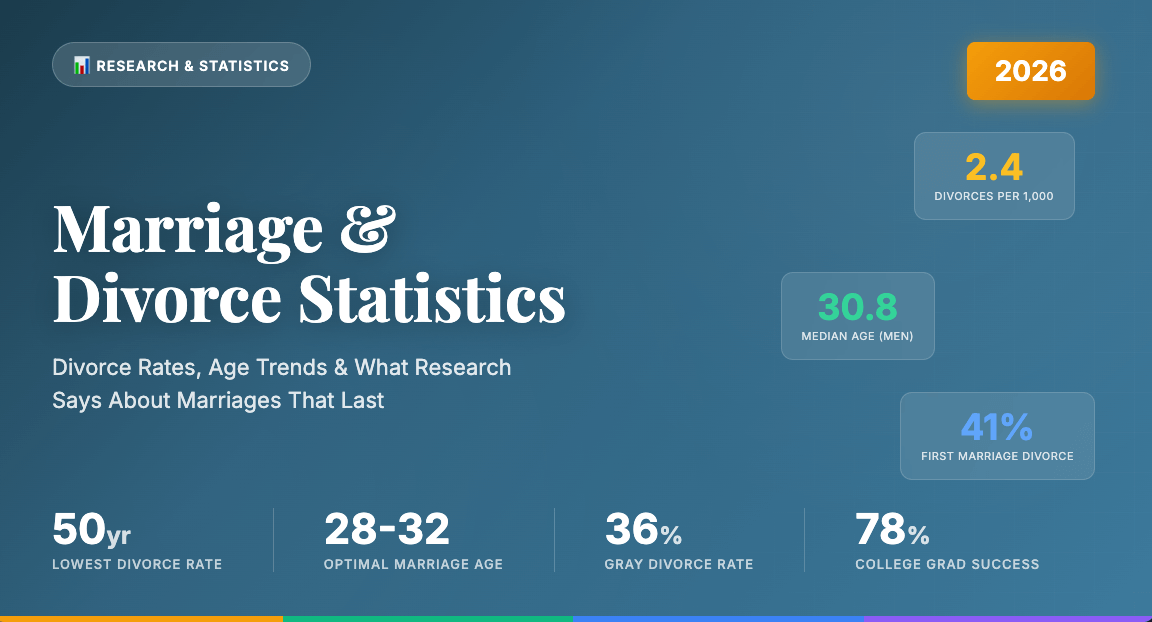
The crude divorce rate (divorces per 1,000 total population) sits at approximately 2.4 per 1,000 people as of 2024—the lowest rate since the early 1970s, according to CDC data.
Nearly 987,000 women divorced in 2024. While that sounds like a lot, it represents a steady decline from historical highs. The divorce rate peaked at 22.6 per 1,000 married women in 1980 and has fallen by more than 37% since then.
Why Has the Divorce Rate Dropped?
Several factors explain the declining divorce rate:
People are marrying later – Older couples tend to have more stable marriages
More selective marriage – Couples who do marry are more committed
Fewer marriages overall – Some at-risk relationships never reach the altar
Economic factors – Financial stability correlates with marital stability
Better relationship communication skills – More resources for couples exist today
If you're seeing warning signs your marriage is in trouble, the good news is that couples who address problems early have better outcomes than ever.

"The couples I see who beat the statistics have one thing in common: they don't wait until they're in crisis to get help. They notice when something feels off—less connection, more irritability, avoiding hard conversations—and they address it before resentment builds. The divorce rate is dropping partly because more couples are treating their relationship like something worth investing in, not something that should just work on autopilot."
Divorce Rates by State: Where Marriage Is Strongest (and Weakest)
Divorce rates vary dramatically across the United States. Geographic location, cultural norms, economic conditions, and state laws all play a role.
🗺️ State Divorce Rates 2024 (per 1,000 married women aged 15+)
Highest Divorce Rates
Lowest Divorce Rates
Source: NCFMR analysis of American Community Survey 1-year estimates, 2024
Regional patterns:
Southern states have the highest divorce rates—76% of Southern states fall in the top two quartiles
Northeastern states like Massachusetts, New Jersey, and New York consistently show lower divorce rates
Western states are mixed, with Nevada highest and Montana among the lowest
What explains these differences? States with younger average ages at first marriage, lower educational attainment, and different cultural attitudes toward divorce tend to have higher rates. States where couples marry later and have higher education levels tend to have lower rates.
For Colorado residents dealing with marriage problems, our state falls in the middle range. Couples therapy in Castle Rock and surrounding areas can help address issues before they lead to separation.
Age at First Marriage: Americans Are Waiting Longer Than Ever
Americans are getting married later than at any point in recorded history. The U.S. Census Bureau reports that the median age at first marriage has reached:
Men: 30.8 years old (up from 23.5 in 1975)
Women: 28.4 years old (up from 21.1 in 1975)
This represents a shift of 7+ years for both genders over the past 50 years.
📈 How Marriage Age Has Changed
Source: U.S. Census Bureau, Current Population Survey
Why Are People Waiting Longer to Marry?
Research points to several factors:
Educational attainment – More people are completing college and graduate degrees before marriage
Career focus – Both men and women prioritize career establishment
Financial preparation – Rising costs of living make couples wait until financially stable
Changing social norms – Less pressure to marry young
Cohabitation – Many couples live together before (or instead of) marriage
Does Marrying Later Actually Help?
Yes. According to the Bureau of Labor Statistics, couples who marry before age 18 have a 48% divorce rate within 10 years. Those who wait until after age 25 have only a 25% divorce rate in the same timeframe.
The sweet spot appears to be ages 28-32—couples who marry in this range have the lowest divorce risk.
If you're engaged and want to start strong, premarital counseling in Castle Rock helps couples discuss finances, expectations, and communication styles before walking down the aisle. Research shows couples who complete premarital education have a 30% lower divorce rate.
Second and Third Marriage Divorce Rates
If you've been married before, the statistics on remarriage might surprise you. Despite the common assumption that experience leads to better outcomes, subsequent marriages actually have higher divorce rates.
💔 Divorce Rates by Marriage Order
Sources: American Psychological Association, U.S. Census Bureau
Why Do Second Marriages Fail More Often?
Research from Psychology Today identifies several factors:
Unresolved issues from first marriage – Emotional baggage, trust issues, and unresolved conflicts carry forward
Blended family challenges – Stepchildren, loyalty conflicts, and parenting disputes create stress
Financial complications – Child support, alimony, and competing financial obligations
Rebounding too quickly – Entering a new relationship before processing the previous divorce
Repeating patterns – Without self-reflection, people often choose similar partners
The good news? Couples aware of these risks can take proactive steps. Couples therapy exercises can help partners communicate more effectively and address issues before they become dealbreakers.
Remarriage Statistics
According to the National Center for Family & Marriage Research:
About 70% of divorced individuals eventually remarry
Men remarry faster and at higher rates (35.1 per 1,000) than women (19.4 per 1,000)
The median time between divorce and remarriage is 3.7 years
Remarriage rates have dropped nearly 50% since 1990
"Second marriages often fail for the same reasons the first one did—not because people are bad at marriage, but because they never unpacked what went wrong. If you don't understand your own patterns, your attachment style, and how you show up in conflict, you'll repeat those patterns with a new partner. The good news? These patterns can absolutely be changed with awareness and intention."
Gray Divorce: The Rise of Late-Life Divorce
One of the most significant shifts in American marriage patterns is the dramatic rise in "gray divorce"—divorce among adults aged 50 and older.
While overall divorce rates have declined, gray divorce has doubled since the 1990s. Today, approximately 36% of all divorces involve people over 50, according to research from Bowling Green State University.
👴👵 Gray Divorce by the Numbers
Source: NCFMR, Pew Research Center, American Community Survey 2022-2024
Why Is Gray Divorce Increasing?
Several factors drive this trend:
Longer life expectancy – People facing 20-30 more years are less willing to stay in unhappy marriages
Women's financial independence – More women have careers and retirement savings
Reduced social stigma – Divorce is more accepted than in previous generations
Empty nest syndrome – Children leaving home reveals underlying relationship issues
Growing apart – Decades of focusing on careers and kids can lead to emotional disconnection
Financial Impact of Gray Divorce
Gray divorce carries unique financial consequences. According to the National Library of Medicine:
Women 50+ experience a 45% decline in standard of living after divorce
Men experience a 21% decline in standard of living
Dividing retirement accounts, pensions, and Social Security benefits is complex
Healthcare coverage becomes a significant concern before Medicare eligibility
If you're in a long-term marriage experiencing difficulties, addressing signs of an unhappy marriage early can help couples either repair the relationship or make informed decisions about their future.
Top Reasons for Divorce in 2026
Understanding why marriages fail can help couples avoid common pitfalls. According to multiple studies including research from the National Fatherhood Initiative and the Institute for Family Studies, these are the leading causes of divorce:
🔍 Top 10 Reasons for Divorce
Sources: National Fatherhood Initiative, Institute for Family Studies, PMC Research
Who Files for Divorce More Often?
Women initiate approximately two-thirds (66%) of all divorces in the United States. Research suggests women may be more likely to file when they feel:
Unequal division of household responsibilities
Lack of emotional support
Communication has broken down
Their emotional needs aren't being met
Understanding the four horsemen of relationship apocalypse—criticism, contempt, defensiveness, and stonewalling—can help couples recognize destructive patterns before they lead to divorce.
Education and Divorce: The Diploma Divide
Education level is one of the strongest predictors of marital stability. The data shows a clear pattern: more education correlates with lower divorce risk.
🎓 Divorce Rates by Education Level
Source: Bureau of Labor Statistics, National Survey of Family Growth
College-educated women who married between 2006-2010 have a 78% chance their marriage will last 20+ years, according to Bureau of Labor Statistics data.
Why Does Education Matter?
Later marriage age – College graduates marry about 3.7 years later on average
Financial stability – Higher earning potential reduces money-related stress
Better communication skills – Education often improves conflict resolution abilities
More resources – Access to counseling, relationship education, and support networks
Other Factors That Affect Divorce Risk
Cohabitation Before Marriage
Couples who live together before getting engaged have a 39-40% higher chance of divorce compared to those who don't cohabit before marriage, according to the Institute for Family Studies.
However, research suggests this effect may be weaker when:
Couples have clear intentions about marriage before moving in
Both partners are committed and view cohabitation as a step toward marriage
The couple has discussed long-term goals and expectations
Religious Attendance
Religious involvement appears to provide some protective effect:
Regular religious service attendance is associated with 14% lower divorce risk
Those with no religious affiliation have 14% higher divorce risk
Shared religious values can provide common ground and community support
Age at Marriage
The age you marry significantly impacts divorce risk:
⏰ Divorce Risk by Age at Marriage
The "sweet spot" for marriage appears to be the late 20s to early 30s. Marrying before 25 carries higher risk, but waiting too long (past mid-30s) also shows slightly elevated divorce rates, possibly due to more established individual habits that are harder to merge.
If you're considering marriage and want to give your relationship the best chance, working through premarital questions before marriage can help you and your partner align on important topics.
How to Beat the Statistics: Strengthening Your Marriage
While divorce statistics can feel discouraging, they also reveal what works. Couples who invest in their relationships have significantly better outcomes.
What Research Says About Successful Marriages
According to decades of research from the Gottman Institute, successful couples share several characteristics:
✅ Habits of Couples Who Stay Together
Practical Steps to Reduce Your Divorce Risk
Based on the statistics, here are evidence-based ways to strengthen your marriage:
1. Invest in Premarital Education Couples who complete premarital counseling have a 30% lower divorce rate. How premarital counseling can strengthen your future marriage explains the benefits in detail.
2. Learn Healthy Communication Since poor communication is a top divorce predictor, developing relationship communication skills is one of the best investments you can make.
3. Address Problems Early Couples who seek help at the first sign of trouble have better outcomes than those who wait until they're in crisis. If you notice signs of a failing marriage, don't delay getting support.
4. Understand Your Attachment Style Your attachment style influences how you connect with partners. Understanding whether you have a secure, anxious, or avoidant attachment style can help you build healthier relationship patterns.
5. Practice Regular Check-Ins Using relationship check-in questions helps couples stay connected and address small issues before they become major problems.
6. Know the Warning Signs Learn to recognize the four horsemen of relationships—criticism, contempt, defensiveness, and stonewalling—that predict divorce with over 90% accuracy.
When to Seek Professional Help
Consider couples therapy if you're experiencing:
Frequent arguments that go unresolved
Emotional disconnection or feeling like roommates
Trust issues from infidelity or deception
Major life transitions causing stress
Considering separation or divorce
Couples therapy statistics show that therapy can be highly effective when both partners are committed to the process.
Marriage Rate Statistics 2026
While this article focuses primarily on divorce, it's worth noting that marriage rates have also changed significantly:
Marriage rate (2024): 6.2 marriages per 1,000 total population
Down from: 8.2 per 1,000 in 2000
Pandemic low: 5.1 per 1,000 in 2020
Only 47.1% of U.S. households are headed by married couples (down from 78.8% in 1949)
More Americans are choosing to delay marriage, cohabit without marrying, or remain single. These trends contribute to the declining divorce rate—fewer marriages means fewer divorces.
The Cost of Divorce in 2026
Divorce carries significant financial costs:
💰 Average Cost of Divorce (2024-2025)
Source: Forbes, Institute for Divorce Financial Analysis
Beyond direct legal costs, divorce often means:
Maintaining two households instead of one
Potential loss of health insurance
Division of retirement savings
Impact on children's education funding
Long-term earning potential changes
This is why investing in your marriage—through counseling, education, and ongoing maintenance—often makes both emotional and financial sense.
Frequently Asked Questions About Marriage & Divorce Statistics
The Bottom Line: Marriage in 2026
The data paints a more optimistic picture than the old "50% of marriages fail" myth suggests. Today's divorce rate for first marriages is closer to 41%, and couples who marry in their late 20s to early 30s with college educations have even better odds.
The key takeaways from the 2026 marriage statistics:
Divorce rates are at historic lows – 2.4 per 1,000 people, the lowest since the early 1970s
Age matters – Waiting until 28-32 to marry significantly reduces divorce risk
Education helps – College graduates have substantially lower divorce rates
Gray divorce is rising – Adults 50+ now account for 36% of divorces
Second marriages are riskier – 60% end in divorce vs. 41% for first marriages
Intervention works – Premarital counseling reduces divorce risk by 30%
Whether you're preparing for marriage, working to strengthen an existing relationship, or recovering from divorce, understanding these statistics can help you make informed decisions about your relationship future.
Get Support for Your Relationship
If you're in the Castle Rock, Parker, Highlands Ranch, or greater South Denver area and want to strengthen your relationship, South Denver Therapy offers specialized couples counseling and premarital counseling services.
Our experienced therapists help couples with:
Communication problems and conflict resolution
Preparing for marriage through premarital counseling
Rebuilding trust after betrayal
Navigating major life transitions
Ready to invest in your relationship? Contact us to learn how couples therapy can help you beat the statistics and build a lasting partnership.
Sources & References
CDC National Center for Health Statistics – Marriage and Divorce Data
U.S. Census Bureau – Families and Living Arrangements
National Center for Family & Marriage Research – Bowling Green State University
Bureau of Labor Statistics – Marriage and Divorce Patterns
Pew Research Center – Marriage and Family Trends
Institute for Family Studies – Divorce and Cohabitation Research
American Psychological Association – Marriage and Divorce Statistics
The Gottman Institute – Relationship Research
This article was last updated in January 2026. Statistics are sourced from the most recent available data from federal agencies and peer-reviewed research. For personalized relationship guidance, please consult with a licensed therapist.
